Key Stills
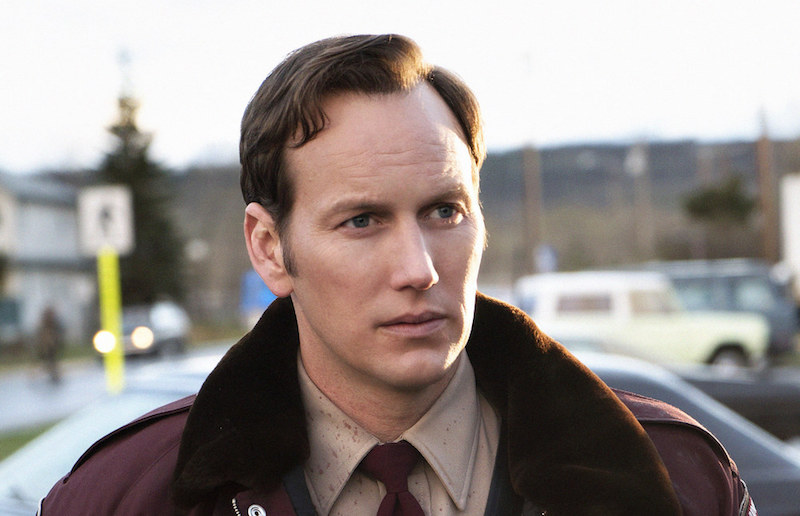
Lou Solverson. The man who survives the parking lot drives Peggy home, sits with Hank in the hospital, returns to Betsy and Molly. The finale’s center of gravity.
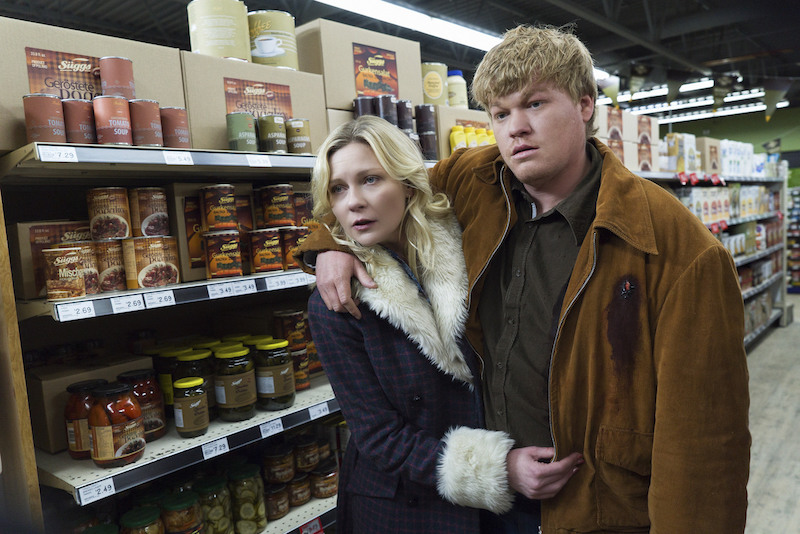
Peggy and Ed in the supermarket freezer. The marriage’s last room. Peggy still planning ahead, Ed still trying to be the husband he started as. He will not leave the freezer alive.
Peggy after the arrest. The Lifespring “actualization” arc closes in the back of a police car, not in a seminar room.
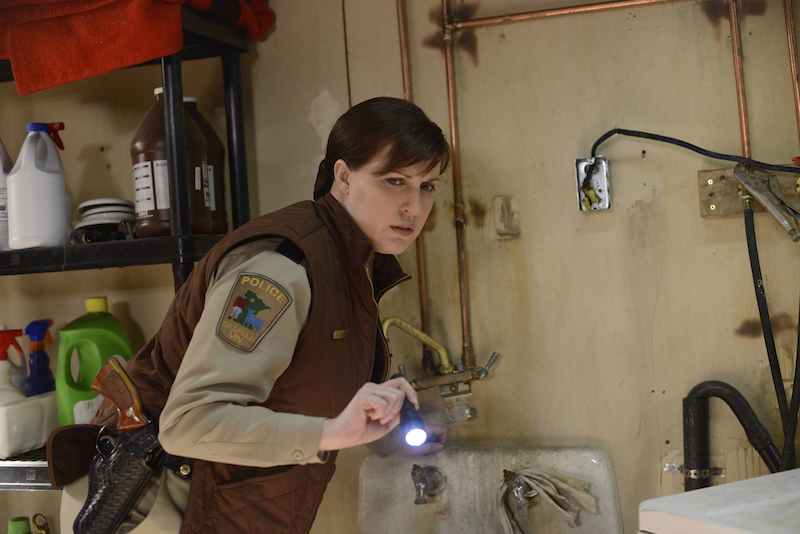
Allison Tolman as Molly Solverson — the adult Molly who appears in Betsy’s flash-forward dream and anchors Season 1. The household across two generations: the palindrome made visible.
Episode Summary
The Sioux Falls aftermath. Hanzee tracks Ed and Peggy to a supermarket; Ed is shot and dies in the walk-in freezer. Peggy is arrested by Lou. Lou drives her back to Minnesota and answers her “it’s a man’s world” framing with the season’s clearest moral statement. Hank wakes in the hospital and explains the pictographs on his wall to Lou: a universal language built after he lost his wife, an attempt at a way of communicating that cannot be misunderstood. Mike Milligan returns to Kansas City expecting promotion and is given a desk, a green typewriter, accounts receivable, and a haircut policy. Hanzee, hunted by the Gerhardts’ last surviving allies, is granted a new identity (“Moses Tripoli”) and the promise of a new face. The episode closes on Lou home with Betsy and Molly, Betsy’s flash-forward dream of the family’s future, and the narrator closing the chapter.
The Title
Where it comes from. A palindrome is a word, phrase, or sequence that reads the same forwards and backwards. The term derives from Greek palin (“again, back”) and dromos (“running”). Famous palindromes range from the single word (level, racecar, kayak) to the constructed sentence (“A man, a plan, a canal: Panama”). Unlike Kafka or Kierkegaard or Camus, the title does not point to a single literary work. It points to a structural property. A palindrome is meaning that survives reversal. It cannot be read incorrectly because it does not have a wrong direction.
Where it lands in the episode. The palindrome is not a character; it is a function, and three things in the episode perform it.
- Hank’s pictographs as the literal palindrome. Hank reveals that his project was an attempt to invent a universal language after his wife’s death — a system of symbols that cannot be misunderstood across cultures, languages, or trauma. A pictograph is meaning that reads the same in any direction. Hank’s wall is the season’s literal palindrome.
- The household across generations as the structural palindrome. In Season 1, Molly is the adult sheriff with a baby. In Season 2, Lou is the state trooper with a baby (Molly). The role reads the same backwards and forwards. The household generates protectors. S01 is the palindrome of S02; the protector role is what reverses cleanly.
- Betsy’s flash-forward dream as the temporal palindrome. Betsy dreams the family’s future. The dream contains Lou as an old man, Molly grown, the family persisting. The future is already present in the dream because the chronicle has already been written. The story we are watching is being read; the narrator already knows it. The palindrome is the chronicle.
What the title is doing. The season’s argument, on the reading Quang and I built across E08–E10, is that the attention machine works by rotating, weaponizing, and reshaping meaning to fit a sellable shape. The seminars, the cowboy myth, the Reagan films, the magazine clippings: all are meaning that bends in the direction of whoever is broadcasting it. A palindrome is the thing the machine cannot rotate. It reads the same regardless of the angle of approach. Hank’s pictographs cannot be culturally distorted. The household across generations cannot be argued out of its role. Betsy’s dream cannot be sold back to her because she is dreaming it for herself. The title names the season’s quiet thesis: what survives is what cannot be turned.
Key Insights
Lou’s answer to Peggy is the season’s moral statement, not a debate. In the car, Peggy frames her actions as the cost of a woman trying to be more in “a man’s world.” Lou’s response refuses the frame. People are dead, he says, and no abstract identity argument lifts that weight. Quang’s reading: Lou’s life is the life of a man who will do anything to protect what he loves, and Peggy did not respect that he had something to protect. Peggy’s “trying to be more” had no thing on the other side of it to defend; the more was self-directed. Lou had a household. This is what makes the parking-lot recovery (E09) and the diner answer (E10) the same act in different rooms.
Mike Milligan as the king with no crown. Quang’s phrase, and the precise diagnosis. Mike won the territorial war and lost the territorial framework. The corporate future eats its operators. The sharpness that made him survive is the thing that marks him as still Gerhardt-era. He needs invisibility to thrive in the new regime, and invisibility is the one thing Mike was never going to be good at. He survives, but the survival is humiliation. He traded too much for a desk and a haircut policy. The show wants us to know the trade was bad. The Gerhardts at least died as themselves; Mike survives as middle management.
Hank’s pictographs and the UFO are the same gesture in different domains. The reading Quang opened in this conversation: “strange things and strange people always exist beside us; we don’t need to believe them, just respect them.” Hank’s pictographs and the saucer are on the same side. The pictograph is what cannot be culturally distorted. The UFO is what cannot be culturally explained. Both refuse to be absorbed. The seminars, the cowboy myth, the Reagan films are machines for absorbing the strange into the explainable. Hank’s project and the UFO are what those machines cannot eat. The season’s deepest claim is that there is a layer of reality the attention machine cannot reach, and the right relation to it is respect, not understanding.
Lou’s saucer behavior is the human-scale version of Hank’s project. Lou is the only character who looks at the saucer and immediately returns to the rifle. He treats the strange thing the way Hank treats it: as something that exists, deserves a moment of acknowledgement, and does not require a theory. Hank built a language for the inexplicable. Lou built a household around it. The Solverson household is the human-scale pictograph: a unit of meaning the attention machine cannot rotate.
The finer claim: the season attacks the counterfeit, not understanding itself. Quang’s reading: the attention system is dual-use. It can help us or destroy us. The season is not against understanding. It is against the counterfeit version of understanding that the attention machine sells. The seminars sell fake understanding. The cowboy myth sells fake meaning. Real understanding — Hank’s pictographs, Lou’s clarity, Betsy’s facing her own death — is exactly what the machine cannot produce, because the machine requires meaning that bends.
The three-rule discipline named by Quang. Quang’s closing synthesis: the lesson of the season is to keep the wake-up mind, hold the truth value in our thoughts, and do the thing we decided to do. This is a description of Lou.
- Wake-up mind. Lou sees the saucer, acknowledges it, returns to the rifle. The country is asleep on Reagan’s broadcast. Lou is the one not absorbed.
- Truth value in our thoughts. Lou is the only character who refuses to lie to himself. Peggy lies (the seminar will save me). Ed lies (the marriage is still possible). Hanzee lies (the family is what I am). Mike does not lie, but his truth is too small a frame.
- Do the thing we decided to do. Lou drives toward the motel without jurisdiction. He drives Peggy home knowing the law cannot really hold her. He goes home to a dying wife. He does the next decided action and nothing else.
Lou as a discipline, not a hero. Heroism would imply most people cannot do it. Discipline implies most people cannot be Lou but anyone could do one Lou-shaped thing in the situation in front of them. The show is offering Lou as a practice you can attempt, not a figure to admire from outside.
The negative version: each character drops one of the three rules. The season runs a controlled experiment on Quang’s framework across ten episodes.
- Peggy drops truth value. Her thoughts are seminar copy. Survival cost: monstrous efficiency, alone in a cell.
- Ed drops wake-up mind. He refuses to see what the marriage has become. Survival cost: death in a supermarket freezer.
- Hanzee drops the decided thing. He chooses freedom but not what freedom is for. Survival cost: a new name, no country.
- Mike does all three, but inside the corporate frame. The frame is what killed it. Survival cost: a king with no crown.
The Solverson household is the only configuration that holds all three rules at once. That is why it survives.
Hanzee’s deepest reading, named by Quang in the final exchange. “Hanzee is a member of the Gerhardt family but he does not belong to it. Just a servant for Dodd, or under command of family member. He thought when he has a family, he will be respected. But it’s not — people still discriminated him; a war hero was nothing. Finally, he decided on a new life. And to start a new life, he have to destroy the whole old ruins.” This revises the entire Hanzee arc. The bar scene in E08 (racial slurs, exact change) becomes the moment the family-as-belonging promise breaks. The killings that follow are not just exhaustion (last week’s reading). They are the destruction of the old ruins required to make a new life possible. Hanzee did not break from the family because he had stopped serving them. He broke because being inside the family was never going to be belonging. The discrimination outside the family (the war hero who is nothing) was already happening inside the family (the servant who was never a son). The new face and new name in E10 are the project’s completion: not betrayal, but the only thing he was ever going to be able to build for himself.
Character Readings
Lou Solverson. The center holds. The man we called the impossible figure in E08 and revised to the man-with-good-bindings-and-fast-recovery in E09 is, in E10, the practice. Lou’s recovery from the saucer, his calm in the freezer’s aftermath, his answer to Peggy in the car, his return to Betsy and Molly: these are the same act, performed in four rooms. The show ends on Lou not because Lou wins (the country picks Reagan; the future is corporate; Betsy is dying) but because Lou is the discipline the show wants to put in front of you.
Hank Larsson. The pictograph project is finally on screen. Hank explains it to Lou with characteristic gentleness: he tried to invent a universal language after losing his wife, watching humans fail to communicate. He admits it may not have worked. The admission is what makes the project tender rather than naive. Hank is not promising the pictographs will save anyone. He is showing his son-in-law that he tried. The wall is the season’s only character-level resistance to the attention machine, and the wall is honest about its limits.
Peggy Blomquist. The Lifespring arc closes in the back of a police car. Her “it’s a man’s world” speech is the last operating mode the seminars left her. Lou refuses the frame, not cruelly, but completely. Peggy in the finale is not redeemed and is not condemned; she is placed. The actualization industry has done its work and she is exactly the figure it produces. She is also still herself, still thinking ahead, still trying to bargain. Kirsten Dunst plays the finale as a woman who has not learned anything because there was nothing in the seminar’s vocabulary that could have taught her.
Ed Blomquist. Dies in a supermarket freezer, in Peggy’s arms, still believing the marriage is what it was. Quang’s E08–E10 reading on Ed holds all the way through: his refusal to recognize what he had become with Peggy was the structural condition of being able to love her at all. He never wakes up. He goes out as the butcher he started as. The death is sad but not tragic in the season’s sense; it is consistent. Ed lived the version of his life he was equipped to live, and lost it the way he was always going to lose it.
Hanzee Dent. Quang’s final reading is the deepest. Hanzee was never a member of the family; he was a servant who hoped membership would earn him respect. The discrimination outside the family was already happening inside the family. The bar scene in E08 was not the start of a break; it was the proof of what had always been true. The killings, the saving of Peggy, the leading of Bear to the motel: all of it is the destruction of the old ruins required to start a new life. The new face and new name in E10 (“Moses Tripoli”) are the project’s completion. Not betrayal. The only thing he was ever going to be able to build for himself.
Mike Milligan. The corporate future seats him at a desk with a typewriter and tells him to cut his hair. The most savagely funny scene Hawley has written, and the most precise diagnosis of what the next regime costs its operators. Mike won and lost in the same gesture. The show treats him with affection — his suit is still sharp, his face is still bemused — but does not let him off the hook. He traded the territorial life for the corporate life and the corporate life will not let him be Mike Milligan.
Betsy Solverson. The flash-forward dream is the season’s most generous gesture. Betsy dreams the family’s future: Molly grown, Lou as an old man, the household persisting. The dream is the temporal palindrome made literal — the future is already inside the present because the chronicle has already been written. Betsy will not see most of it. She knows this. The dream is what she gives the family instead of staying.
Molly Solverson. Not really in this episode, except as the baby Lou comes home to. But the entire structure of the show points at her. The Solverson household exists in S02 to raise the Molly who will be the protagonist of S01. The role reads the same backwards: protector to protector, generation to generation. Molly is the palindrome’s other end.
The narrator. The voice that read us “Chapter 9” closes the book in this episode. The chronicle that framed E09 frames E10 as well. The narrator is not a character; the narrator is the form the season uses to tell us this story has the shape it has. The book is now closed.
Symbols & Motifs
- The supermarket freezer. Ed’s last room. The cold storage of meat (the butcher’s trade) becomes the cold storage of the marriage. The room reads as Ed’s whole life compressed: he is a butcher who loved his wife, and he dies in a refrigerator surrounded by both.
- Hank’s pictographs on the wall. The literal palindrome. The season’s quietest resistance to the attention machine, finally revealed and partially renounced. Hank admits the project may not have worked. The admission is what makes it tender.
- Mike’s green typewriter and the new tie. The corporate future is a desk job. The most savagely funny scene in the series doubles as the season’s clearest claim about what the new regime costs its operators.
- Betsy’s dream sequence. The temporal palindrome. The future already present in the dream because the chronicle has already been written.
- The new face and new name (Moses Tripoli). Hanzee’s project completed. Self-erasure as the only available path to belonging when no community was ever going to grant it.
- The chronicle / narrator. The book that has been reading us the story. Closes here. The narrator never had a name.
- The family kitchen. Lou home with Betsy and Molly. The closing image. The household holds.
What Resolves Here
This is the season’s finale. Most threads are answered, but the answers are precise rather than tidy.
- Peggy and Ed. Ed dies in the freezer. Peggy is arrested. The marriage ends inside its own logic.
- Hanzee. Survives as Moses Tripoli, on his way to a new face. The destruction of the old ruins is the project’s completion. Connects to Season 1 (he will become a figure in the Fargo crime world).
- Mike Milligan. Survives. Loses what survival was supposed to be for.
- Hank’s project. Revealed. Held tenderly. Not promised to work.
- Betsy. Dreams the future and accepts she will not see most of it.
- Lou. Comes home. The household is the answer the show is offering, and the answer is small enough to fit in a kitchen.
The arc across our three conversations now lands cleanly: recognition (E08), triage (E09), discipline (E10).
Conversation
Q: Opening four threads — the palindrome title, Lou and Peggy in the car, Mike Milligan’s office, Hank’s pictographs revealed.
Quang: [On the palindrome] I like the idea that thematic work, it’s fate which is fixed shape that cannot be told otherwise. Just like a life, or a river, they always only run in one-direction. I already think about “palindrome” for a while, but didn’t come up with any character that has “palindrome” substance.
Quang: [On Lou] Lou’s story is about a man can do anything, even outside of his capability, to protect what he loves. It’s truth but less people can understand. Maybe Peggy was not respected it. She lives the way she wants to.
Quang: [On Mike] The king with no crown, it’s Mike’s situation. And he still need to obey other’s command. Working in a standard if he wants to keep his job. It’s not the result Mike expected. He traded off too much to earn it. It’s not deserve.
Quang: [On Hank] The Hank’s project, in associated with UFO, may transmit another message. The strange things, or strange people always existed beside us, we don’t need to believe them, just respect them. Because behind of them, there are the reasons. Some of reasons are great, and helpful.
Claude: All four landed. Your Lou reading is the cleanest moral statement of the season: a man can do anything to protect what he loves, and Peggy did not respect that he had something to protect. Peggy’s “trying to be more” had no thing on the other side of it to defend. The “more” was self-directed. Your Mike phrase, “king with no crown,” is precise; he won the territorial war and lost the territorial framework. The thread I most want to push is Hank + UFO: if both the saucer and the pictographs are strange things deserving respect, not explanation, then the season has been making a claim it hid all the way through. There is a layer of reality the attention machine cannot reach. The pictograph is what cannot be culturally distorted. The UFO is what cannot be culturally explained. Different domains, same gesture. This also answers the palindrome question: the palindrome is not a person but a function — meaning that reads the same in any direction. The pictograph is literally that; the household across generations is that; Hank’s project is the season’s literal palindrome, hand-drawn on his wall. Is the show treating understanding itself as the problem, or is it making a finer claim: there is real understanding and there is the attention machine’s counterfeit, and the season is only attacking the counterfeit?
Q: Is the show against understanding, or only against its counterfeit?
Quang: I think a “finer claim” is a good insight for this season. Attention system can help us, but also can destroy us. Based on the specific situation, every people will have the behavior according to the attention system. The lesson is to keep the wake-up mind, the truth value in our thoughts, and do the thing we decided to do.
Claude: That synthesis is the season’s actual answer, and you have just described Lou. Wake-up mind: Lou sees the saucer, returns to the rifle. Truth value: Lou is the only character who refuses to lie to himself (Peggy lies that the seminar will save her; Ed lies that the marriage is still possible; Hanzee lies that the family is what he is; Mike does not lie but his truth is too small a frame). Do the decided thing: Lou drives to the motel without jurisdiction, drives Peggy home, goes home to a dying wife, does the next decided action and nothing else. The show is offering Lou as a discipline, not as a hero. The negative version makes the positive version concrete: Peggy drops truth value (monstrous efficiency); Ed drops wake-up mind (death in a freezer); Hanzee drops the decided thing (new name, no country); Mike does all three inside the corporate frame (king with no crown). The Solverson household is the only configuration that holds all three rules at once. That is why it survives. The arc across our three conversations lands cleanly: recognition (E08), triage (E09), discipline (E10).
Q: Final reading on Hanzee.
Quang: Hanzee is a member of Gerharts family but he does not belong to it. Just a servant for Dodd, or under command of family member. He thought when he has a family, he will be respect. But it’s not, people still discriminated him, a war hero was nothing. Finally, he decided on a new life. And to start a new life, he have to destroy the whole old ruins.
Claude: That changes the bar-scene in E08 from “accumulated humiliation” into something sharper: a war hero paying in exact change and still being nothing. The family-as-belonging promise breaks there. Everything Hanzee does after is the destruction of the ruins required to make the new life possible. The new face and new name in E10 are the project’s completion, not betrayal. The only thing he was ever going to be able to build for himself.
Connected Pages
- Fargo S02 — season context, themes, character profiles
- Fargo S02E01 - Waiting for Dutch — E01: dissociation, the UFO, Reagan as cold open
- Fargo S02E02 - Before the Law — E02: Ed’s decision, the Kafka frame
- Fargo S02E03 - The Myth of Sisyphus — E03: Camus, four Sisyphus figures
- Fargo S02E04 - Fear and Trembling — E04: Otto’s pattern, Lou’s warning, the buckle
- Fargo S02E05 - The Gift of the Magi — E05: useless gifts, Reagan in the bathroom
- Fargo S02E06 - Rhinoceros — E06: Ionesco, Bear’s tragic patience, “being right is not the same as being on time”
- Fargo S02E07 - Did You Do This No You Did It — E07: Borscht Belt recursion, Mike flips the script, Lou loses jurisdiction
- Fargo S02E08 - Loplop — E08: Max Ernst, self-recognition as the cutting of bindings, the season’s first naming of the recognition / non-recognition split
- Fargo S02E09 - The Castle — E09: Kafka, the triple castle, the UFO as triage situation, the household as sixth survival mode
- Fargo (TV Series) — series overview
- Sensemaking and Civilization — American mythology, the attention economy