Key Stills
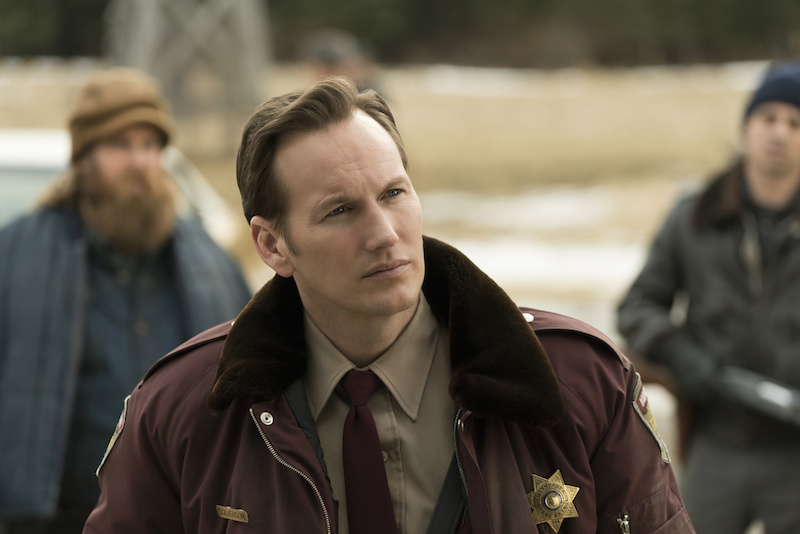
Lou Solverson — confronting forces much bigger than him.
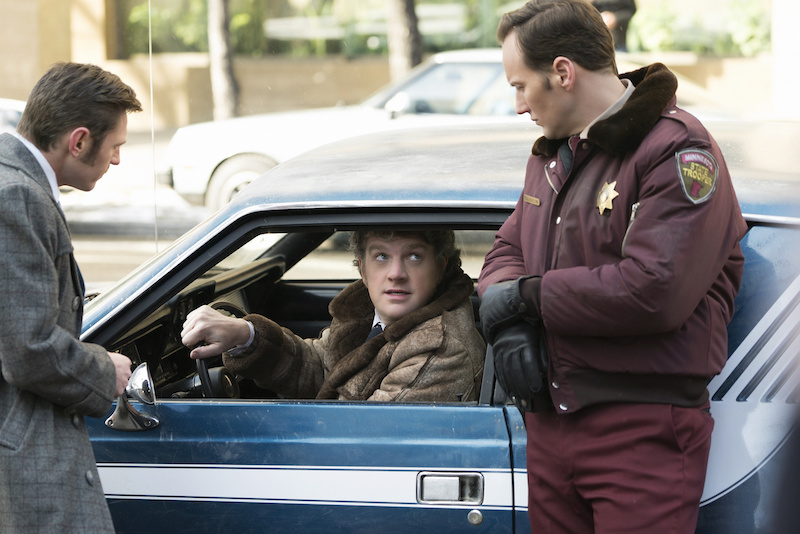
Lou with the state troopers — the law mobilizing.
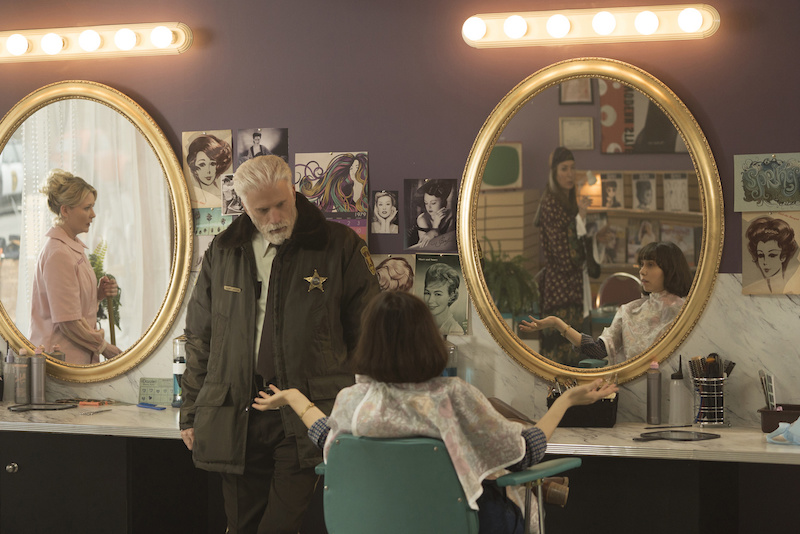
Peggy at the kitchen table — overhearing a theory she did not expect.
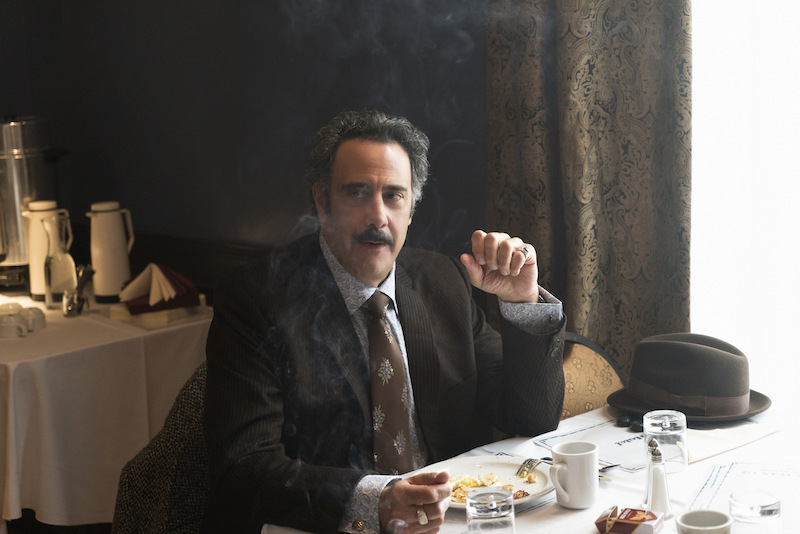
Joe Bulo — Kansas City management arrives in person.
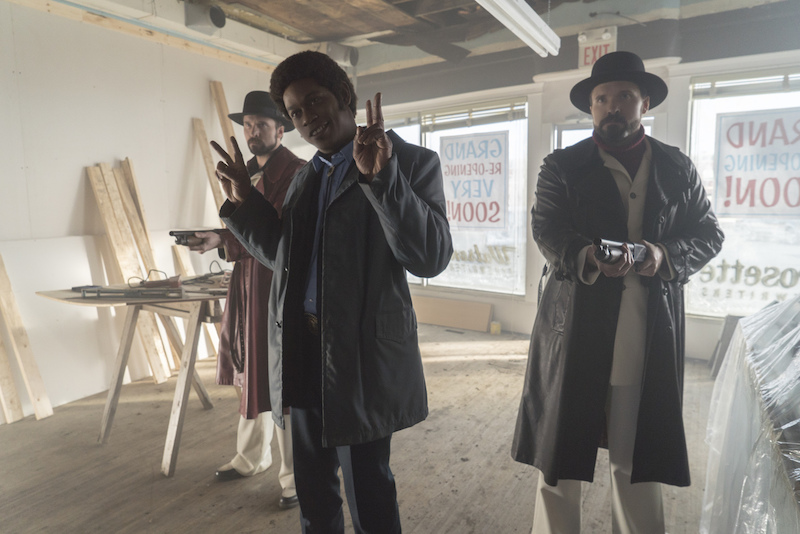
Mike Milligan and the Kitchen brothers — the corporate enforcers in motion.
Episode Summary
The Gerhardts intensify the search for Rye. Hanzee tracks his trail through the snow with frightening competence, recovering the gun and the location of the accident. Lou drives to Fargo, walks into Gerhardt territory, and tells Floyd he believes her son was at the Waffle Hut. He then confronts Mike Milligan and the Kitchen brothers in a parking lot. Peggy and Ed try to get the dented car repaired and out of sight. Charlie Gerhardt asks his father Bear to stay home and help with family business; Bear refuses and tells him to go back to college. Simone Gerhardt rebels against her father Dodd’s brutal treatment. Threads tighten. No one yet has Rye.
The Title
Where it comes from. “The Myth of Sisyphus” is Albert Camus’s 1942 philosophical essay. In Greek myth, Sisyphus is condemned by the gods to push a boulder up a hill forever — each time he reaches the top, the boulder rolls back down, and he must begin again. Camus uses Sisyphus as the central figure of his philosophy of the absurd. The essay’s argument is that life is meaningless in any cosmic sense, but the person who recognizes that meaninglessness and persists anyway — without appeal to gods, future rewards, or transcendence — is the only authentic figure in modern existence. The famous closing line: “One must imagine Sisyphus happy.” Meaning is not in the outcome. Meaning is in the act of pushing.
Where it lands in the episode. There is no single Sisyphus scene. The episode is constructed by lining up four different characters as Sisyphus figures and inviting the viewer to read each push differently:
- Lou pushes against forces that vastly outmatch him (Floyd in her own kitchen, Mike Milligan in a parking lot) and finds dignity in confrontation. Camusian Sisyphus — the authentic absurd hero.
- Hanzee tracks the trail of a man who has been ground into hamburger by a butcher. Absurdism stripped of dignity — the search itself made meaningless by the dramatic irony the audience holds.
- Peggy and Ed push a damaged car around hoping the universe will let them keep their lives. Sisyphus as self-deception — the boulder is the past they are trying to roll back uphill.
- Simone pushes against her father’s worldview. Sisyphus as revolt — pushing not for survival but for refusal.
What the title is doing. Camus’s essay endorses the pushing. The episode is doing something subtler — it asks which kinds of pushing count as meaningful, and refuses to give a clean answer. Lou’s stake is moral, so his confrontation has dignity. Hanzee’s stake is operational, but the audience knows his target does not exist, so his competence becomes its own kind of horror. Peggy and Ed’s stake is fantasy, so their pushing is self-deception. Simone’s stake is identity, but the family she is rebelling against will not survive long enough for her revolt to land. The title is the question, not the answer. Camus says imagine Sisyphus happy. The episode says: which Sisyphus, and happy in what way?
Key Insights
Lou as the moral spine. This is Patrick Wilson’s most commanding episode so far. Lou drives unannounced into Gerhardt territory and tells Floyd, in her own kitchen, that her missing son is connected to a triple homicide. He then steps in front of three armed Kansas City men in a parking lot and refuses to flinch. The show is establishing him as the only character whose pushing is not absurd — because his stake is moral, not transactional. He is not trying to win territory or restore family or escape consequence. He is trying to do his job. That clarity is what makes everyone else’s incoherence visible.
Peggy as proactive, not passive. Building on E02’s read of Peggy’s calm, this episode shows her more clearly steering. Ed is the one panicking about the car and the future; Peggy keeps redirecting, keeps managing. Her self-help magazines and Lifespring talk read here less as detached daydream and more as a worldview she is actively imposing on her marriage. She is not just letting Ed protect her. She is shaping the story he tells himself about why protecting her is the right thing to do.
Charlie and the choice the Gerhardts cannot offer. Bear’s son Charlie wants to stay and help during the crisis. Bear refuses and pushes him back toward college. This is the only Gerhardt scene in the series so far where someone older tries to hold a younger member out of the family business. It plants the seed of a kid who could exit — and the tragic question of whether the family will let him.
Simone’s revolt as inverted gender. You noticed that Simone’s struggle with Dodd has a gender-coded edge — Dodd treats her as the wrong kind of child, and her revolt has the quality of someone refusing to be defined by what she was supposed to be. The Gerhardt patriarchy assigns roles by sex; Simone is rebelling against the role itself. This will matter later — her betrayal, when it comes, will not feel like betrayal to her, because she was never given a real seat at the table to leave.
Character Readings
Lou Solverson — The episode treats him as the show’s still point. He confronts Floyd at her own table and Mike Milligan in a parking lot in the same hour. Both confrontations are won by tone, not force. Lou speaks plainly, names what he sees, and refuses to perform either deference or aggression. He is the only character this season whose actions are fully aligned with his stated values, which makes him slightly mythic — and dangerous to the people around him, because his clarity exposes their compromises.
Hanzee Dent — Introduced more fully here as the season’s most competent investigator. He moves silently, reads ground that other characters cannot read, and finds Rye’s trail with terrifying precision. The dramatic irony is total: he is the best tracker in the show, working harder than anyone, hunting a corpse that no longer exists in any reconstructable form. The show is asking us to feel the cost of competence pointed at nothing.
Peggy Blomquist — More clearly steering Ed than dissociating from him. The shift from E02 to E03 is subtle but important: the magazines, the seminar, the calm — these are no longer just symptoms of a fractured self. They are tools she uses to keep the marriage on a track she has chosen. Whether she is fully conscious of this is still ambiguous, but the asymmetry of agency between her and Ed is now visible.
Ed Blomquist — The man who acted decisively in the garage is, in this episode, anxious and out of his depth. The car is the visible problem, but the deeper problem is that Ed cannot read the world Peggy is steering them into. His competence is local — butcher shop, garage, immediate task. Peggy’s is total — a story about who they are. He is following her, even as he believes he is leading.
Simone Gerhardt — Her conflict with Dodd this episode is foundational for her arc. She is a Gerhardt by blood but disposable by sex in her father’s worldview. The revolt that follows in later episodes begins here, in the small humiliations she refuses to accept any longer.
Charlie Gerhardt — A new kind of Gerhardt: bookish, willing, asking to be useful in a way none of his uncles ever asked. Bear’s refusal is parental love trying to draw a line that the family’s logic will not actually allow. The line will not hold.
Floyd Gerhardt — Confronted at home by a state trooper she did not invite, she neither flinches nor lies. Her composure is a tell: she already knows Rye is dead, even if she does not yet have proof. The most strategically intelligent character in any room continues to be her.
Mike Milligan and the Kitchen brothers — Their parking-lot exchange with Lou is the season’s first hint that Mike’s verbal artillery has limits. He talks; Lou stays quiet; Mike blinks first. Mike is dangerous in rooms full of people who play his game. Lou refuses the game.
Symbols & Motifs
- The boulder and the hill — every protagonist this episode is pushing something that will not stay where they leave it: a search, a story, a car, a family
- The trail in the snow — Hanzee’s tracking renders dramatic irony as physical landscape; the audience knows what lies at the end of the trail and the show makes us watch him follow it anyway
- The kitchen table (Floyd) and the parking lot (Mike Milligan) — Lou’s two confrontations are staged in places defined by their use: home and transaction; he refuses to be moved by either
- The damaged car — Peggy and Ed’s repair effort as the comic-tragic visual of trying to undo what cannot be undone; the dent in the metal is the visible piece of a story that has many invisible dents
Open Questions
- Does Lou’s directness in Fargo cost him something later — does walking into Floyd’s house mark him in the Gerhardts’ eyes in a way he will pay for?
- Hanzee’s tracking is uncanny — what is the show telling us about him by making him this competent? Is he loyal to the Gerhardts, or to the act of tracking itself?
- Charlie wants in. Bear says no. Where does the show place him by season’s end?
- Is Peggy’s steering of Ed conscious manipulation or unconscious worldview? Does the distinction matter to the outcome?
- Simone’s revolt is small here. What is its trajectory?
Conversation
Q: The Sisyphus title — who is the Sisyphus of this episode?
Quang: The title reminds me of an essay by Albert Camus — “one must imagine Sisyphus happy, because he finds meaning in struggle itself.” Lou faced two big forces: the Gerhardt family and Kansas City. He’s brave and dares to confront them. Hanzee struggles with finding Rye. The oldest brother’s daughter struggles with her dad — and in the opposite direction, she wants to have a boy, not a girl. Peggy and her husband deal with Rye’s car. There are many struggle situations in this episode. Fascinating!
Claude: Camus’s frame might be ironic here. Lou’s pushing has dignity — meaning lives in the act of confrontation. Hanzee’s pushing is absurd in the bleak sense — he is the most competent searcher in the show, hunting a corpse that no longer exists. Peggy and Ed’s pushing is delusional — they are trying to undo what cannot be undone. Simone’s pushing is revolt — she is refusing the role her father assigned her at birth. Same rock, different mountains, very different meanings.
Q: Peggy after the accident — passive or proactive?
Quang: She is manipulating her husband proactively. To protect herself.
Claude: The shift from E02 to E03 makes that clearer. The magazines and the seminar are not just symptoms of a fractured self anymore — they are tools she uses to keep the marriage on a track she has chosen. Ed believes he is protecting her. He is also being steered.
Q: Charlie Gerhardt — why introduce him here?
Quang: The only scene related to Charlie is when his dad asks him to go back to college, to stay away from the current family event. But Charlie wants to stay and help.
Claude: It is the first scene in the series where an older Gerhardt tries to keep a younger one out of the family. Bear is drawing a line the family’s logic will not actually allow him to hold. Charlie is the seed of a Gerhardt who could have exited — and the question becomes whether the world will let him.
Connected Pages
- Fargo S02 — season context, character profiles, themes
- Fargo S02E01 - Waiting for Dutch — E01 analysis: dissociation, UFO, the Reagan cold open
- Fargo S02E02 - Before the Law — E02 analysis: Ed’s decision, the Kafka frame, the search for a man who no longer exists
- Fargo (TV Series) — series overview