Key Stills
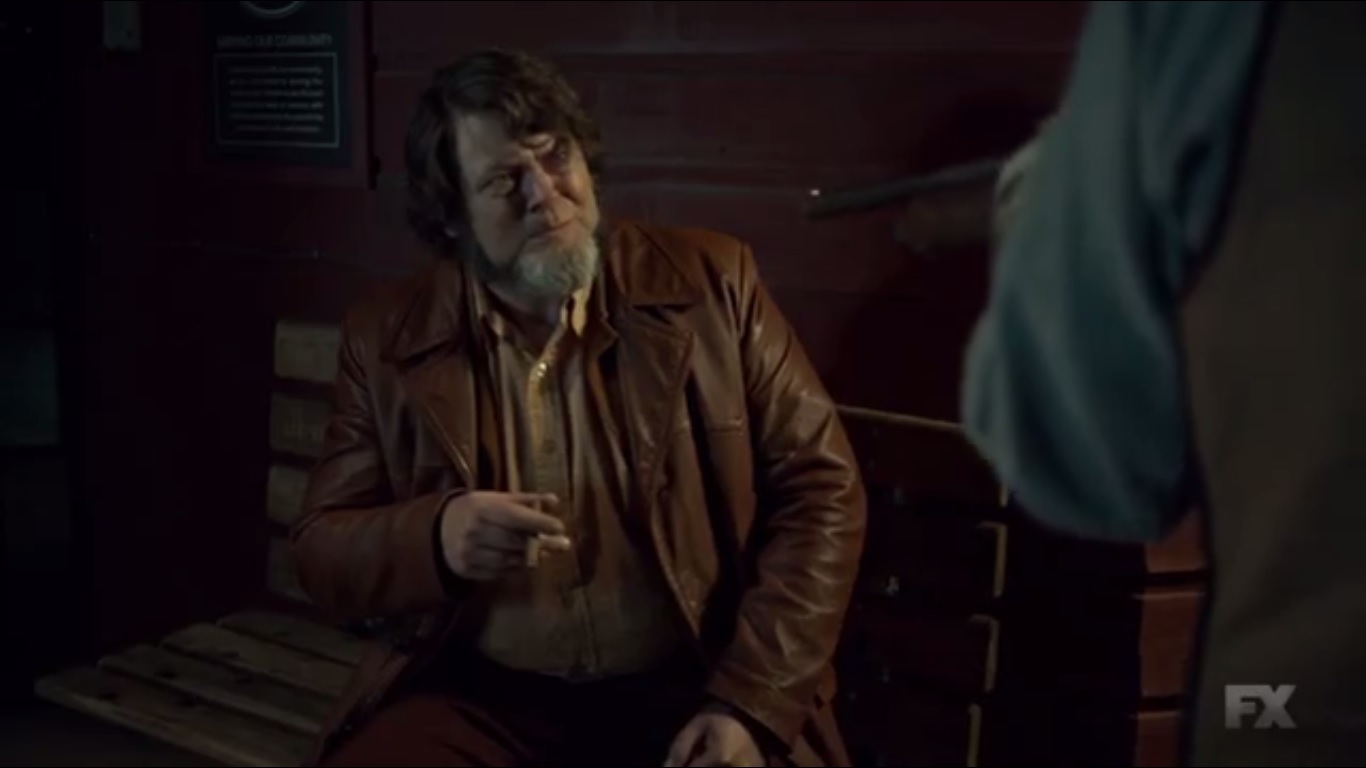
Karl Weathers and Bear Gerhardt at the door of the police station — the season’s clearest image of civilization held together by a drunk lawyer and a phrase about warrants.
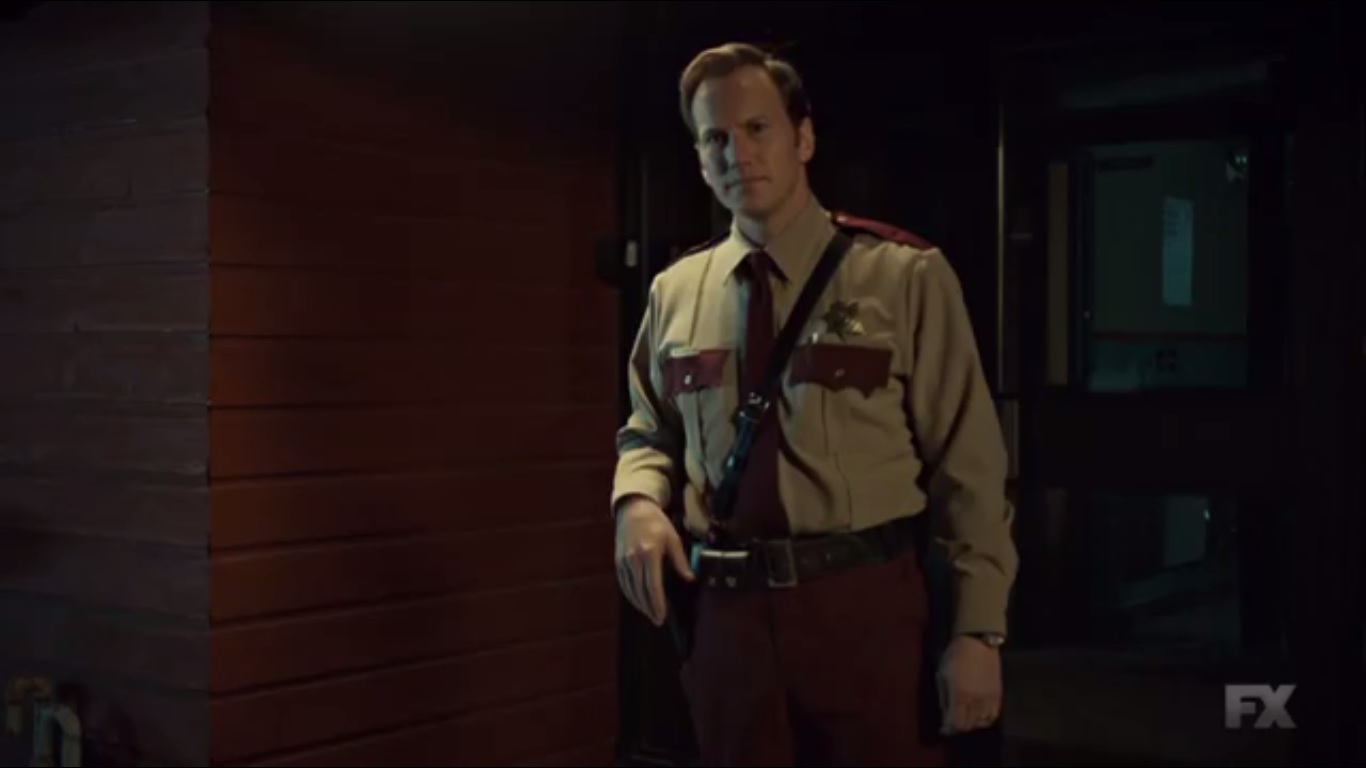
Lou Solverson stands between Bear and the cell. Calm in the face of an army that outnumbers him.
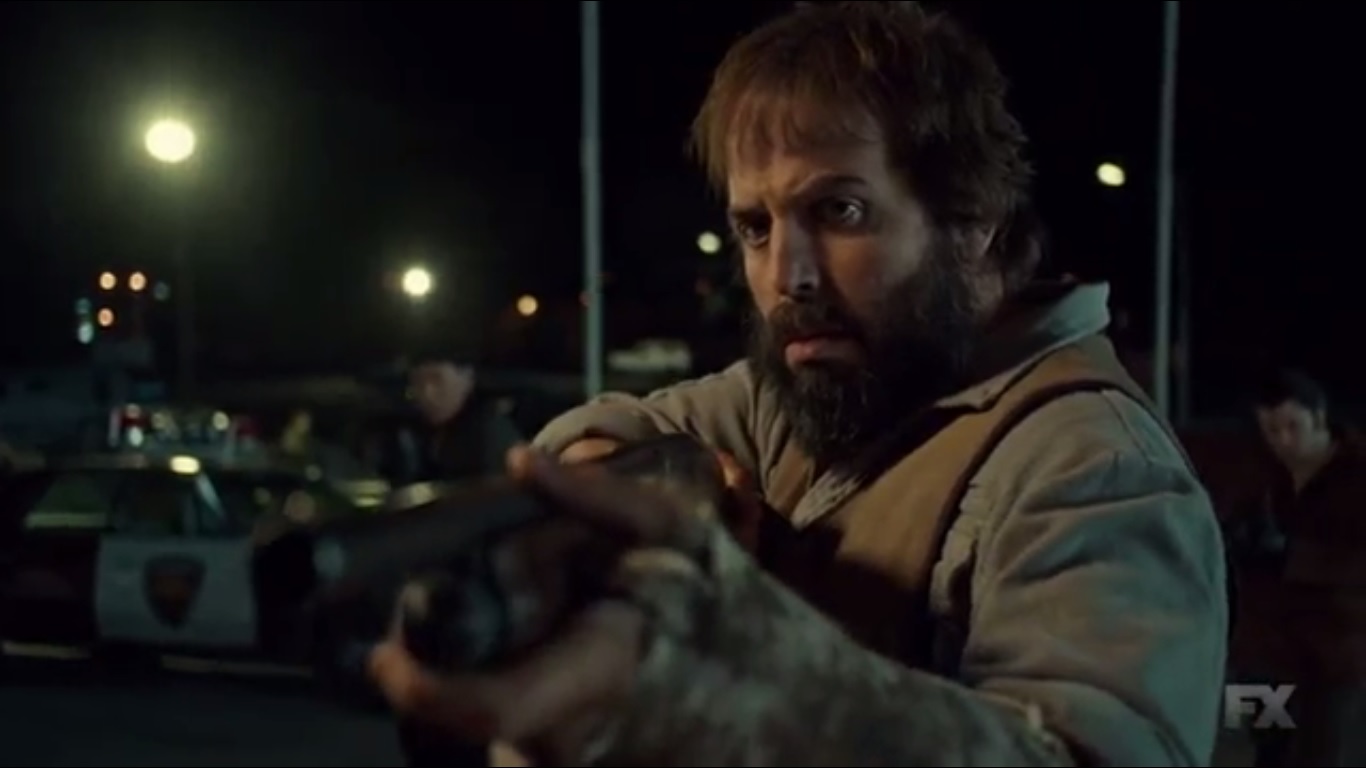
Bear Gerhardt considers his options for Charlie’s sake — the Gerhardt who can think before he shoots, and whose moment is not now.
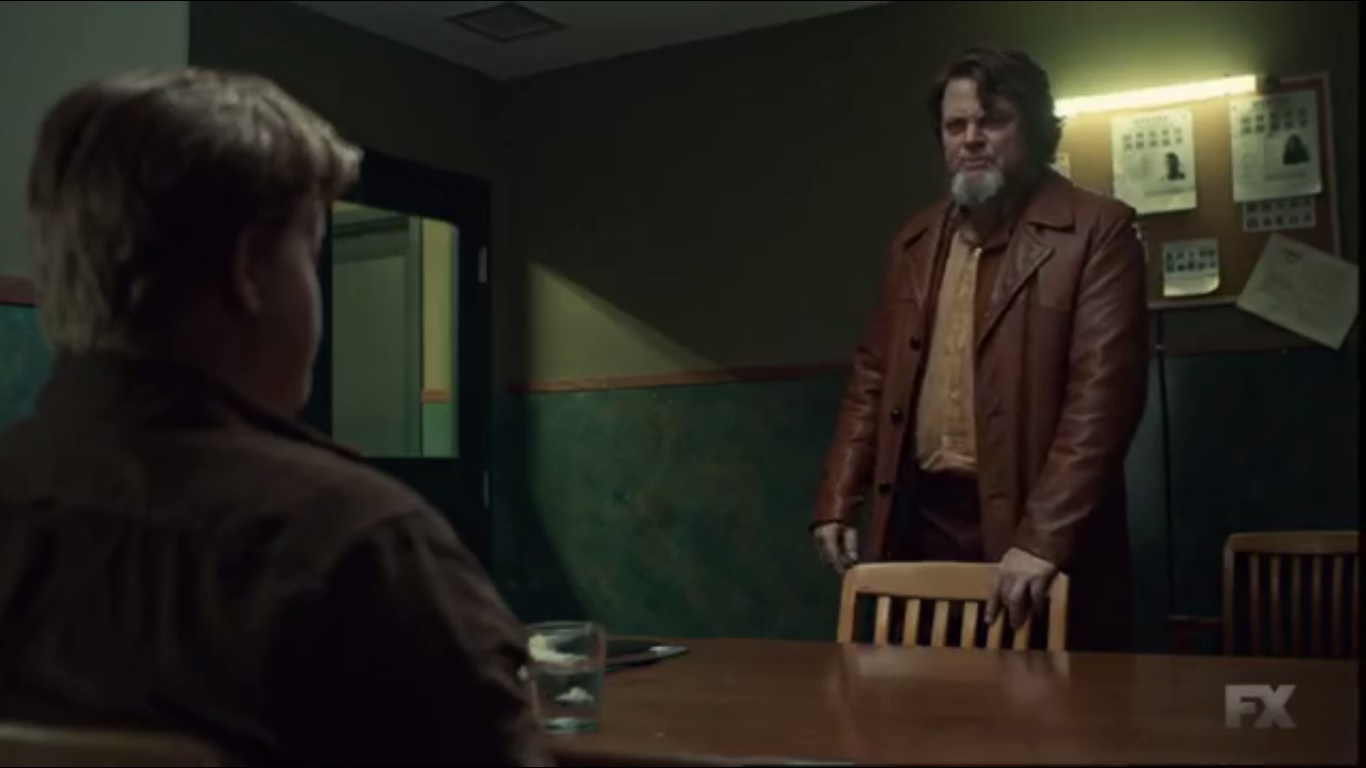
Karl gives Ed his legal counsel — the small-town lawyer who keeps stepping into roles his town has already decided he is not serious enough to play.
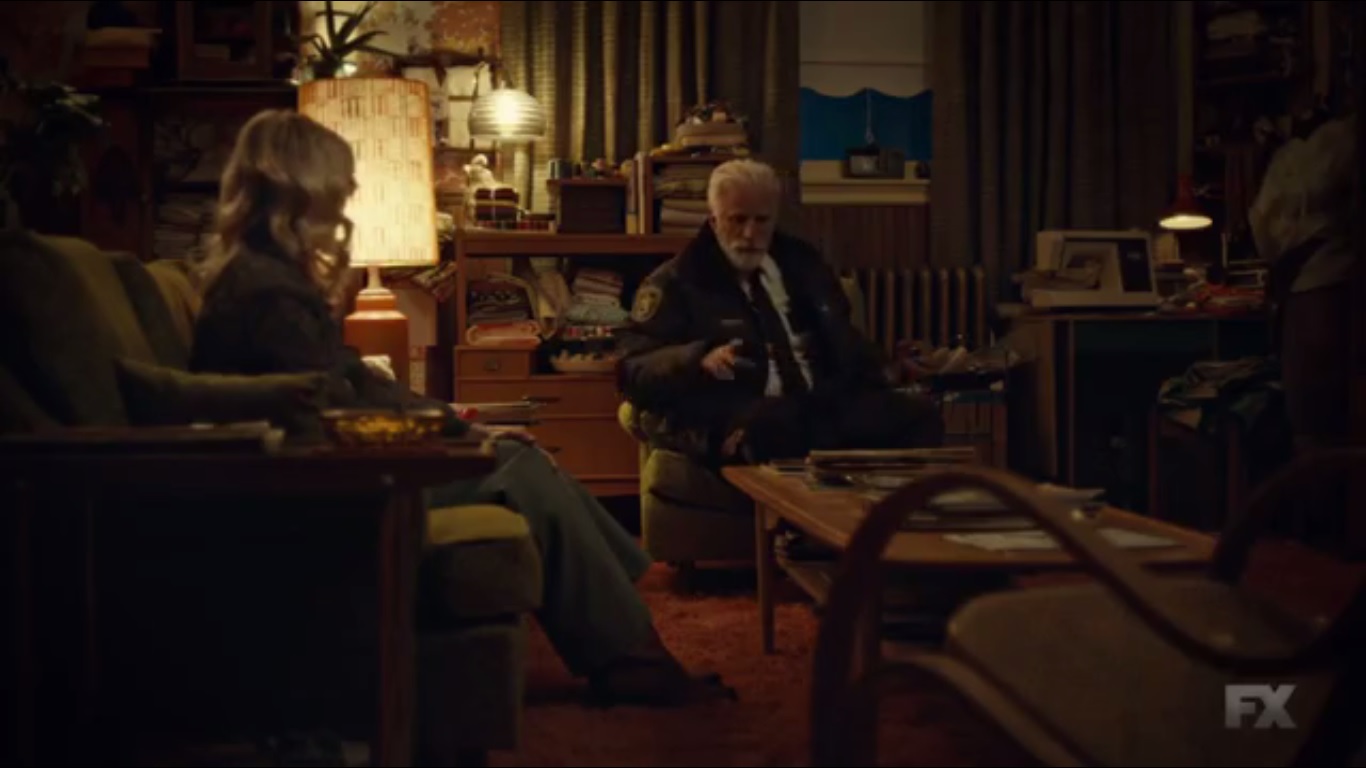
Hank asks Peggy why she didn’t get help after hitting Rye — the older lawman doing in a kitchen what Lou will do at gunpoint across town.
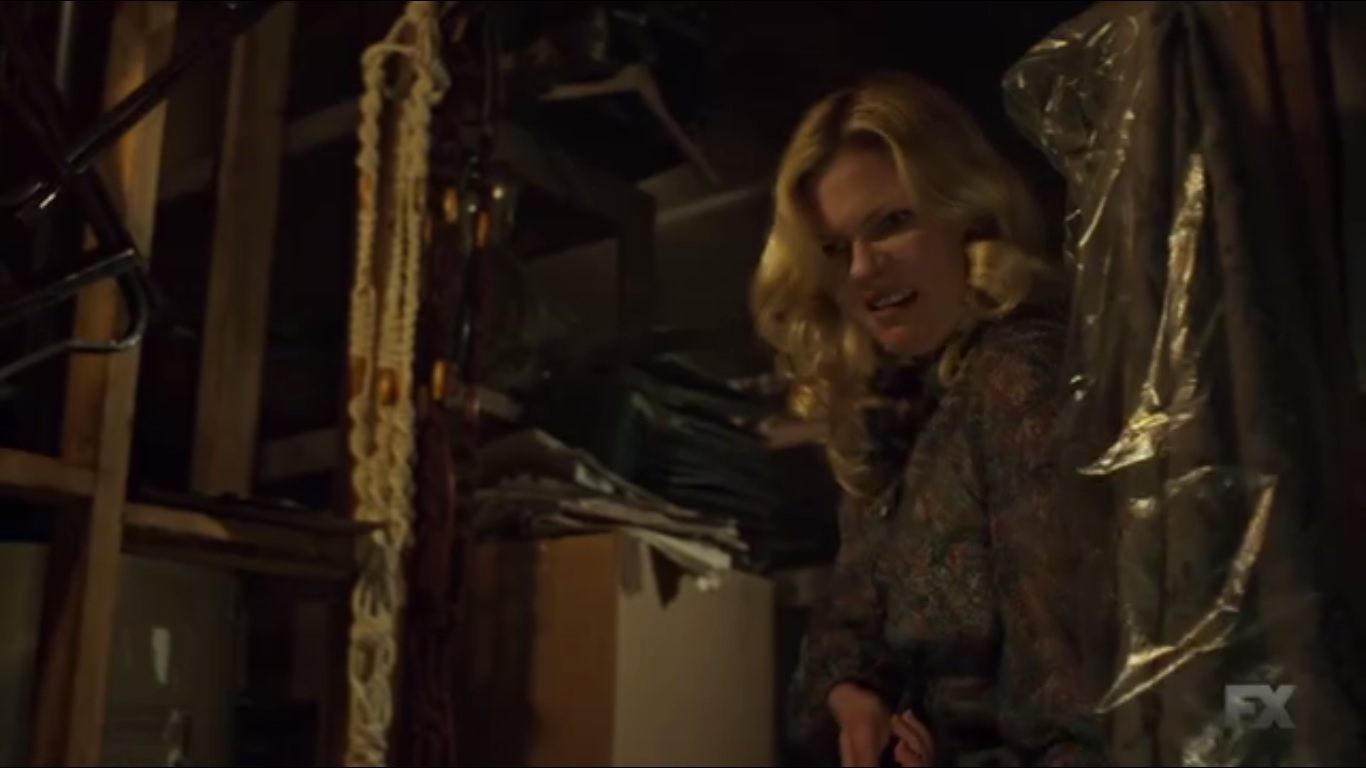
Peggy turns the cattle prod on Dodd — the woman whose actualization seminars promised her a self, becoming one in the worst possible room.
Episode Summary
Ed and Charlie are in custody in Luverne; Bear arrives at the station with armed Gerhardt men to take Charlie back; Dodd peels off to find Peggy at the Blomquist house. Hank stalls Bear at the door of the station while Lou guards the cell from inside. Karl Weathers, dragged sober from the veterans’ hall, walks out the front door and faces Bear with a constitutional argument. Across town, Dodd corners Peggy in the kitchen and Peggy, terrified and improvising, attacks him with a cattle prod and a cooking pot. Hanzee arrives at the Blomquist house separately and tracks Ed’s escape into the woods. The Kansas City Syndicate, meanwhile, hits the Gerhardt farmhouse in retaliation, and the season’s two halves of the war finally bleed into one another. The episode unfolds in something close to real time, taut as a chamber piece.
The Title
Where it comes from. Rhinoceros is Eugène Ionesco’s 1959 absurdist play, written in the wake of his own experience watching fascism take hold in his native Romania during the 1930s and ’40s. The play is set in a small French town. One by one, the inhabitants transform into rhinoceroses. They are not coerced. They simply accept the new normal — first one neighbor, then a friend, then a colleague at the office. Each transformation looks, from inside the community, like that person changing their mind. The disease of conformity to brute force spreads house by house. Only Berenger, an unimpressive, slightly drunk, ordinary man, refuses to transform — and does so without grand speeches, without certainty, without any conviction more durable than stubbornness. The play is one of the great parables about how moral collapse actually happens: not through coercion, but through neighbors quietly accepting each other’s transformations until the entire town has changed shape and the one human left is the embarrassment, not the hero.
Where it lands in the episode. Two characters carry the frame:
- Ed Blomquist is the rhinoceros. By E06 he has killed Virgil, burned the shop, fled into the woods with a butcher’s knife. The Ed of E01 could not have done any of these things; the Ed of E06 has done them all in a single hour. He is, scene by scene, taking the form of the violence around him. Lou’s appeal at the cabin door — give yourself up, I will protect you — is precisely the appeal made to the rhinoceros in Ionesco’s play. The rhinoceros cannot accept it. Ed runs.
- Karl Weathers is the Berenger. The unimpressive small-town lawyer, drunk in the veterans’ hall, dragged out to face an army with a sentence about warrants. He holds the line by refusing to transform — articulating, on the porch in E05 and the station door in E06, that the rule of law still applies. The fact that Karl is ridiculous, theatrical, and slightly hammered is the point. Ionesco’s Berenger is unimpressive too. Civilization is held by people who do not look like they are holding it.
What the title is doing. Ionesco’s question is: how does moral collapse spread? His answer: through ordinary people accepting each other’s transformations until there is no one left who hasn’t transformed. Fargo S02E06 maps that question onto Luverne. The cost of being Berenger in Ionesco is loneliness — the play ends with Berenger alone, surrounded by a city of rhinoceroses, refusing to transform without any guarantee that his refusal matters. The cost of being Karl in Fargo is that his nerve buys hours, not safety. The cost of becoming a rhinoceros in Ionesco is that you are no longer a person. The cost of becoming Ed is the same.
Key Insights
Karl, twice in two episodes, doing the same impossible thing. In E05 Karl held the Blomquist porch with a constitutional argument. In E06 he holds the police station door with an only slightly different one. The show is making a deliberate point by repeating him. Karl is not having a single heroic moment; Karl is the season’s ongoing argument that civilization is a particular kind of performance — articulated by people the town has decided are not serious, repeated until it holds. Nick Offerman plays Karl as both ridiculous and grand, and the ridiculousness is the load-bearing part. If Karl were a heroic lawyer in a clean suit, the argument would be triumphalist. Karl drunk in the veterans’ hall, dragged out to face an army with a sentence about warrants, is the show’s actual claim: civilization is held together by people who do not look like they are holding it together. The fact that Karl works twice is the point. Civilization is repetition.
Bear’s tragedy — virtues timed wrong for the situation. Bear is, by every measure available in this episode, the Gerhardt most capable of leading. He listens. He weighs. He calls his men back. He chooses Charlie over the throne. These are Floyd’s qualities in a son. They are also exactly the qualities Otto’s pattern (the 1951 cold open of E04: a gun, a man, a son to make into a killer) was designed to not produce. Otto’s pattern produces cold blood. It produced Dodd. It rejected Bear. Bear’s deference to Floyd in this episode is not a failure of nerve; it is a man who knows that the family structure has no place for him yet. He is waiting for his moment. The season’s deepest cruelty is that his moment is not coming. The Gerhardts will be destroyed before Bear ever leads. The capability is in the room. The structure cannot use it.
The pattern across the episode: virtues timed wrong. Once you see Bear’s arc clearly, the same shape becomes visible across the episode. Peggy is becoming a self for a future she will never reach — her actualization arrives at a moment where it cannot save her marriage, her safety, or her life. Karl’s nerve and law buy hours, not safety. Lou arrives at the Blomquist house too late; right answer, wrong moment. Only Hanzee moves at the exact tempo the violence requires. He is the only character whose virtues (such as they are) are in phase with the world he is in. Everyone else is out of phase. The season’s quiet thesis: in this America, being right is not the same as being on time.
Lou’s softness as the cost of his virtue. Lou had Ed three episodes ago. He doubted him. He warned him in E04. He let him run in E05. In E06 he stands at the cabin and pleads instead of cuffing. A harder cop would have prevented body counts. The show is honest about this — Lou’s virtue is not effective, and effectiveness is not virtue. They cannot be the same thing in this world. Hanzee is the man fully in phase with the situation precisely because he has none of the things Lou is trying to protect. The price of Lou’s virtues is that people die. The price of giving up Lou’s virtues is that nothing of America is worth saving. This is why Reagan was in E05 and Lou was in the bathroom across from him: Reagan is the performance of Lou’s virtues without their cost; Lou is the practice; the country chose the performance.
Two parallel succession stories, one working, one breaking. Hank → Lou inherits something. Otto → Dodd → Charlie cannot inherit. The lawmen split this episode in two — Hank takes the kitchen with Peggy, Lou takes the station with Bear — and the episode works because each man does, alone, what the other could not do alone. Hank’s mode is gentleness across a kitchen table; Lou’s mode is firmness across a corridor. The Gerhardt line cannot pass anything down: Otto gave Dodd a gun in 1951 and produced a killer; Dodd gave Charlie a gun in 1979 and produced a cripple in a cell. The pattern that made Dodd cannot be applied a third time. The lawmen’s inheritance is moral seriousness across two generations. The Gerhardt inheritance is the failure to recognize that Bear is the only son who could lead, because Bear does not match the cold-blooded pattern the family is structured to elevate.
Real-time as form mirroring content. The episode plays out in something close to actual time. This is not a stylistic flourish; it is a thematic move. When the show slows to real time, it forces the viewer to feel each character’s bad timing in their own body. We watch Hank stall. We watch Karl assemble himself. We watch Lou choose a posture. We watch Peggy improvise with a cattle prod. The real-time form makes “virtues timed wrong” not just an idea but an experience — every scene happens too slowly for the situation it is in, until Hanzee arrives and time accelerates around him.
Character Readings
Ed Blomquist — The rhinoceros has fully formed. The man of E01 could not have killed Virgil, burned a shop, or run into the woods with a butcher’s knife. The Ed of E06 has already become the kind of figure his life was supposed to protect Peggy from. He is no longer covering up a single accident; he is the accident. The Ionesco frame is exact: he is not a bad man becoming worse, he is an ordinary man transforming into the violence he saw and accepted. Lou’s appeal at the cabin — give yourself up, I will protect you — is precisely the appeal made to the rhinoceros. The rhinoceros cannot accept it. Ed runs.
Peggy Blomquist — The cattle-prod sequence is the season’s most physical statement of her arc. Peggy has, for five episodes, been steering: Lifespring, Sioux Falls, the self she has not yet become. In E06 she is steering with a cooking pot and a cattle prod against a man twice her size in her own kitchen, and she wins. The show is honest about what this victory is: not actualization, just survival. Her virtues — adaptability, refusal to freeze, capacity to improvise — are arriving in a kitchen at gunpoint, not in a seminar in Sioux Falls. Her actualization is timed wrong. It is also the only thing keeping her alive.
Lou Solverson — Holds the cell. Refuses to hand Charlie over. Drives to the cabin. Pleads with Ed. Calm in the face of an army he cannot defeat. Lou’s whole posture in this episode is the posture of a man who knows he cannot save the situation but will not accept the version of himself that gives up trying. The “softness” Quang named — the doubt of Ed, the warnings instead of arrests, the plea instead of the cuff — is a deliberate moral choice. Lou is protecting the country whose institutions he embodies, even when those institutions cannot protect the people in them. The show neither rewards him for it nor mocks him. It simply lets the cost stand.
Hank Larsson — Takes the kitchen with Peggy. The older lawman uses gentleness as a tool: a story about his son-in-law, a question about why she didn’t call. Hank does the work that requires patience and Lou does the work that requires firmness, and the episode argues, by structure, that the moral world of the season needs both at once — neither generation can hold the line alone. Hank is also the season’s proof that wisdom can be passed down: Lou has clearly learned posture from him without becoming him.
Karl Weathers — Twice now in two episodes the small-town lawyer has stood between an armed crime family and the people he is meant to defend, holding nothing but law. The repetition is the show’s argument. Karl is not a one-time hero; he is the recurring proof that civilization works because unimpressive people keep showing up to do unglamorous things until the room changes shape. The fact that he is drunk, theatrical, ridiculous — these are not flaws the show is forgiving. They are the show’s actual claim about who holds civilization up.
Bear Gerhardt — Listens. Weighs. Calls his men back. Refuses to fire when firing would lose him Charlie. The Gerhardt who could lead, deferring because the family structure does not yet have a place for him. His virtues — patience, calculation, loyalty — are the right virtues for a long game. The Gerhardts do not have a long game.
Dodd Gerhardt — Goes to the Blomquist house alone, gets cattle-prodded by a beautician with a cooking pot. The pattern that made him in 1951 is producing failures everywhere it is applied. He is the most dangerous figure in the family and the least suited to leading it, and the season is, slowly, allowing the second of those two facts to overtake the first.
Floyd Gerhardt — At the farmhouse, holding the family while Kansas City attacks. Confronts Simone. Tells Dodd to knock it off. Floyd is the only Gerhardt operating with both authority and judgment, and the season has been, since E04, making the case that she is the heir Otto’s pattern produced and the family cannot recognize, because the family cannot recognize a woman as the answer to a succession question.
Hanzee Dent — Tracks Ed into the woods. Moves at exactly the pace the violence requires. As named in E05, Hanzee is the only character fully in phase with the world the season has built. The closer the episode gets to real time, the more visible his command of that time becomes. He is not faster than the others; he is correctly paced.
Simone Gerhardt — Confronted by Floyd, who asks if she is with the family. Simone says she is. She has already told Mike where the Gerhardts will be. The line E04–E05 named — private rebellion vs. actionable betrayal — has now closed behind her, and her lie to her grandmother is the moment the betrayal becomes her own.
Charlie Gerhardt — In the cell. Bear is at the door for him. Charlie is the structural pivot of the episode: the reason Bear is restrained, the reason Lou cannot leave the station, the reason Karl is needed. The boy who was supposed to inherit the family is now the leverage on which the family’s capacity for restraint depends.
Symbols & Motifs
- The Ionesco frame — Ed transforming into the rhinoceros, Karl as the Berenger refusing to transform; civilization as the act of not changing form under pressure
- Karl repeated — the porch in E05, the station door in E06; the show’s argument that civilization is not a single heroic moment but a repetition
- Real-time pacing — form mirroring content; the viewer made to feel each character’s bad timing as a physical experience
- The cattle prod and the cooking pot — Peggy’s actualization manifesting as the use of household objects in self-defense; the seminar’s promise arriving in the wrong room
- The cell, the door, the kitchen — the episode’s three rooms each guarded by a different lawman or surrogate (Lou, Karl, Hank); civilization as a set of doors held by ordinary people
- The split between Hank and Lou — generational succession in the lawmen line working precisely because the two men do different work in parallel
- Bear’s restraint — the Gerhardt who calls his men back; the inheritance the family was structured to refuse
Open Questions
- Bear’s “moment is not now” — does the season ever give him one, or is the show telling us his patience was always going to be wasted?
- Hanzee is in the woods after Ed. He is the only character in phase with the world. When does his agency stop being instrumental and become its own program?
- Peggy survived Dodd. Does she still believe in Lifespring, or has the cattle prod replaced the seminar as her image of self-realization?
- Lou’s softness has now cost two episodes’ worth of body counts. Does the season ever let him be hard, or is the show committed to him as the man who watches?
- Floyd faced Kansas City at the farmhouse. The KC counterattack lands the same night the Gerhardts split their forces between Luverne and home. Is the war already lost by the end of this episode and the family doesn’t know yet?
- Simone has lied to Floyd’s face about being with the family. The show has told us, since E04, that Floyd is the most capable judge of character in the Gerhardt house. Does Floyd already know?
- Karl bought another night. The third time he is asked to buy a night, what does it cost him?
Conversation
Q: The “Rhinoceros” title — Ionesco’s play about people transforming into rhinoceroses while one man, Berenger, refuses. Who in this episode is becoming a rhinoceros, and who is the Berenger?
Quang: I think Ed becomes a rhinoceros and the lawyer becomes Berenger, he prevents the gunfire.
Claude: Exactly right. Ed has scene-by-scene taken the form of the violence around him: killed Virgil, burned the shop, run into the woods with his knife. Ionesco’s rhinoceros doesn’t become a rhinoceros through coercion — the new normal arrives and the ordinary man accepts it. That is Ed. And Karl is the Berenger: the unimpressive man refusing to transform, holding the station door with nothing but a sentence about warrants. The Ionesco point is that being Berenger costs you — in the play, isolation; in Fargo, the fact that Karl’s nerve buys hours, not safety. He buys them anyway.
Q: Bear and Charlie. Bear has loyalty in the form of a son to recover. What does his behavior in this episode tell you that we hadn’t seen before?
Quang: He loves his son. He has compassion in his mind and he thinks logically, not only violent.
Claude: Yes — and notice that those qualities (calculation, restraint, weighing the cost) are precisely Floyd’s qualities in a son. Bear is, by every measure in this episode, the Gerhardt most capable of leading the family. He listens. He weighs. He calls his men back. The family structure doesn’t elevate him because Otto’s pattern was designed to produce cold blood, and Bear doesn’t match. The succession question is not whether Bear can be recognized; it’s whether the family’s structure can use him at all. You said it precisely: “his moment is not now.”
Q: Lou and Hank, separated. What does the show gain by splitting its two moral centers between the kitchen and the cell?
Quang: The older with the woman. The younger protects people in the police station. It’s transformation between two generations. It’s different from the Gerhardt family, the transformation is failed. And their family may be destroyed soon.
Claude: That’s the season’s deepest structural move and you’ve spotted it. Two parallel succession stories: Hank → Lou inherits something, Otto → Dodd → Charlie cannot. Hank uses gentleness across a kitchen table; Lou uses firmness across a corridor; both are necessary, neither is sufficient alone. The Gerhardt inheritance is the failure to recognize that Bear is the only son who could lead, because the family structure was built to elevate the cold-blooded heir, not the patient one. The lawmen pass something down. The Gerhardts cannot.
Q: Bear’s patience as virtue, and the fact that the family doesn’t have time for it. What does that say about the season?
Quang: You’re right about Otto’s pattern. It’s cold blood. Bear does not match. The problem is not about recognition, it’s about fit. Bear chooses to follow his mother, he may know that his moment is not now.
Claude: “His moment is not now” is the season’s reading of Bear, and it’s also the season’s deepest cruelty toward him. Hold that phrase — virtues timed wrong for the situation — and look around the episode. Peggy is becoming a self for a future she will never reach. Karl’s nerve buys hours, not safety. Lou arrives too late. Bear waits. Only Hanzee moves at the exact tempo the violence requires. The show is arguing that in this season, being right is not the same as being on time. The good people are out of phase with the world. The man in phase is Hanzee.
Q: Lou as the man who sees clearly and prevents almost nothing. Soft, or principled?
Quang: Lou can’t prevent events happening in Fargo, he is far from there. In Minnesota, he also can’t be present in time at the right place. He doubted Ed and gave him a chance to expose the truth. If he pushed hard on Ed and Peggy, the result may be different from now. He’s soft I think.
Claude: You’re right that a harder cop would have closed this earlier and the body count would be smaller. But the softness is not weakness — it’s a deliberate moral choice. Lou treats people as people, not as suspects, because what he is trying to protect is precisely the world in which that distinction still holds. The show is brutally honest about the cost: Lou’s virtue is not effective, and effectiveness is not virtue. They cannot be the same thing in this world. Hanzee is in phase with the violence because he has none of the things Lou is trying to protect. This is why Reagan was in E05: Reagan is the performance of Lou’s virtues without their cost; Lou is the practice; the country chose the performance.
Connected Pages
- Fargo S02 — season context, themes, character profiles
- Fargo S02E01 - Waiting for Dutch — E01 analysis: dissociation, UFO, the Reagan cold open
- Fargo S02E02 - Before the Law — E02 analysis: Ed’s decision, the Kafka frame
- Fargo S02E03 - The Myth of Sisyphus — E03 analysis: Camus as ironic frame, Lou as moral spine
- Fargo S02E04 - Fear and Trembling — E04 analysis: Otto’s pattern, Lou’s warning, Hanzee finds the buckle
- Fargo S02E05 - The Gift of the Magi — E05 analysis: useless gifts, Reagan in the bathroom, Karl’s first porch
- Fargo (TV Series) — series overview