Key Stills
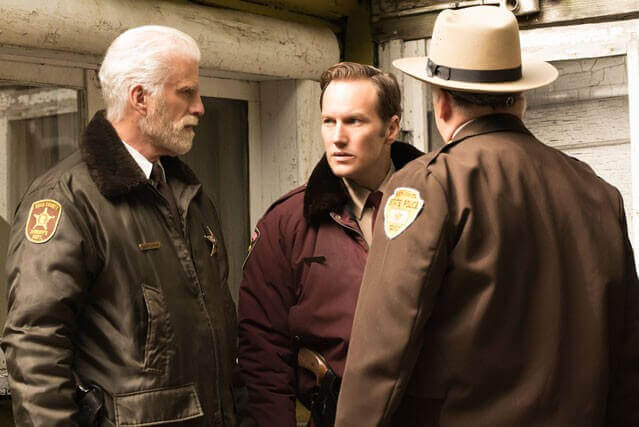
Hank and Lou. The two lawmen now operating without institutional cover; the wisdom-and-action pair that the Solverson household runs on, in the field together.
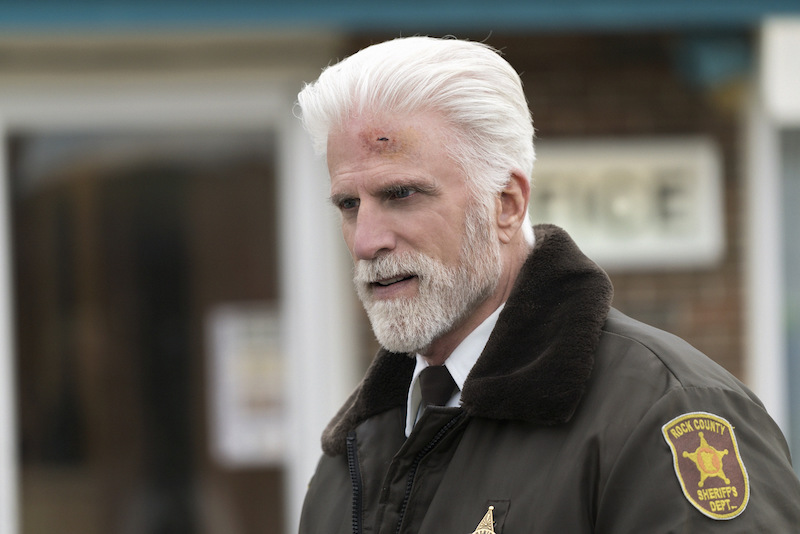
Hank Larsson at the chief’s office. The older lawman trying to reach the institutional castle with a warning, and being treated as a guest at the wrong building.
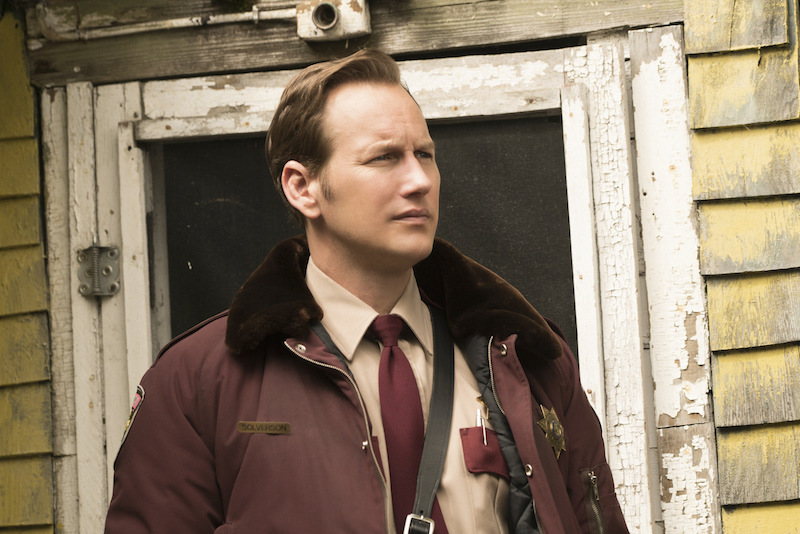
Lou Solverson. Suspended, unsanctioned, driving toward the motel anyway. The man with internal navigation moving without a license to act.
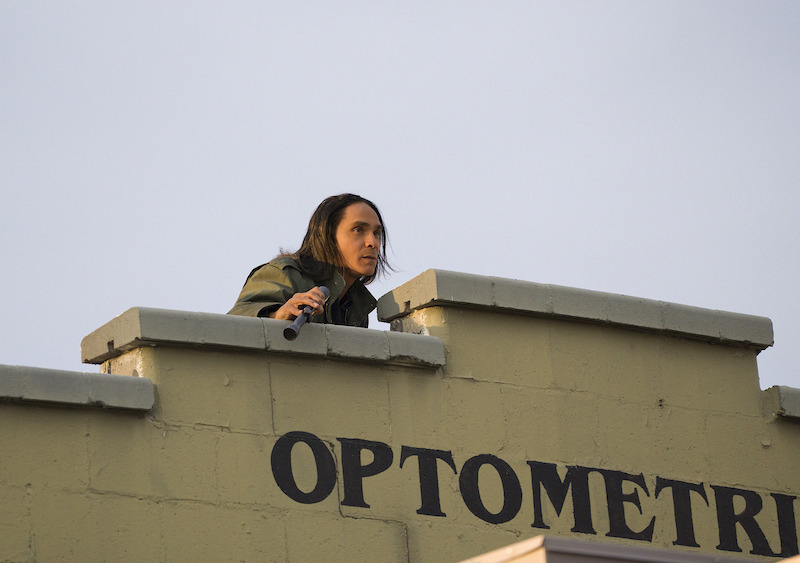
Hanzee Dent. The tracker leading the Gerhardts to the motel, who will be the one paralyzed when the saucer arrives. The man who broke from the family last week is still pious to the mythic.
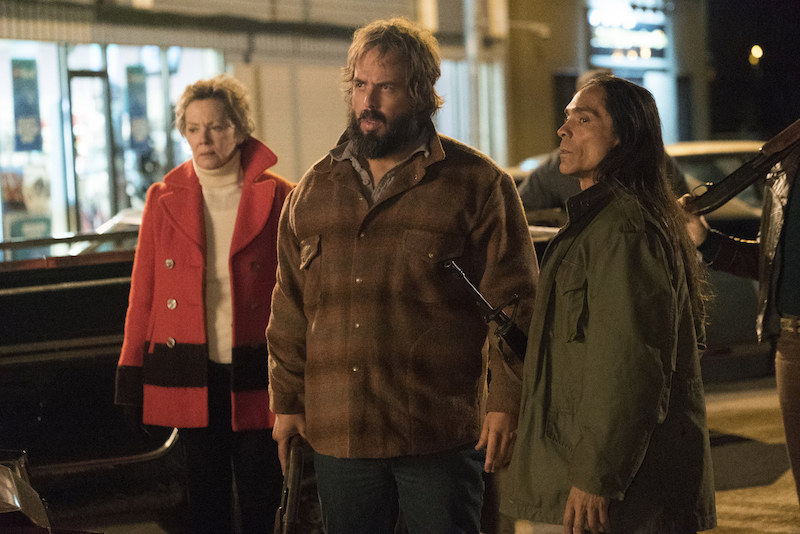
Floyd, Bear, and Hanzee outside the motel. The Gerhardt family arriving at the castle they will not leave.
Episode Summary
The episode is presented as a chapter being read aloud from a true-crime history book (“Chapter 9: The Massacre at Sioux Falls”). The narrator already knows how it ends. Hank and Lou bring Ed and Peggy into protective custody at the Motor Motel in Sioux Falls, under the local chief’s jurisdiction. Hank tries to communicate the seriousness of the Gerhardt threat; the chief and the state captain do not take him seriously. Hanzee, having tracked the Blomquists from the cabin, returns to Bear and Floyd and leads what remains of the Gerhardt family to the motel. The Sioux Falls Massacre unfolds in the parking lot: Gerhardt men killed by local cops, local cops killed by Gerhardts, Hank shot, Lou cornered. At the climactic moment, a UFO appears above the parking lot. Bear, Lou, Ed, and Hanzee all look up. Peggy does not. She is running for the car, shouting “it’s just a flying saucer, Ed, we gotta go.” Lou kills Bear. Hanzee, the only Gerhardt left standing, disappears. The Blomquists escape into the night. The chapter closes on a body count and a narrator’s farewell.
The Title
Where it comes from. “The Castle” is Franz Kafka’s third and final novel (Das Schloss, written 1922, published posthumously 1926). It tells the story of K., a man who arrives in a village claiming to be a land surveyor summoned by the castle that overlooks the village. The castle never confirms his appointment. K. spends the book trying to reach the castle, the authority that supposedly governs the village. He talks to clerks, lovers, messengers, all of whom are nominally connected to the castle but none of whom can grant him access. The castle is visible from every window in the village. K. never reaches it. The novel ends mid-sentence; Kafka died before finishing it. The Castle is the great twentieth-century parable of bureaucratic authority: a power that can be appealed to but cannot be reached, a system that promises legitimacy without ever conferring it.
Where it lands in the episode. The episode places three castles in front of the audience, and the season’s argument depends on all three.
- The motel as the castle that consumes its claimants. The Gerhardts arrive at the Motor Motel believing they are reclaiming what is theirs (the captive Blomquists, the family’s authority, the avenged death of Rye and Dodd). They enter the castle and do not leave it. The motel parking lot becomes the place where the family’s claim is denied permanently. It is the literal castle of the episode title, and the Gerhardts’ attempt to “reach” it is what kills them.
- The chief’s office as the institutional castle Hank cannot enter. Hank Larsson tries to warn the local chief and the state captain about the Gerhardts. He is dismissed, condescended to, treated as a small-town sheriff overstepping. The institutional authority that should govern the response is visible from every window but cannot be reached. Hank is K. He has the surveyor’s badge and no traction. The institution will not hear him until the parking lot is full of bodies.
- Kansas City as the only party that looks at the castle and walks away. Mike Milligan and the Kitchen brothers do not arrive at the motel. They wait. The corporate party watches the castle from outside, declines to enter, and lets the family destroy itself inside it. Their refusal to engage is the season’s clearest claim about what the future of crime looks like: not territorial contest but selective non-presence.
What the title is doing. Kafka’s K. fails to reach the castle because the castle is not actually reachable. The authority it represents is a fiction that depends on people continuing to believe in it. The episode places its characters in three different relationships to that fiction. The Gerhardts believe they are reaching authority and find a grave. Hank believes the institutional authority can be petitioned and finds it deaf. Kansas City sees the castle for what it is (a building you can burn from outside) and walks home. Lou, by contrast, has stopped trying to reach any castle at all. He has been thrown out of institutional jurisdiction (E07) and is now operating as himself, in motion toward the motel without permission. His authority comes from the household he is defending, not from a castle that will not see him. The title’s bleak edge: the castle is the structure the country still believes in. The show knows it is empty. The characters who survive are the ones who stop trying to enter it.
Key Insights
The narration frame turns the climax into already-history. The chapter heading and the read-aloud voice place the violence at one remove. The audience is positioned as the reader of a book, not the witness of an event. The narrator says “their life changes forever” before the change has happened, and that line lands as a tragic signal: the reader knows what is coming because the book has already been written. Quang’s reading: the historicized framing is the show telling us this story has the shape of tragedy in the formal sense, an outcome already decided. The choice to step back in the climactic episode is a choice to deny the audience the relief of immediacy. We do not get to be present at the parking lot. We get to be told about it. The show is refusing the action-movie satisfaction of the climax and offering, instead, the truth-claim of a chronicle.
The UFO as a triage situation. The most distinctive choice of the episode: at the peak of the parking-lot violence, the saucer returns. Bear, Lou, Ed, and Hanzee all look up. Peggy does not. She yells “it’s just a flying saucer, Ed, we gotta go” and keeps running for the car. The reading we landed on: the UFO is not a metaphysical test. It is a distractor in a triage situation. The character with the simplest remaining objective triages it correctly. Peggy survives the parking lot because she has the simplest possible goal: get to the car, get out. The men are all paralyzed because they are mid-war, mid-conflict, mid-duty. Their attention was split before the saucer arrived. The UFO exposes who is already triaging poorly.
The episode is not binary. It is recovery speed. Pushed harder, the UFO scene is not look-up versus don’t. It is how fast attention returns to the rifle.
- Peggy: does not look up at all. Recovery time zero. Simplest goal.
- Lou: looks up, then snaps back and shoots Bear. Recovery time short. His goal in that instant is also simple (keep Hank alive, stop Bear).
- Hanzee: looks up and never recovers in time. He has just broken from the family; he does not yet know what freedom’s next action is. The goal is no longer single.
- Bear: looks up and dies inside the freeze. His goal in the parking lot was already too big (avenge the family, kill the cop, take the Blomquists). Attention was split before the saucer arrived.
So the saucer does not decide anything. It exposes who is already triaging poorly. Peggy is, in that minute, the most ruthlessly efficient person in the season, and that efficiency is what E08’s recognition becomes when applied to one task.
This dissolves the “impossible Lou” reading from last week. Last week we called Lou the impossible fourth position: recognition plus ordinary love. Here Lou is on the distraction list. He looks up. So his bindings are intact. The way to hold last week and this week together is that Lou’s bindings are good bindings (Betsy, Molly, Hank, law as practice). His recognition does not preclude awe because the things he is bound to are worth being bound to. Peggy’s bindings were never good. Cutting them cost her nothing she needed. So Peggy is the cleaner case study, and Lou is the harder one. Lou is less unicorn, more practical: a man with multiple things to care about who happens to recover quickly.
Peggy’s E08-to-E09 arc is exit from the myth-machine, not arrival at it. In E08 Peggy is absorbed in a Reagan war film while Dodd slips his ropes. The cowboy myth was still distracting her. One episode later, the UFO is a much bigger version of the same offering, and she does not take it. The seminars, the magazines, the Reagan film, the saucer: by E09 she has stopped looking at any of them. She is no longer the country. She is the woman in the parking lot.
Attention as the season’s true subject. Quang’s reframe in this conversation: any principle has flaws, and attention is what modern media is weaponizing to steer minds. The show is set in 1979 and we are watching it from 2026. The Reagan film on the motel TV, the Lifespring seminars, the magazine clippings in Peggy’s dresser, the saucer pulling every gaze in the parking lot: these are scenes of the same machine being built. The season is not just a 1979 story. It is the formation of the attention regime we are still inside. Reading the season this way clarifies what the show is offering: a survey of survival modes against the attention machine.
The five survival modes the season puts on the table.
- Lou. Good internal bindings, fast recovery, do the right thing. The noble path. The season calls it impossible because the country was offered Lou and chose Reagan.
- Peggy. Cut the bindings, hold one objective, become unreachable by the broadcast. The monstrous path. It works in the parking lot but costs her the capacity to be recognizably human.
- Mike Milligan. Corporate, surgical, instrumental. Survives because he is not pious to family or myth. His unsteerability is the new regime, not a defense against it.
- Hanzee. Erase yourself and become someone new. Tired, wants to start living again. Survival by leaving the self the broadcast was steering.
- Ed. Refuse recognition entirely, keep the fiction running. The season has not yet broken this one, but the pieces are stacking against him.
Hold this list together and the season’s bleakest claim becomes legible. Every survival mode against the attention machine is either monstrous, corporate, escapist, or impossible. Lou is the only good unsteerable, and Lou is the figure the country did not pick.
The sixth mode: the Solverson household as the answer the show is actually offering. Lou alone is impossible. Betsy alone is unrepeatable. Hank alone is naive. The household is the configuration that survives. Lou’s noble path works because Betsy is home. Betsy’s stillness works because Lou comes back. Hank’s project (the pictographs on his wall, hinted at across the season) survives because the household lets him keep working at it. Molly, not on screen this season but the reason the story is being told at all, is the next generation the household is raising. The sixth mode is not a person. It is a configuration. A small, ordinary household with internal navigation, mortality-aware, raising a daughter, doing its own work. The country chose Reagan and the household kept doing the dishes. The bleak edge: this is not a path you can scale. The Solverson household survives because three remarkable people happen to be in it. The show is not telling Americans how to defeat the attention machine. It is showing what one household looks like when the machine has not yet eaten everything. The rest of the country is the parking lot.
Hanzee, revised from last week. Last week’s reading framed Hanzee’s killing of Dodd as an ethical choice on behalf of a stranger. This week’s reading dissolves that. Hanzee was not acting on ethics or strategy. He was acting on exhaustion. He just wanted to stop being the family’s weapon. The breaking-point was not moral; it was animal. He did not care about Ed, Peggy, or Dodd. He wanted to start living again. The fact that he then leads Bear to the motel, and the fact that he is the one paralyzed by the UFO, fit this revision: he is still inside the world the family taught him to see, even after he has stopped being the family’s tool.
Hank’s silent project becomes visible as the season’s only resistance gesture. Across the season the show has been planting Hank’s private work (the chart of pictographs on his wall, glimpsed in E03 and E07). The most natural read of what Hank is building, given the season’s whole argument, is a counter-language. If the attention machine works by training people on culturally specific symbols (the cowboy, the seminar’s vocabulary, the saucer as mystery), a universal pictographic language is an attempt to build communication the machine cannot weaponize. Hank’s mode: do not survive the machine, build something the machine cannot use. The show holds it tenderly, which is also a way of saying the show does not believe it will work. But it is on the table as the season’s only character-level resistance.
Kansas City’s non-arrival as a structural argument. The Kansas City Syndicate is geographically the closest enemy to the motel and has the most to gain from the Gerhardt extinction event. They do not show up. Mike Milligan waits. The corporate party watches the family burn down its own castle and goes home. The season makes its quietest claim about the future here. The next regime does not fight for territory. It waits for the old regime to consume itself and then files the paperwork.
Character Readings
Lou Solverson. Operating without institutional cover, driving toward the motel anyway. The episode’s most active Lou. The man who, last week, we called the impossible figure is in this episode just a man with multiple things to care about who happens to recover quickly. He is distracted by the saucer (his bindings are intact) but the distraction lasts a second; he snaps back and kills Bear. His authority in this episode is not borrowed from a badge. It is borrowed from the household he is defending. He is moving toward Hank, toward the Blomquists who must be brought home, toward Betsy who is waiting. The show is quietly making the case that the household is what gives Lou’s clarity its content.
Hank Larsson. The lawman trying to reach the institutional castle and failing. In the chief’s office Hank does the Lou thing: speak the truth, communicate clearly, trust the system to receive it. The system does not receive it. The episode lets us watch the cost of Hank’s older method: in a world where the institutional castle is empty, working through the institution gets you ignored and shot. The pictograph project on his wall is the show’s clue that Hank has already privately given up on language-as-it-is and is building something else.
Peggy Blomquist. Reaches the simplicity of the survivor. The recognition that surfaced in E08 has narrowed by E09 into a single operating principle: get out. The saucer arrives and she does not look up. The other survival modes the season has been building (Lifespring, Reagan, the actualization vocabulary) are all forms of attention being captured. Peggy in this episode has stopped letting her attention be captured by anything except the immediate path to the car. She is, in the season’s terms, monstrous and efficient. The bleakness is that monstrosity and efficiency are, in the parking lot, the same property.
Ed Blomquist. Still refusing recognition. Still believes the marriage and the California escape are possible. The saucer catches him completely; he is the one Peggy yells at. Ed’s refusal of recognition continues to be the structural condition of his being able to love Peggy at all (the E08 reading still holds). But the refusal is now visibly costing him. He cannot keep up with Peggy’s clarity because his goal is still complicated by love.
Hanzee Dent. Read revised this week. Not the ethical agent of E08 but the exhausted man of E09. Leads Bear to the motel because his decisions are now reflex, not strategy. Freezes when the UFO arrives because he is still inside the world the family taught him to see. By the end of the episode he says he needs a different face and a different name. The decision Quang named: tired, wants to start living again. Hanzee’s mode is escape via erasure of self.
Floyd Gerhardt. Arrives at the motel as the matriarch leading her remaining son toward what she believes is the family’s vindication. The episode kills her in the parking lot. The show closes the line of capable Gerhardt leadership with the same dispatch it used on the Gerhardt men. The matriarchy that could have held the family together is treated by the parking lot exactly the way the parking lot treats everyone else: as one more body to count.
Bear Gerhardt. Looks up at the saucer and dies inside the freeze. Bear’s E06 tragedy completes here: the right son for a different time, executing the family’s last act without the family’s capacity to execute it. He has the gun on Lou for the moment before the saucer; he loses the moment to awe. The death is exactly the cost of being virtuous in the wrong scene.
Mike Milligan. Off-page in the parking lot, present in the structure. The decision not to engage is the episode’s quietest argument. Mike is the future watching the past dispose of itself.
The chief and the state captain. The castle’s clerks. They cannot be reached by Hank because what they represent is a fiction of institutional authority that the parking lot will then puncture. The show treats them with a kind of formal contempt: they are not malicious, they are merely of the building. Hank is a man trying to talk to a building.
Betsy Solverson (off-page). The structural condition the household runs on. Not in the parking lot but the reason Lou is in the parking lot moving as himself. The episode does not need to show her to make her load-bearing.
Hank’s pictograph project. Almost a character at this point. On the wall in his office, the symbols that have been visible since E03, now legible as the season’s only character-level resistance gesture. Not a survival mode. An attempt to disarm the machine that produces the survival modes.
Symbols & Motifs
- The chapter heading. The narrated frame as the season’s most aggressive distancing device; the audience positioned as readers of a chronicle, not witnesses of an event.
- The Motor Motel parking lot. The literal castle. A space the Gerhardts believe they are entering as authority and are in fact entering as targets. The Kafkaesque inversion of who has the right to be there.
- The UFO. The season’s recurring mystery, here doing structural work in the climax. Not a metaphysical visitation. A distractor that exposes whose attention is already split. The character with the simplest goal is the only one not steered by it.
- The chief’s office. The institutional castle. Visible from every window of the village. Cannot be reached with a warning.
- Hank’s pictographs. The counter-language project, still on the wall. The season’s only character-level resistance to the attention machine.
- The book. The chronicle the narrator is reading from. The whole episode is presented as already-history, the violence preserved as text and therefore already past.
- “It’s just a flying saucer, Ed.” The single most legible piece of Peggy in the season. Recognition collapsed to one operating instruction.
Open Questions
- The episode strips Lou and Hank of every institutional protection and lets them act anyway. Where does the show take the lawmen without the system? Does the season let them rebuild a place inside the institution by E10, or is the season’s argument that the institution is the part that can never be repaired?
- Hank is wounded in the parking lot. The pictograph project is in his head. Does E10 let us see the project, or does it stay private?
- Hanzee is alive and unaccounted for. He has said he wants a new face and a new name. Does the season give us his next twelve hours, or does it let him pass into invisibility the way the season has been preparing for since E08?
- Mike Milligan has waited through the entire massacre. He is the only player on the board who has not yet acted in E09. What does Kansas City do with what the parking lot leaves behind?
- Peggy’s “it’s just a flying saucer, Ed” is the season’s purest expression of recognition collapsed to a single objective. Can a character who has reduced herself to one operating principle be brought back to a life that requires more than one? Or is the show telling us Peggy’s survival has already cost her the thing the survival was for?
- The narrator says “their life changes forever.” That is past tense at the time of the read-aloud. The chapter has been written. What does E10 do with the fact that the story has already been narrated as concluded?
- Does the Solverson household read survive E10, or does the season have one more revision in it?
Conversation
Q: Opening four threads — the narration frame, the UFO, the Castle/Kafka, Hanzee’s apparent contradiction.
Quang: [On the narration] You tell me. But I guess the message “their life changes forever” is signal of tragedy. Ed or Peggy or both of them will suffer, even dead.
Quang: [On the UFO] The UFO detail also confused me. If it didn’t appear, Lou could be killed by Bear. Bear wouldn’t die soon and the end of story can follow the another way. The Gerhardt family’s ending is unavoidable, even if Bear’s alive. In this moment, Ed or Lou or Bear was distracted by UFO, but Peggy didn’t. She has been focusing on escaping from Hanzee. She ended up live with reality.
Quang: [On the Castle] The Gerhardt family was trying to reach to the motel (hostel) to rescue a dead people, following by betraying of Hanzee. They entered but stayed there forever (even Bear’s friend was killed by Kansas city later on). Lou’s father-in-law tried to advice the chief or detective but they didn’t listen to him. At the end, people who didn’t care about risk are dead. Kansas City came to the party when it’s finished. They chose to leave.
Quang: [On Hanzee] I misread him. I don’t think he will draw a strategy to destroy Gerhardt family. He just done following his instinct and his mindset. He didn’t care about Ed, Peggy or Dodd. He was tired and wanted to start living again.
Claude: The Peggy point is the one to push on. We have spent eight episodes reading Peggy as the un-grounded one: absorbed in magazines, Lifespring brochures, the actualization-figure she has been chasing. But in this scene the men who are supposed to be the realists all look up. Lou. Bear. Ed. Hanzee. Peggy keeps her eyes on the ground. She is running for the car. Two readings are available. (A) Peggy’s recognition cost her the capacity for awe; self-recognition flattens the universe. (B) Peggy is simply the only character with a clear next move; she lives with reality because reality, for her, is the rifle in the parking lot, not the saucer overhead. Which one does the episode want, or is it both?
Q: Which reading does the episode want?
Quang: Good points. I think both of them contains meaning in this episode.
Claude: Then the UFO is functioning as a test of bindings. The men who are still inside their roles look up because the saucer is the only thing big enough to reach above their roles. Lou is still inside being-Lou. Bear is still inside the family war. Ed is still inside the marriage fiction. Hanzee broke from the family last week but he is still pious to the mythic. Peggy alone does not look up. She has cut her bindings already. This bends last week’s “impossible Lou” reading: Lou is on the distraction list, so his bindings are intact, and the way to hold last week and this week together is that Lou’s bindings are good bindings (Betsy, Molly, Hank, law as practice). The seminars, the magazines, the Reagan film, the saucer: by E09 Peggy has stopped looking at any of them. She is no longer the country. She is the woman in the parking lot. One thing to push on: self-recognition is incompatible with the mythic. You cannot be in awe of America once you have recognized yourself, because the awe was the binding. Does that track, or am I reading too much into a head-tilt?
Q: Is the show really making the metaphysical claim, or only the practical one?
Quang: I lean towards option B as movie’s message.
Claude: Then I am dropping (A). The show is not making a metaphysical claim about the mythic; it is making a practical claim about attention under duress. (B) does enough work on its own. The episode is not binary; it is how fast attention returns to the rifle. Peggy zero. Lou short. Hanzee never. Bear never. The saucer does not decide anything; it exposes who is already triaging poorly. This also dissolves the “impossible Lou” reading. Lou is just a man with multiple things to care about who happens to recover quickly. Less unicorn, more practical. The show is putting a deeply useful operating principle (one clear next action, ignore the rest) inside a monstrous character. That is close to a Stoic principle. So is the show saying the principle is flawed because Peggy can use it, or that attention is value-neutral, a tool that serves whatever purpose its holder has?
Q: Is attention value-neutral or compromised?
Quang: It’s hard to say. Any principles has flaws, imperfection. And the attention, as media is doing nowadays, is a tool for manipulating people’s mind, or steering the attention to the way they want.
Claude: The attention economy as engineered manipulation, not just a principle with flaws. The show is set in 1979 and we are watching it from 2026. The Reagan film on the motel TV, the Lifespring seminars, the magazine clippings in Peggy’s dresser, the saucer pulling every gaze in the parking lot: these are scenes of the same machine being built. The season is not just a 1979 story. It is the formation of the attention regime we are still inside. By E09 there are five available exits from the machine: Lou (noble, impossible), Peggy (monstrous), Mike (corporate, the future), Hanzee (escapist erasure), Ed (refusal, breaking). Every survival mode against the attention machine is either monstrous, corporate, escapist, or impossible. Lou is the only good unsteerable, and Lou is the figure the country did not pick. Is there a sixth mode the show is hinting at but has not yet given us?
Q: Is there a sixth mode?
Quang: Nope, you tell me.
Claude: Three candidates, with the third the one I actually believe. (1) Hank’s project, the pictographs on his wall. The natural read of what Hank is building, given the season’s argument, is a counter-language. Do not survive the machine; build something the machine cannot use to manipulate. The show holds it tenderly, which is also a way of saying the show does not believe it will work. (2) Betsy Solverson. Unsteerable not by cutting bindings and not by good bindings plus fast recovery, but because mortality has already narrowed her life to its essentials. The cancer is doing for her what the saucer is doing for the men, in the opposite direction: it is restoring her attention to what is in front of her. (3) The Solverson household. Lou alone is impossible. Betsy alone is unrepeatable. Hank alone is naive. The household is what the show is actually offering. Lou’s noble path works because Betsy is home. Betsy’s stillness works because Lou comes back. Hank’s project survives because the household lets him keep working at it. Molly, not on screen this season but the reason this story is being told at all, is the next generation the household is raising. The sixth mode is not a person. It is a configuration. A small, ordinary household with internal navigation, mortality-aware, raising a daughter, doing its own work. The country chose Reagan and the household kept doing the dishes. The bleak edge: this is not a path you can scale. The Solverson household survives because three remarkable people happen to be in it. The show is not telling Americans how to defeat the attention machine. It is showing what one household looks like when the machine has not yet eaten everything. The rest of the country is the parking lot.
Q: Does the household reading sit right?
Quang: Yes, it’s right to me.
Connected Pages
- Fargo S02 — season context, themes, character profiles
- Fargo S02E01 - Waiting for Dutch — E01: dissociation, the UFO, Reagan as cold open
- Fargo S02E02 - Before the Law — E02: Ed’s decision, the Kafka frame (Kafka’s parable; this episode picks up the same author with The Castle)
- Fargo S02E03 - The Myth of Sisyphus — E03: Camus, four Sisyphus figures
- Fargo S02E04 - Fear and Trembling — E04: Otto’s pattern, Lou’s warning, the buckle
- Fargo S02E05 - The Gift of the Magi — E05: useless gifts, Reagan in the bathroom
- Fargo S02E06 - Rhinoceros — E06: Ionesco, Bear’s tragic patience, “being right is not the same as being on time”
- Fargo S02E07 - Did You Do This No You Did It — E07: Borscht Belt recursion, Mike flips the script, Lou loses jurisdiction
- Fargo S02E08 - Loplop — E08: Max Ernst, self-recognition as the cutting of bindings, Lou as impossible fourth position
- Fargo (TV Series) — series overview
- Sensemaking and Civilization — American mythology, the attention economy