Key Stills
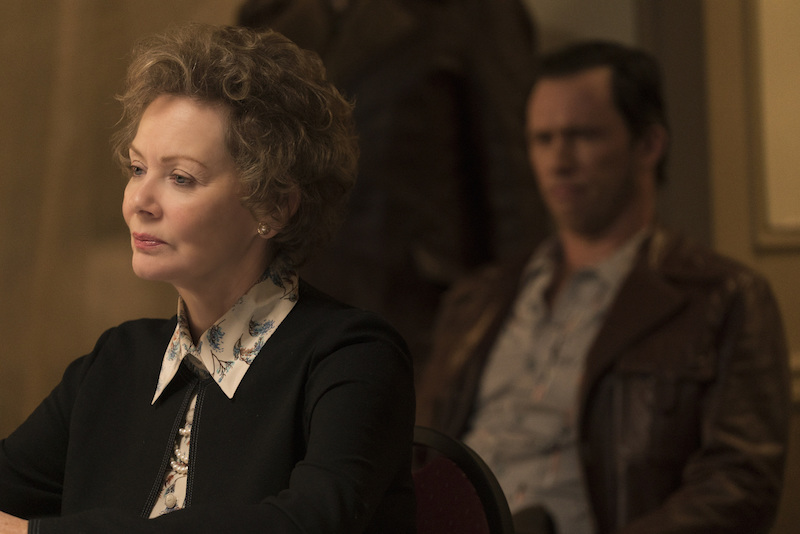
Floyd and Dodd Gerhardt — the matriarch and her would-be successor.
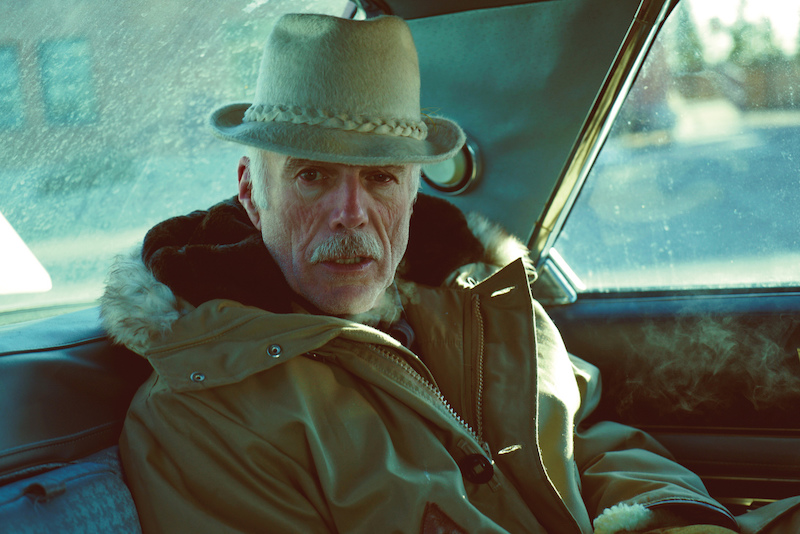
Otto Gerhardt — the silent patriarch, surviving an ambush he cannot understand.
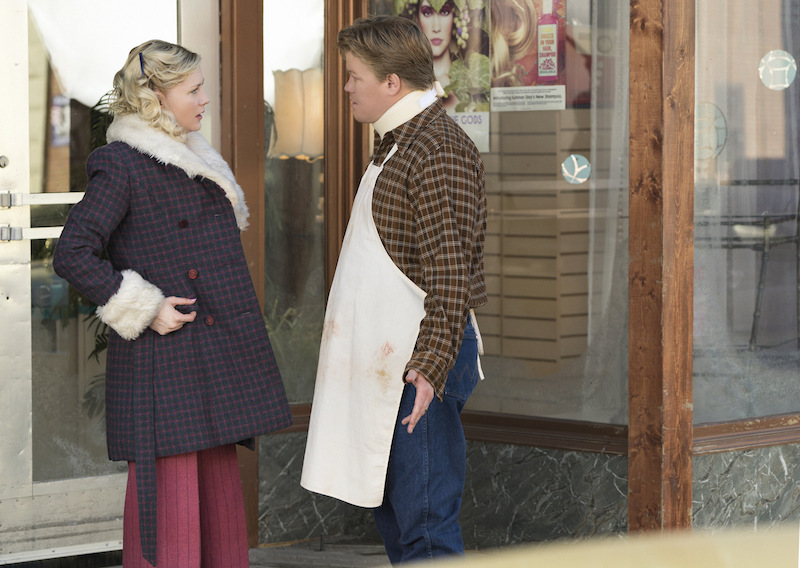
Peggy and Ed Blomquist — the future they are both still trying to buy.
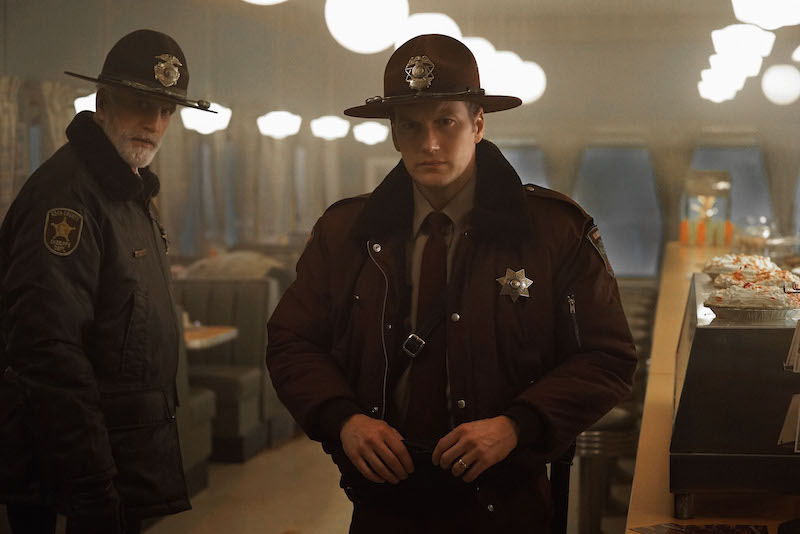
Lou and Hank — the law closing in on Luverne.
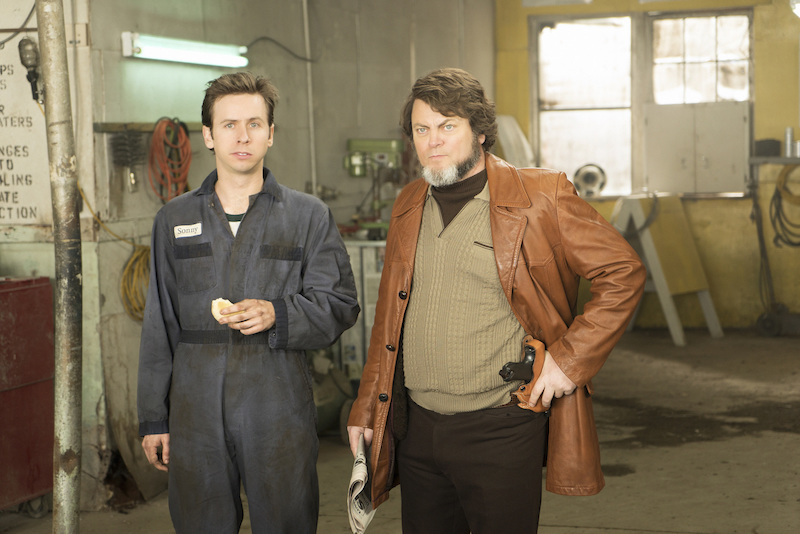
Karl Weathers and Sonny Greer — the small-town men adjacent to a war they cannot see yet.
Episode Summary
A 1951 cold open shows a young Dodd Gerhardt being made into a killer by his father Otto, executing a man named Kellerman in a movie theater to avenge his grandfather. In present day, Kansas City attempts to assassinate Otto in a clinic parking lot; he survives but the violence has now moved into broad daylight. Floyd, Dodd, and Bear meet Joe Bulo and counter with a partnership offer; Bulo rejects it, demands full surrender, and lowers the buyout by two million dollars. Hanzee tracks the missing-Rye thread to its source — finding Rye’s belt buckle in the Blomquists’ fireplace. Lou and Hank arrive at the Blomquist home with the same suspicion. Lou confronts Ed and Peggy directly and warns them, plainly, what is coming. Floyd, at episode’s end, prepares the family for war.
The Title
Where it comes from. Fear and Trembling is Søren Kierkegaard’s 1843 philosophical-religious treatise, written under the pseudonym Johannes de Silentio. It is a meditation on the Genesis 22 story of Abraham being commanded by God to sacrifice his son Isaac. Kierkegaard introduces the figure of the knight of faith — the person who suspends ethics to perform what God commands, trusting that the absurd command makes sense at a level beyond human reason. Abraham raises the knife. The angel stops him. Kierkegaard’s central question is not the binding itself but the interval: what does Abraham experience in the days between receiving the command and being told to stop? “Fear and trembling” — borrowed from Philippians 2:12 — names the spiritual condition of that interval, the dread of acting on a faith that cannot be ethically justified.
Where it lands in the episode. The 1951 cold open. Otto Gerhardt hands young Dodd a gun in a movie theater and makes him execute a man named Kellerman to avenge the boy’s grandfather. This is not Kierkegaard’s Abraham. Abraham raises the knife above his own son, in obedience to God. Otto puts the knife in his son’s hand and aims it at someone else, in obedience to family. The episode shows the founding sacrifice of the Gerhardts: the act that produced Dodd as a Gerhardt by performing a binding on him as a child. The man we have been watching for three episodes — brutal, impatient, ego-driven — is what was left over after that 1951 ceremony.
What the title is doing. The episode invites us to look for knights of faith and ethical suspensions everywhere, and finds them in every direction:
- Floyd’s counter-offer is a leap into a future where her family no longer dictates terms.
- Ed buying the butcher shop is a leap into a future that no longer exists.
- Peggy planning Lifespring is a leap into a self she has not yet become.
- Simone sleeping with Mike is a leap out of the family she was born into.
- Lou warning the Blomquists is the inverse leap — refusing the ethical suspension that would let him either arrest them or abandon them. Lou is the only character who declines the Kierkegaardian frame, and the episode treats his refusal as the moral peak of the season so far.
The episode is the season’s most explicit theological meditation. Every adult on screen is performing some version of Abraham’s interval — acting in fear and trembling toward a future they cannot ethically justify. The cruelest reading is that the founding leap of the Gerhardt family was Otto’s, and every leap since has been a faithful performance of his.
Key Insights
Floyd’s counter-offer as the hidden defeat. Floyd does not reject Bulo. She proposes a partnership — operate independently, give Kansas City 20%. This is a profound concession dressed as a counter. The matriarch who meets-only-from-strength is now bargaining from below. Bulo’s response is the corporate logic of the future Mike Milligan represents: rationality with no respect for what the family has built. He counters lower, and demands total surrender. Floyd’s loss in this scene is not the offer she will be forced to accept — it is the moment she realized she could no longer dictate terms. The “prepare for war” at episode’s end is not strategy. It is the only move left to a leader who has already lost the negotiation.
Lou’s warning at the Blomquist house. Lou sits with Ed and Peggy and tells them, with the directness that defines him, exactly what is happening. The Gerhardts are coming. He doesn’t arrest them. He doesn’t bluster. He gives them the truth and a chance. This is one of the most morally precise scenes in the season: a man with the legal authority to act against them choosing instead to tell them what they have done and what is coming, because he believes they deserve to know it. It is also a Kierkegaardian moment in reverse — Lou is the only character in this episode who refuses the leap into ethical suspension. He will not break the law to save them, and he will not abandon them to it without a warning. The integrity of his clarity is unbearable for the Blomquists, because it presents them with a reality they cannot integrate.
The belt buckle and the closing of dramatic irony. For three episodes the audience has watched a search for a man who does not exist in any reconstructable form. In this episode, Hanzee finds the buckle in the Blomquist fireplace. The dramatic irony that has powered the season — the world in motion looking for a body already destroyed — collapses. Hanzee has the answer. The Gerhardts will have it within hours. The slow accumulation of secrets the Blomquists have been protecting was always going to end this way; the question now becomes how long they have, and what they choose to do with it.
Ed buying the butcher shop, Peggy planning Lifespring. In the same week that the future they were planning has become structurally impossible, Ed commits financially to that future, and Peggy makes plans to leave for Sioux Falls to attend the Lifespring seminar. This is Kierkegaard’s leap, but pointed at illusions. Both Blomquists are performing acts of faith in a life they no longer have. Ed’s faith is in the ordinary — buy the shop, become Bud’s successor, raise children. Peggy’s faith is in transformation — actualize, become a fuller self, leave Luverne. Both are sincere. Both are tragic. The marriage is now two people sprinting in opposite directions, both certain they are running toward salvation.
Simone and Mike Milligan. Simone goes to Mike Milligan’s hotel and sleeps with him. The episode frames this as continuation of her revolt against Dodd — but it is also her own Kierkegaardian leap. She is sacrificing family for a self she does not yet have a name for. What makes this read more than betrayal is that she is the first Gerhardt to act on the perception Floyd already has: that the family she was born into is finished. Simone is moving toward what comes after, even if Mike is the worst possible vehicle for that movement.
Character Readings
Dodd Gerhardt — The cold open re-keys him completely. The man we have seen for three episodes as a violent obstacle is shown in his original form: a child handed a weapon by his father and told what to do with it. This does not redeem him. It places him. The brutality is not character; it is inheritance, performed faithfully into adulthood. His push for succession in the present makes more sense now — he is the son who paid the highest price to be a Gerhardt and resents anyone, including his mother, who appears to be getting the role he believes was bought with his childhood.
Otto Gerhardt — Largely silent in the present after his stroke, but the cold open shows the man he was. The patriarchy of the family is his work. The 1951 sequence is in some ways the season’s true cold open — the founding violence the entire present-day story is the consequence of. He survives the parking-lot ambush, but his survival is mostly procedural. The man who built the family is no longer present in any meaningful sense.
Floyd Gerhardt — Shows the cost of leadership for the first time. Her counter-offer to Bulo is strategic but it reveals her position. The most strategically intelligent character in the show now operates from a board where her best moves still do not work. The “prepare for war” at episode’s end is not a leader rallying her family. It is a leader who has run out of other options.
Bulo and Kansas City — Their negotiation behavior reveals the show’s ongoing thesis about corporate violence. There is no respect, no reciprocity, no ritual. Floyd offers partnership; Bulo lowers his offer. This is not how families negotiate. It is how an acquirer treats a distressed asset. The Gerhardts are still operating in a world of family honor; KC is operating in a world of P&L.
Hanzee Dent — Finds the buckle. The competence the show established in E03 closes the dramatic irony of the season. We now begin a new phase: the Blomquists are known.
Lou Solverson — His warning to the Blomquists is the moral peak of the season so far. He sees them clearly, names what he sees, and gives them a chance. This is Lou as the show’s only knight of faith pointed in the right direction — willing to perform an unusual ethical act (warning rather than arresting) because his clarity demands it.
Ed Blomquist — Doubling down on the future. His commitment to buying the shop is genuine, touching, and structurally suicidal. Ed’s faith remains in the ordinary; the ordinary is precisely what the events of the season have made impossible for him.
Peggy Blomquist — Her planning for the Lifespring seminar shows her continuing to live in a story disconnected from the one she is materially in. Her actualization project remains the engine of her interior life, even as the exterior life is collapsing. The asymmetry between her direction (transformation, away) and Ed’s (commitment, here) becomes structural in this episode.
Simone Gerhardt — Her sleeping with Mike Milligan crosses a line that cannot be uncrossed. The revolt that began as resistance to her father’s worldview is now active betrayal. The ambiguity the show preserves: is she using Mike, or is he using her, or is the real answer that the question itself is no longer interesting because the family she would have been betraying is already structurally dead?
Symbols & Motifs
- The 1951 movie theater — violence performed inside a fiction-machine; Reagan was the cold open of the season, Hollywood as American myth; this is the same structure on a smaller scale, with the Gerhardts staging an execution inside a place built for stories
- The belt buckle — the smallest possible artifact closing the largest possible irony; the entire search for Rye comes down to a circle of metal in a fireplace
- The fireplace — Ed’s instinct in E02 was to dispose of Rye through the butcher shop; the buckle survives because metal does not burn; the limits of erasure are physical
- The clinic parking lot — Otto’s ambush takes place in the most ordinary possible setting, in daylight, by men in suits; the violence has now left the rural night and entered the public sphere
- The Lifespring seminar — the destination Peggy has been building toward for the entire season; “actualization” as the name of the future she is choosing over the marriage
- Faith and binding — Kierkegaard’s frame at every level: Otto binding Dodd, Floyd binding the family, Ed binding himself to a future that no longer exists, Peggy binding herself to a self she has not yet become
Open Questions
- The cold open repositions Dodd as a product of Otto’s binding. Does this read carry forward — does the show let us continue to despise him, or does it complicate that hatred all the way through?
- Floyd’s “prepare for war” — is she actually mobilizing for a fight she can win, or is she acting as a leader is supposed to act when there are no good options left?
- Lou warned the Blomquists. They did not surrender. What happens to a man whose moral clarity is not received?
- Hanzee has the buckle. What is the gap between his knowing and the Gerhardts knowing — and who tries to close it, and how?
- Simone and Mike Milligan — is this a relationship the show develops, or is it the moment Simone’s arc became a betrayal narrative the writers already know how to end?
- Charlie’s pull toward family business — does this episode tighten the rope that pulls him in, or is there still slack?
Conversation
Q: The cold open with young Dodd. What did the flashback do to your view of him?
Quang: The flashback helps me understand the character development of Dodd partially. He was trained to be a killer when he was a child. It happened in the cinema, where people enjoy the movie, not a murder. This scene also showed an Otto, decisive and daring man. He’s very dangerous, especially under a dead-end situation.
Claude: The cinema setting is doing serious work — the Gerhardts perform real violence inside a building purpose-built for pretend violence. It mirrors the Reagan-on-a-Western-set cold open of E01. The show keeps placing real bloodshed inside places designed for storytelling. Otto chose this setting deliberately: he is teaching his son that violence belongs anywhere, even where ordinary life is happening.
Q: Floyd’s counter-offer to Kansas City — what is she sacrificing, what is she trying to save?
Quang: Floyd acts as if KC will accept her offer. She’s buying time for her eldest son to become stable enough to lead. But he’s also exactly why KC refuses the deal. No one sees him as a viable partner. She’s clinging to the belief that the Gerhardt name can survive, trapped by her own role as a mother. Deep down, she knows he won’t change. So she convinces herself otherwise. Does she protect her family, or the illusion of the family? In the end, she chooses war, not because it’s smart, but because she’s already made any other choice impossible.
Claude: This is the tragic irony. Floyd is trying to keep the family alive long enough for Dodd to become someone KC will deal with — but Dodd’s instability is also why KC will not give her the time. The thing she is protecting is the thing making her unprotectable. Her “prepare for war” is both strategically wrong (KC is bigger) and the only move left (Dodd would never accept surrender). She is choosing the path her unstable son makes inevitable.
Q: Ed wanting to buy the butcher shop — denial, faith, or something more dangerous?
Quang: It’s an attachment. It guarantees suffering - whether he gets what he wants or not. He’ll keep crossing new lines. His actions don’t just protect Peggy; they protect what he’s already done. He convinces himself it’s justified. He clings to the idea of buying the butcher shop to prove it was all worth it. If he can’t, everything collapses. A dream isn’t a goal anymore; it’s the excuse. That’s how it turns dangerous.
Claude: The Buddhist framing is exact — clinging to a future is the engine of Ed’s coming wrongdoing. He already crossed the line in E02 from love. The deeper risk now is that each act of protection has to defend not just Peggy but every previous act of protection. Ed is becoming a man whose moral compass is purely retrospective: “what would justify what I have already done.”
Q: Simone with Mike Milligan — revolt, or her own Kierkegaardian leap?
Quang: Is this mutual exploitation, or just reckless enjoyment? I lean closer to reckless enjoyment than calculated exploitation. Simone is pushing back against her father, but I don’t think she’s ready to betray her family. She is too young for a real leap, but too old for a purely childish revolt. She’s operating in a grey area, closer to the line than she realizes. She doesn’t understand the cost of that freedom, and she is making choices she doesn’t fully control. If she crosses the line by giving Mike something real, she becomes a betrayer. If she’s already told him about Otto’s hospital, then she’s already crossed that line. Simone doesn’t think she’s betraying, but her actions already follow that logic, “sleep with the enemy”.
Claude: Your hesitation is right — I leaned harder than the episode does. The show holds the question open. The real test is whether she gives Mike anything actionable. Sleeping with him is a private act. Telling him family business is the line that turns rebellion into betrayal. Watch for that.
Connected Pages
- Fargo S02 — season context, character profiles, themes
- Fargo S02E01 - Waiting for Dutch — E01 analysis: dissociation, UFO, the Reagan cold open
- Fargo S02E02 - Before the Law — E02 analysis: Ed’s decision, the Kafka frame, the search for a man who no longer exists
- Fargo S02E03 - The Myth of Sisyphus — E03 analysis: Camus as ironic frame, Lou as moral spine, Peggy as proactive steerer
- Fargo (TV Series) — series overview