Key Stills
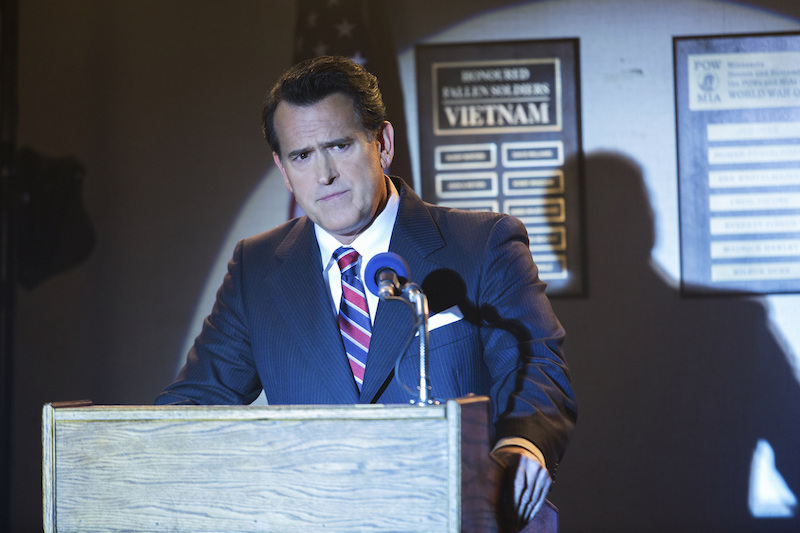
Bruce Campbell as Ronald Reagan — the Western mythology of E01 walks back onto the screen as a candidate for president.
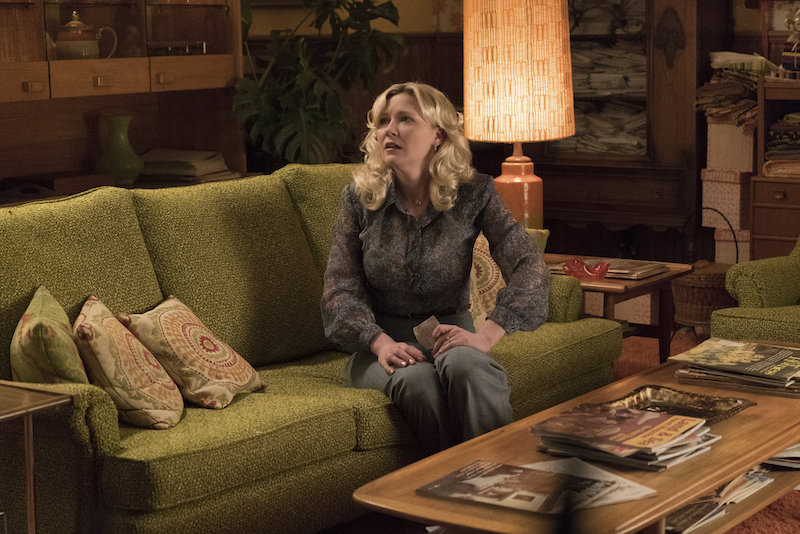
Peggy Blomquist — still steering toward Lifespring, still steering toward a self she has not yet become.
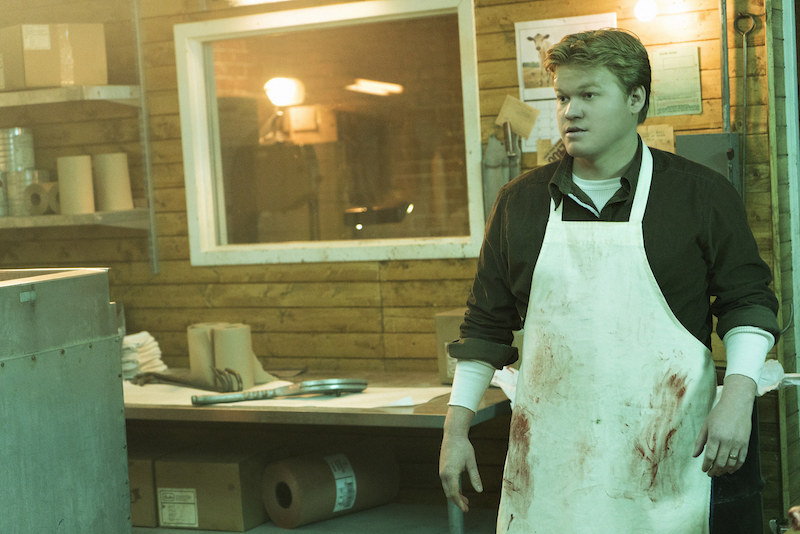
Ed Blomquist — the butcher’s calm of a man defending the future he has already lost.
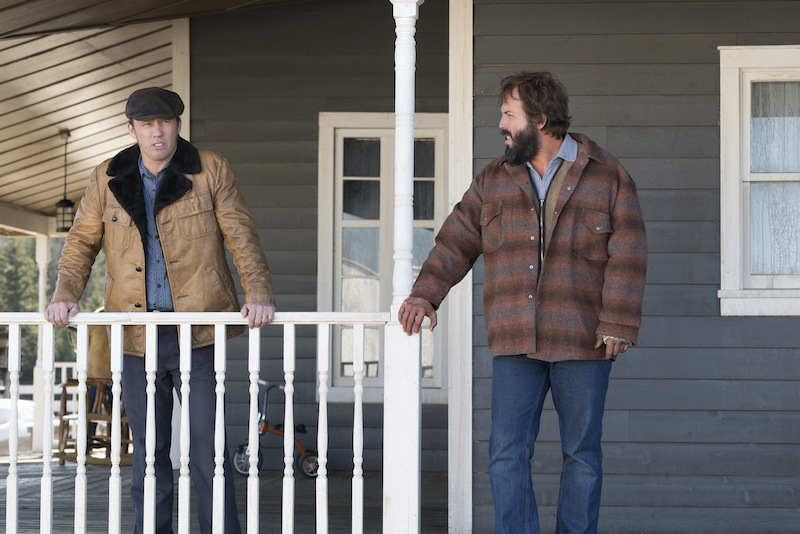
Dodd and Bear Gerhardt — brothers under a mother whose authority is now contested in the open.
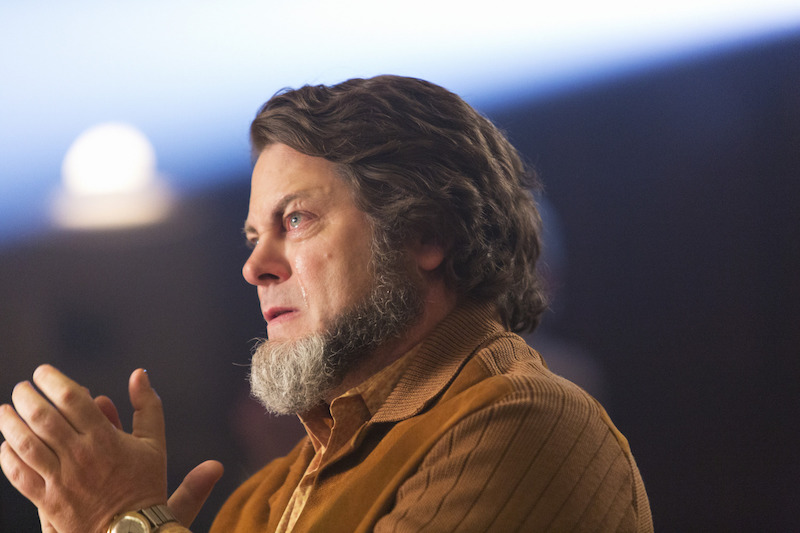
Karl Weathers — the small-town lawyer suddenly standing between the Blomquists and the war.
Episode Summary
The Gerhardts ambush a Kansas City convoy and thin Joe Bulo’s crew, the first open act of the war Floyd declared at the end of E04. Reagan campaigns through Luverne; Lou meets him in a men’s room and asks the future president the kind of question Lou asks everyone, and gets no answer. Hanzee feeds the Gerhardts the Blomquist address. Dodd sends Charlie (with Virgil) to kill Ed at the butcher shop; the hit fails, Virgil dies, Charlie is arrested, and Ed burns the shop down with Hanzee inside (or so he thinks). Peggy goes to Lifespring after all. Karl Weathers, drunk and improbable, talks the Gerhardts off the Blomquist front porch with nothing but a constitutional argument and his own nerve. By the end, the Gerhardts know who the Blomquists are, the Blomquists have nothing left to defend, and the season has crossed from before-the-war to inside-it.
The Title
Where it comes from. “The Gift of the Magi” is O. Henry’s 1905 Christmas short story — one of the most anthologized pieces of American short fiction. A poor young couple, Della and Jim, want to give each other a meaningful Christmas gift. Della sells her long hair to a wig shop to buy Jim a platinum chain for his pocket watch. Jim sells his pocket watch to a pawn shop to buy Della tortoiseshell combs for her hair. They arrive home and discover both gifts are useless. The “Magi” are the three wise men of the Christian nativity, the original wise gift-givers — they brought gold, frankincense, and myrrh to the infant Jesus. O. Henry’s closing line names Della and Jim as the true magi: their love made them wiser than the original three, because the wisdom of love is sacrificing what you most value for someone you value more. A useless gift can still be wise if love made it.
Where it lands in the episode. Peggy sells her car — her means of escape, her ride to Lifespring, the engine of the future-self she has been planning all season — and gives Ed the check to buy the butcher shop he is clinging to. The O. Henry parallel is exact: each spouse trades the thing they most value for the thing the other most wants. Within hours of the gift, Ed’s shop is on fire. The check is useless. The car is gone. Hanzee delivers Joe Bulo’s head upward to Dodd as tribute in a war Dodd has already lost — the dark inversion of the same gesture, a gift offered too late to mean what it was meant to mean. Lou’s earlier warning to the Blomquists in E04 was a gift they could not receive. The episode is structured around three useless gifts.
What the title is doing. Fargo S02E05 takes O. Henry’s frame and inverts it. O. Henry says love can make a useless gift wise. The episode says useless gifts are what people give when they cannot face the situation they are actually in. Peggy’s check funds a future already burning. Hanzee’s tribute belongs to a war already lost. Lou’s warning was gifted to people not yet ready to hear it. The “Magi” of the title are not, in this episode, the wise; they are the people performing wisdom they cannot afford. The cruelest reading: the gift is real, the love is real, the timing is wrong, and timing is what determines whether wisdom counts.
Key Insights
Reagan in the men’s room. The cold open of S02 was Ronald Reagan on a Western set, the man who will shortly remake America by performing the cowboy myth that made him. Now Reagan returns, mid-campaign, in Luverne. Lou meets him in a bathroom and asks the question the show has been asking since E01: how do we keep going in a world this dark. Reagan has nothing real to say. He performs the answer in the way he will perform the presidency. Lou stands across from a man whose entire effectiveness is the appearance of a moral clarity Lou actually possesses. The exchange is the season’s most efficient indictment of American myth-making: the cowboy on screen has no answer for the actual cowboy in the room.
Hanzee’s delay as the moment he becomes a player. At the end of E04, Hanzee found the buckle. He had the answer. He could have given it to Dodd that night. He held it. The gap between his knowing and the family’s knowing, brief as it is, is the moment Hanzee stops being a tracker the Gerhardts point at problems and starts being a man choosing what truth reaches whom. Information is the only power he has, and he has discovered he can use it. From E05 onward, the question stops being “what does Hanzee know” and becomes “what is Hanzee choosing to do with what he knows.” That choice will drive the back half of the season.
Charlie’s failed initiation, and the Otto pattern that does not hold. E04 opened with Otto giving young Dodd a gun and a man to kill. The binding took. Dodd became a Gerhardt by the violence his father had performed on him. In E05, Dodd reaches for the same pattern with Charlie: send the boy on a hit, let the violence make him. The pattern fails. Charlie is shot, loses his arm, is arrested. The family business is offered to a third generation and the third generation cannot receive it. The Gerhardt mechanism for producing Gerhardts has stopped working. This is the structural defeat of the family even before Kansas City finishes them.
Karl Weathers and the last line of civilization. The Gerhardts stand on the Blomquist porch with guns. They will go inside. Between them and Peggy and Ed stands Karl Weathers, drunk, a town lawyer of no consequence, holding nothing but a constitutional argument. He talks them off the porch. The fact that this works at all is the show’s most fragile statement of hope: the rule of law, articulated by an unimpressive man, can hold a moment longer than violence expects. The fact that it only buys hours, not safety, is the show’s bleaker note. Civilization’s last line in this season is paper, held up by a drunk. It still holds.
Ed burns the shop. Ed’s faith for four episodes has been faith in the ordinary: the butcher shop, Bud’s succession, children, a small life. In E05 he is forced to defend that life with violence and finally to set fire to it himself. He kills Virgil, then sets the fire that he believes will kill Hanzee. The man of no imagination has now committed two further killings, taken his Kierkegaardian leap, and burned the future he was clinging to in E04. Peggy’s gift to him (the check from the car) becomes useless in the same hour she gave it. Ed is now a man whose moral compass is purely retrospective: every act has to defend every previous act. The trajectory we named in the E04 reading has resolved.
Character Readings
Peggy Blomquist — Sells the car. This is the season’s clearest sacrifice and its bitterest. The car was the engine of the future she had been planning: Lifespring, Sioux Falls, the self she has not yet become. She trades it for Ed’s future, the future of the marriage she is also still trying to leave. The O. Henry parallel is exact, and the show is not generous about it. Peggy is not nobler for the sacrifice; she is more trapped. Every choice she makes in the direction of the marriage costs her the actualization she still believes is possible, and every choice in the direction of actualization costs her the marriage she has not yet been able to leave.
Ed Blomquist — Survives. Kills Virgil. Burns the shop. The Ed of E01 could not have done any of these things. The Ed of E05 has done them inside a single hour. His instinct in the fire (set the building alight to kill Hanzee) is the butcher’s logic applied to a man: dispose of the body through the means available. The shop, the future, the dream he was buying with Peggy’s check, all of it is consumed in the same fire he set to save them. The trajectory from E04’s “buy the shop” to E05’s “burn the shop” is the precise arc of a man whose love has made him capable of anything, including the thing he most feared.
Lou Solverson — Meets Reagan and asks the question. Gets no answer. This is the show formalizing the limit of his moral clarity: Lou can see clearly, can act rightly, can warn the people who will not listen, but cannot make the country he serves do any of these things. The bathroom scene is also the show’s quiet tribute to him. Reagan is the performance of moral seriousness. Lou is the thing being performed. The country chose the performance.
Hanzee Dent — Becomes a player. Delivers Bulo’s head. Holds the Blomquist information until he chooses to release it. Survives the fire. He is now the only character on either side of the war who fully understands the situation. The show begins to let us read him as a man with an interior life the Gerhardts cannot see, which is precisely the position from which he is most dangerous.
Dodd Gerhardt — Sends a child to do a man’s work. Charlie loses an arm and his freedom. The succession Dodd has been pushing for, the leadership he believes was bought with his own childhood, is now being offered downward and refused by the next generation. The Otto pattern that produced Dodd is failing in his hands. He does not see this clearly yet. He will.
Charlie Gerhardt — Volunteers. Pulls the trigger. Loses an arm. The gentlest Gerhardt is taken into the family business in the most violent possible way, and the business does not accept him. He is now a witness to his own initiation, alive in a jail cell, the one Gerhardt who has both seen and been broken by what the family is. His existence is now a hostage Bear cannot ignore.
Bear Gerhardt — Loses Charlie. The middle son who has been holding the family together by pure loyalty has now lost the son he has been trying to keep out of the family. The grief sets up the recklessness of the back half. Bear is the most dangerous Gerhardt because his violence is never strategic, only loyal, and now loyalty has its own debt to collect.
Karl Weathers — The episode’s surprise. The town drunk, the comic relief, finds himself standing between an armed crime family and his neighbors, and he stands. The constitutional argument he uses is genuine: the Gerhardts cannot enter without a warrant, the warrant they don’t have, and Karl knows enough law to make this stick for one night. The episode treats this as both ridiculous and serious. Civilization is held by people we have decided are not serious, performing arguments we have decided are not load-bearing. They are.
Mike Milligan — Loses Bulo. Loses crew. Adapts. The corporate-violence machine of Kansas City takes its first real damage and immediately begins recalculating. Mike’s tone in his post-ambush scenes is unchanged. He quotes more poetry. KC will reinforce and grind on. The Gerhardts are still operating in a world where this kind of damage is meaningful; KC has already absorbed it.
Simone Gerhardt — Continues feeding Mike. Tells him about the ambush. The line we named in E04 (private rebellion vs. actionable betrayal) has now been crossed. She is not the Gerhardt who hesitated to give Mike anything operational. She is the Gerhardt who told Mike where to be.
Symbols & Motifs
- Reagan in Luverne, Reagan in the bathroom — the cold open of the season returns as the cold open of the second half; the man performing the cowboy meets the actual cowboy and has nothing to say
- The check from Peggy’s car — the O. Henry artifact; the smallest possible gift containing the largest possible sacrifice; useless within hours of being given
- Bulo’s head — the gift turned upward as tribute; the dark mirror of Peggy’s check; both gifts arrive too late to mean what they were meant to mean
- The butcher shop fire — Ed’s faith in the ordinary literalized as fuel; the future he was clinging to consumed by the violence he committed to defend it; the season’s most direct image of self-defeat
- Charlie’s arm — the cost of being made into a Gerhardt; the inheritance Dodd received in 1951 received in 1979 by a son whose body cannot pay the price
- Karl on the porch — the rule of law as a single drunk man holding a single line; civilization as a fragile, embarrassing, and load-bearing performance
- Hanzee’s silence between E04 and E05 — information held back as the first act of agency; the most dangerous person on the show is now the one choosing what others are allowed to know
Open Questions
- Hanzee escaped the fire. He now knows the Blomquists, the Gerhardts, and Kansas City. When does he stop carrying messages and start writing them?
- Charlie is in jail. Bear has lost his only son to the family he has been killing for. What does that grief do to him in the next few hours?
- Peggy’s check exists. The shop does not. Does Ed cash it, return it, lose it? Does the gift survive its own uselessness?
- Karl bought the Blomquists one night. The Gerhardts will be back. Is there a second line of defense in this town, or was Karl it?
- Dodd’s plan failed and his nephew is in jail. Floyd’s faith in Dodd was already strained. Does this end the succession question, or does Dodd double down?
- Mike Milligan lost Bulo and crew. KC will reinforce. What does the next wave look like, and how soon?
- Simone has now told Mike something operational. Does the show let her keep moving, or has the betrayal narrative now closed around her?
Conversation
Q: The title — “The Gift of the Magi.” Who gives what gift, at what cost?
Quang: Hanzee gave a head as the gift. I don’t know who Magi is. Peggy also gave Ed a check after she sold her car.
Claude: The Magi are the three wise men of the nativity story, the original wise gift-givers. O. Henry’s 1905 short story is the title’s direct source: a poor young couple at Christmas, she sells her hair to buy him a watch chain, he sells his watch to buy her combs for her hair, both gifts useless. The story’s point is that their love made them the true magi anyway. Peggy’s check is the direct O. Henry mirror — she sells her means of escape (the car, her ride to Lifespring) to fund Ed’s dream of the butcher shop, and within hours the shop is on fire. Hanzee’s head is the dark inversion: same word, “gift,” opposite meaning — sacrifice for survival inside a violent hierarchy, not sacrifice for love. The cruel reading the show is making: every gift in this episode is too late. O. Henry says love makes a useless gift wise. Fargo S02E05 says useless gifts are what people give when they cannot face the situation they are actually in.
Q: Hanzee’s delay — at the end of E04 he had the buckle. Why did he hold it before delivering, and what does that delay mean?
Quang: I don’t really get it. Try give your idea.
Claude: That gap between E04 and E05 is the moment Hanzee stops being a tool and becomes a player. Until then he was a tracker the Gerhardts pointed at problems. By choosing when the family knows what he knows, he discovers that information is power and starts using it. The show begins to let us read him as a man with an interior life the Gerhardts cannot see, which is precisely the position from which he is most dangerous. From E05 onward, the question stops being “what does Hanzee know” and becomes “what is Hanzee choosing to do with what he knows.”
Connected Pages
- Fargo S02 — season context, character profiles, themes
- Fargo S02E01 - Waiting for Dutch — E01 analysis: dissociation, UFO, the Reagan cold open
- Fargo S02E02 - Before the Law — E02 analysis: Ed’s decision, the Kafka frame, the search for a man who no longer exists
- Fargo S02E03 - The Myth of Sisyphus — E03 analysis: Camus as ironic frame, Lou as moral spine, Peggy as proactive steerer
- Fargo S02E04 - Fear and Trembling — E04 analysis: Kierkegaard, the cold open of young Dodd, Lou’s warning, Hanzee finds the buckle
- Fargo (TV Series) — series overview