Key Stills
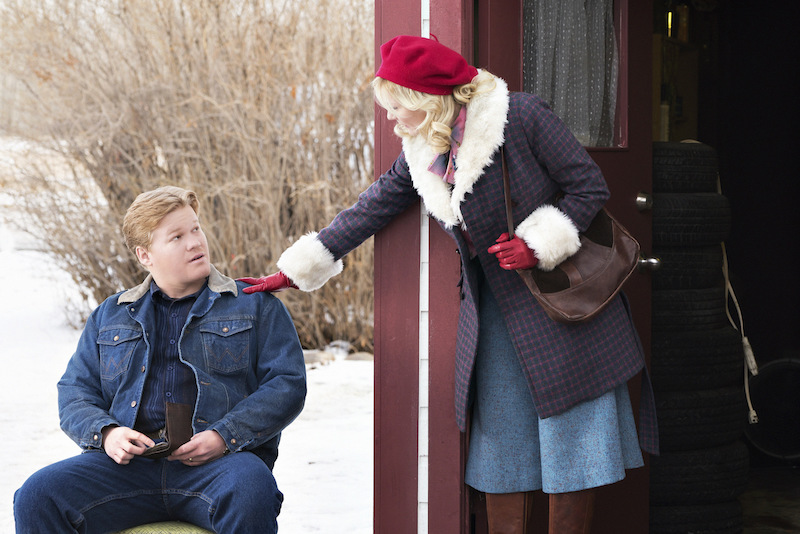
Ed and Peggy Blomquist — the morning after.
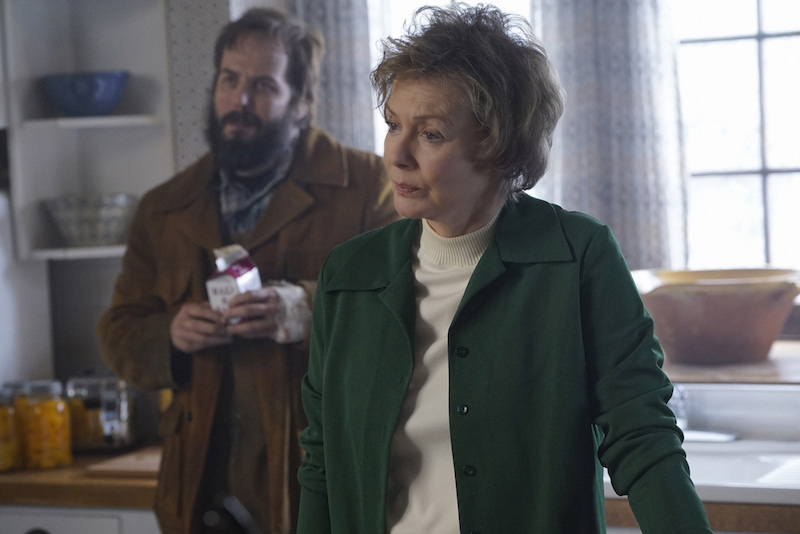
Floyd and Bear Gerhardt — holding the family together.
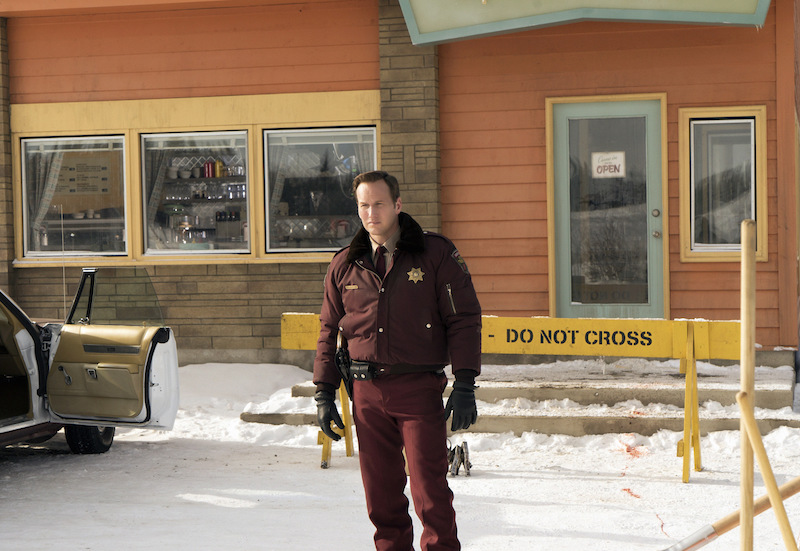
Lou Solverson — following the thread.
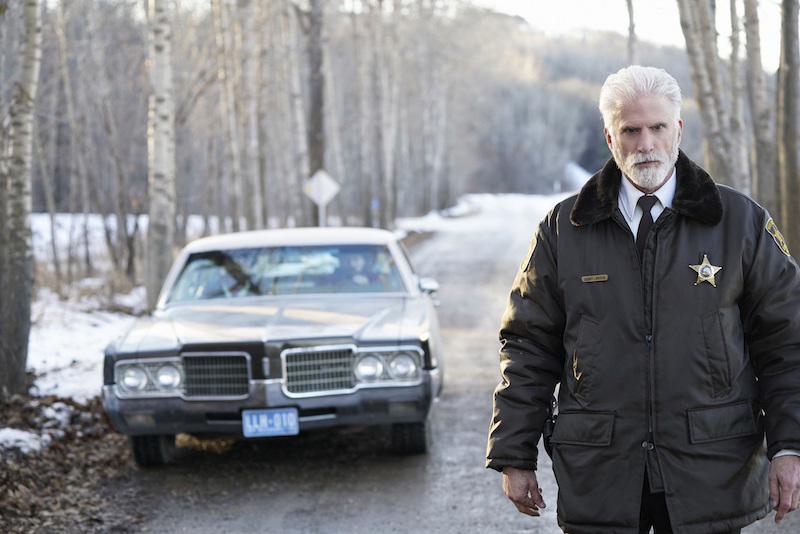
Hank Larsson — watching, waiting.
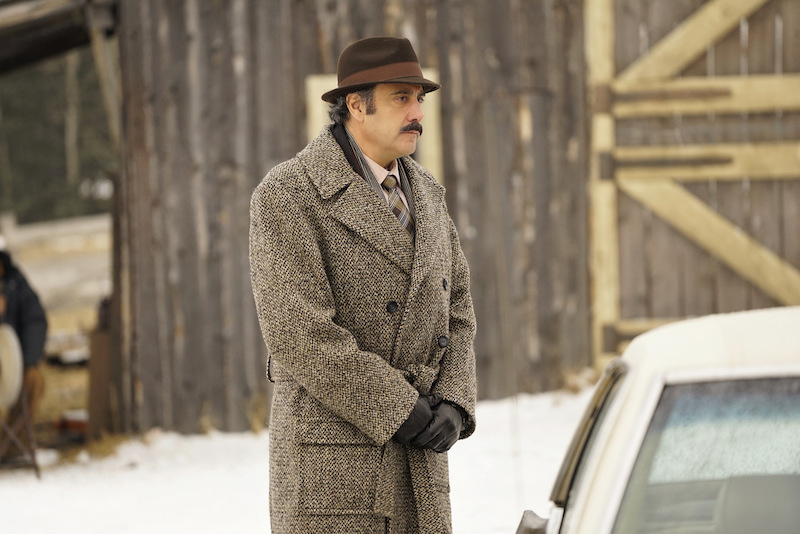
Joe Bulo — Kansas City’s offer on the table.
Episode Summary
Ed discovers Rye is still alive in the garage, and makes a deliberate decision to end it — using the skills he has as a butcher. Peggy processes what has happened with more calm than should be possible, returning to her hairstyle shop as normal. Floyd Gerhardt meets with the Kansas City representatives and refuses their absorption offer — but the meeting reveals her strategic thinking: she is positioning Dodd as heir while keeping family unity as her shield. Lou and Hank continue investigating the Waffle Hut killings. Multiple forces — the Gerhardts, Kansas City, the law — are now searching for Rye, who no longer exists.
The Title
Where it comes from. “Before the Law” is the title of one of Kafka’s most famous parables, embedded inside The Trial (1925) and also published separately as a short piece. A man from the country arrives at a gate guarded by a doorkeeper and asks to enter the Law. The doorkeeper tells him he cannot enter “now, but perhaps later.” The man waits at the gate his entire life, growing old, sometimes bribing the doorkeeper, sometimes pleading. As he is dying, he asks why no one else ever tried to enter. The doorkeeper answers: this gate was meant only for you, and now I am closing it. The parable is about the Law as something that exists, that governs your life, and that you are perpetually stationed in front of — you can neither enter it cleanly nor walk away from it.
Where it lands in the episode. The garage. Ed sits in front of the garage door with Rye still alive inside, and chooses. The threshold is literal: a door, behind which lies the choice that will determine whether Ed can ever return to the social order he was born into. Kafka’s man waits at the gate his whole life and never enters. Ed crosses. The episode is asking which fate is worse: a life spent before a door that never opens, or a single act that closes the door behind you forever.
What the title is doing. Every major character in this episode is positioned “before the Law” in the Kafka sense — in the presence of an authority that governs them but that they cannot fully enter or escape. Floyd is before the Kansas City offer (the corporate law she cannot defeat by family logic). Lou is before the Waffle Hut crime scene (a body of evidence that does not yet resolve into a story). Peggy is before the question of who she actually is. The title positions the episode less as a story about Ed’s choice and more as a structural argument: under conditions of pressure, every character finds themselves at a gate they did not build, and what they do at that gate is the season.
Key Insights
Ed’s decision as calculated love. Finding Rye alive in the garage, Ed faces a genuine fork: retreat into innocence (call it in, face consequences) or commit. He commits — methodically, using exactly the professional skills he has. What makes this moment so precise is that Ed isn’t acting from coldness. He is acting from love and from vision: a future with Peggy, the butcher shop, the ordinary life he’s promised himself. He thought it through and chose the path that preserved the plan. The horror is that the same qualities that make him a good husband — loyalty, deliberateness, willingness to absorb difficulty for the people he loves — are what make him capable of this.
Peggy as the stronger force. Peggy’s calm after the fact is not just disconnection — it has a directive quality. She has processed the event, compartmentalized it, and returned to life. Ed, by contrast, needed to be steadied. There is something in Peggy that leads, even when she isn’t consciously manipulating. Ed’s love for her is so complete that his moral compass follows hers. Whether Peggy is consciously exploiting this is the question the season is building toward.
The dark irony of the search. By episode’s end, multiple forces — the Gerhardts seeking their missing son, Kansas City trying to leverage the situation, Lou and Hank investigating the Waffle Hut — are all looking for Rye Gerhardt. Rye has been processed through the butcher shop. The search is for someone who has already been erased. This is the season’s central dramatic irony operating at full pitch: the world in motion searching for something that no longer exists, because of a decision made in a garage by a man who loves his wife.
Character Readings
Ed Blomquist — The garage scene confirms Ed as a man of action when the people he loves require it. His deliberateness is what distinguishes him from Peggy: where she dissociates, he calculates. He considered the options, weighed the future, and acted. That same quality — methodical, loyal, present — will make him both effective and irredeemable as the season progresses.
Peggy Blomquist — Her return to the hairstyle shop as normal is the episode’s most chilling beat. She is not in denial; she has made a decision about what reality she is inhabiting. In E01 we read her disconnection as a symptom of a broken self. Here it starts to look like something more active: a capacity to choose which version of her life she wants to be living. Ed follows her lead. Whether she knows she’s leading him is an open question.
Floyd Gerhardt — Her meeting with Kansas City shows her strategic mind at full operating capacity. She refuses absorption but doesn’t escalate — she buys time while positioning the family. Her decision to hint to Dodd that “his moment will come” is a calculated move: give the ambitious son a reason to stay loyal by promising him the future he wants. And sending the Apache (Hanzee) to find Rye suggests she knows the family’s emotional weak point is the missing youngest son — she is trying to manage that before Kansas City can exploit it. The most capable person in every room she enters.
Mike Milligan and the Kansas City men — Their approach to the Gerhardts confirms their strategy: find the weakest node (Rye, the youngest, the least disciplined) and apply pressure there. That the weakest node has already been obliterated, unknowingly to them, means their entire opening move has been played against nothing. Kansas City is playing a sophisticated game on a board that has already changed.
Symbols & Motifs
- The garage — threshold space; the site of Ed’s irreversible decision; ordinary domestic space transformed into the place where something fatal happens
- The butcher shop — Ed’s craft turned toward concealment; the professional and the criminal occupying the same hands
- The gate (Kafka) — the Law is present, standing over all characters, but entry is impossible; each character is “before the Law” in their own way
- The search for Rye — dramatic irony as structural device; the season’s central engine running on a body that no longer exists
Open Questions
- Is Peggy consciously leading Ed, or is she simply being herself and he follows? When does she become aware of how much power she holds over him?
- Floyd gave Dodd a hint about his future — does he act on it prematurely, and does that become her undoing?
- What does Hanzee’s role reveal about the Gerhardt family’s actual power structure?
- How does Lou’s reading of the Waffle Hut killings develop — what thread does he pull on?
Conversation
Q: Ed’s decision in the garage. What do you make of that moment?
Quang: It’s a fascinating moment because Ed is completely aware of the weight of his choice. He’s thinking about love, about the future he wants, about the family he’s building, and he still goes through with it. That’s what makes it disturbing: the same sense of responsibility that drives him to protect his future is what leads him to cross the line.
Claude: Ed isn’t acting from coldness. He’s acting from love and from vision. The horror is that the same qualities that make him a good husband are what make him capable of this.
Q: The title “Before the Law” is a direct Kafka reference. What does it suggest?
Quang: The title “Before the Law” frames a moment of tension before a moral boundary. Like Kafka’s parable, it’s about the act of standing in front of the law; it’s not just about the law itself. The door is open, but you’re paralyzed by the uncertainty of the choice. Unlike Kafka’s figure, Ed doesn’t wait. He crosses the line.
Q: Peggy vs. Ed after the fact. Whose coping is more dangerous?
Quang: Ed’s coping is to control the damage and minimize risks. Peggy, on the other hand, acts as if nothing happened, remaining emotionally detached from the accident. Peggy is more dangerous because she lacks guilt, which makes her more likely push things further if the situation escalates.
Claude: Is Peggy a villain or a victim of her own broken self? And does that distinction matter once consequences are in motion?
Quang: At this point, it’s still unclear who Peggy really is. Is she a villain or just a woman shaped by her own broken self? But that distinction stops mattering because Rye is already dead. The damage can’t be undone.
Claude: “Broken self” means: she doesn’t fully inhabit her life. She lives in self-help magazines and fantasies about actualization. That disconnection is what let her keep driving in E01. Whether that excuses anything, no. The more useful question going into E03: does Peggy actually want the future Ed is protecting, or is she just letting him build it while she stays in her head?
Quang: Good catch!
Claude: Ed is burning everything down to protect a future Peggy may not even want. That’s a slow-motion tragedy.
Q: Floyd after the Kansas City meeting.
Quang: I’m confused about her choice after the discussion with Kansas City. A war or follow their lead. She warned the oldest son about “this moment”, and hinted him that his moment will come after that. Then she asked the Apache guy to find Rye. It looks like she wants the family to stay together, to prepare for the upcoming events. At the Kansas City side, they want to separate the Floyd’s family, by approaching the youngest son (the weakest one). And now, many forces have been searching for Rye, who was cut into hundreds of pieces.
Claude: Kansas City is playing a sophisticated game on a board that has already changed. Their entire opening move was played against nothing.
Connected Pages
- Fargo S02 — season context, character profiles, themes
- Fargo S02E01 - Waiting for Dutch — E01 analysis: dissociation, UFO, the Reagan cold open
- Fargo (TV Series) — series overview