Season Summary
Set in the autumn of 1979 in Luverne, Minnesota and Fargo, North Dakota, Season 2 is widely considered Fargo’s finest. It is simultaneously a crime thriller, a meditation on American mythology, and a portrait of a marriage under impossible pressure. The scale is larger than Season 1 — two crime organizations, a dozen significant characters, a decade’s worth of cultural anxiety compressed into ten episodes — yet the show never loses sight of its human center: an ordinary couple who made one terrible decision and cannot find their way back.
The season is a prequel in relation to Season 1 — Lou Solverson here is a young state trooper, the father of Molly Solverson who anchors the first season. This continuity is used lightly; S02 stands completely alone, but knowing that Lou survives this world and raises a good daughter gives his moral seriousness a particular weight.
Visually and tonally, this is the most ambitious season. The Coen Brothers’ influence is most explicit here — Blood Simple, No Country for Old Men, and True Grit all cast shadows. But the season also engages deeply with the American Western as a myth, beginning with an extraordinary cold open on a film set where Ronald Reagan is shooting a Western in 1979 — the man who will shortly remake America as a cowboy president, performing the cowboy mythology that made him.
Central Conflict
The Gerhardt family — a multi-generational Midwestern crime empire based in Fargo — is in crisis. Patriarch Otto Gerhardt has a stroke, leaving matriarch Floyd to hold the family together while her sons fight over succession. Into this fragile moment, the Kansas City Syndicate sends emissaries to absorb the Gerhardt operation. Floyd refuses.
This war is triggered, accidentally, by Rye Gerhardt — the youngest son, trying to collect a debt — who witnesses a UFO, kills three people at a waffle house in a fugue state, and then is hit by Peggy Blomquist’s car as he stumbles onto the highway. Peggy drives home with him embedded in her windshield. Her husband Ed helps cover it up. The Gerhardts are now looking for a missing son. The Kansas City men are circling. Lou Solverson is trying to figure out what happened at the waffle house. These threads converge slowly, then all at once.
Key Characters
Peggy Blomquist (Kirsten Dunst) — Beautician in Luverne. Hits Rye with her car and keeps driving. She is the most complex character in the season: capable of cold pragmatism in a crisis, but also genuinely lost — absorbed in self-help seminars and magazine clippings about “actualization,” pursuing a self she can’t quite name. Her central contradiction: she wants to be more than her life, but her pursuit of that more leads her into something far worse.
Ed Blomquist (Jesse Plemons) — Butcher. Peggy’s husband. A man of almost no imagination who loves Peggy with his whole self and will do anything to protect her and the life he’s imagined for them. His simplicity reads as both touching and terrifying — he covers up a murder with the same methodical calm he applies to meat processing.
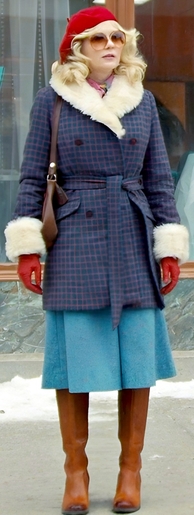
Peggy Blomquist — the season’s most complicated figure.
Lou Solverson (Patrick Wilson) — Minnesota State Trooper. Vietnam veteran. The moral center of the season and, arguably, the whole series. He sees clearly, acts rightly, and cannot make the people around him do the same. His wife Betsy is dying of cancer; he carries this quietly.
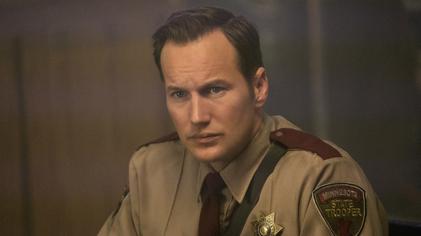
Lou Solverson — the man who sees clearly in a world that doesn’t.
Hank Larsson (Ted Danson) — Luverne Sheriff, Lou’s father-in-law. Older, gentler, haunted by something from his past. A foil to Lou: where Lou is direct, Hank meanders toward wisdom.
Floyd Gerhardt (Jean Smart) — Gerhardt matriarch. Steps into power when Otto has his stroke. Steely, pragmatic, completely committed to family survival. The most capable person in the Gerhardt organization by far — which makes her sons’ usurpation attempts both predictable and tragic.
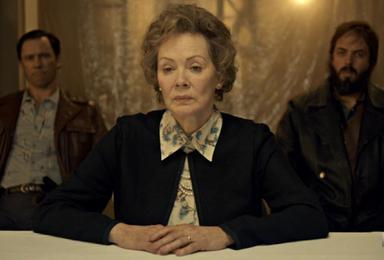
Floyd Gerhardt — the only one who could have held it together.
Dodd Gerhardt (Jeffrey Donovan) — Eldest Gerhardt son. Brutal, impatient, convinced he should be in charge. His violence is never strategic; it’s an expression of ego. Foil to Floyd in every way.
Bear Gerhardt (Angus Sampson) — Middle son. Loyal to family above all, including above self-interest. The most genuinely dangerous Gerhardt because he isn’t driven by ambition — only by grief and duty.
Rye Gerhardt (Kieran Culkin) — Youngest son. Dead by the end of episode one, but his absence drives the entire season. A small man trying to play a big game, who encountered something he couldn’t process.
Mike Milligan (Bokeem Woodbine) — Kansas City’s chief enforcer. Philosophical, literary, charismatic, and profoundly dangerous. He quotes poetry and kills people without apparent affect. The season’s most entertaining character; also its most unsettling portrait of corporate violence.
Karl Weathers (Nick Offerman) — Local lawyer and town drunk. Provides comic relief and unexpected moments of genuine courage.
Simone Gerhardt (Rachel Keller) — Dodd’s daughter. Playing both sides. Her betrayal of family is presented as simultaneously understandable and catastrophic.
Themes
- The American West as myth and lie — the season opens on a Western film set and never lets go of the idea that America runs on stories about itself that are fundamentally false; Reagan as the apotheosis of this
- Ordinary life and extraordinary violence — the Blomquists are the show’s proof that evil doesn’t require evil people; circumstance and self-deception are sufficient
- Masculinity and succession — the Gerhardt sons are studies in different failure modes of patriarchal inheritance; Floyd, a woman, is the only one who could have led
- The unknowable — the UFO; the universe that doesn’t explain itself; Hank’s secret project; fate operating beyond human comprehension
- Corporate vs. family crime — Kansas City represents the future (organized, rational, impersonal); the Gerhardts represent the past (family loyalty, honor, territory); the future wins, and it’s not uplifting
- Complicity and escalation — every character is one decision away from a different life; no one can find that decision after they’ve passed it
Episode Guide
| Ep | Title | Brief Description |
|---|---|---|
| E01 | ”Waiting for Dutch” | Rye Gerhardt visits the Waffle Hut, encounters a UFO, kills three people, gets hit by Peggy’s car. Lou investigates. The war begins. |
| E02 | ”Before the Law” | Ed discovers Rye in the garage and makes a decision. Floyd meets with Kansas City. Lou and Hank investigate the Waffle Hut killings. |
| E03 | ”The Myth of Sisyphus” | Hanzee tracks Rye’s trail. Lou confronts Floyd in Fargo and Mike Milligan in a parking lot. Charlie asks to join the family business. Simone begins her revolt. |
| E04 | ”Fear and Trembling” | 1951 cold open: Otto makes young Dodd a killer. KC ambushes Otto. Floyd’s counter-offer fails. Hanzee finds Rye’s belt buckle in the Blomquist fireplace. Lou warns Ed and Peggy. Floyd: “prepare for war.” |
| E05 | ”The Gift of the Magi” | Gerhardts ambush KC. Reagan campaigns. Charlie’s hit on Ed fails; Ed burns the shop. Karl talks the Gerhardts off the Blomquist porch. The war begins. |
| E06 | ”Rhinoceros” | Bear comes to the station for Charlie. Karl holds the door with law. Lou holds the cell. Dodd corners Peggy and loses to a cattle prod. Hanzee tracks Ed into the woods. KC hits the Gerhardt farm. |
| E07 | ”Did You Do This? No, You Did It!” | Cold-open assassination of KC management. Floyd is released by state authority. Bear executes Simone in the woods. Mike kills the Undertaker. Karl visits dying Betsy. Ed delivers Dodd to Mike as leverage. |
| E08 | ”Loplop” | Cabin bottle episode. Peggy hallucinates the seminar’s voice as a man named Albert. She stabs Dodd. Hanzee, humiliated in a bar, breaks from the family and shoots Dodd to save Peggy. Lou and Hank corner the Blomquists. |
| E09 | ”The Castle” | Kafka-titled climax narrated as a chapter from a true-crime book. Hank cannot reach the institutional castle; the Gerhardts reach the motel castle and die in it; Kansas City refuses to enter and walks home. The UFO returns at the peak of the parking-lot massacre and only Peggy does not look up. |
| E10 | ”Palindrome” | Finale. Ed dies in a freezer; Peggy is arrested. Hank reveals the pictograph project, the season’s literal palindrome — meaning that reads the same in any direction. Mike Milligan is rewarded with a desk and a haircut policy; Hanzee receives a new face and a new name. Lou comes home to Betsy and Molly. The household holds. |
Episode pages will be created by
/watchafter analysis sessions.
See Also
- Fargo (TV Series) — series overview
- Sensemaking and Civilization — American mythology, institutional violence