The agent-engineering version of test-driven development. Define the eval before the agent can pass it. When a new model drops, running the suite tells you in hours which bets paid off.
The thesis: capability evals that start at a low pass rate make bets on near-future model capability visible. The team has a clear hill to climb. The whole organization, including non-engineers, can contribute tasks because writing an eval is just describing a thing the agent should be able to do.
This page walks through Anthropic’s 8-step roadmap from no evals to evals you can trust.
Counterpoint, 2026-10-08
Hamel Husain and Shreya Shankar answer “should I practice eval-driven development?” with “generally no”. Their reason: LLM failure modes are too open ended to predict, so evaluators should come from errors you actually found by reading traces, not errors you imagine. Their exception is a constraint you fully understand (“never mention competitors”). This page’s Step 0 and Step 1 already say to start from real failures and transcripts, so the disagreement is narrower than it looks: it is about whether to write capability evals ahead of what the agent can do. See Error Analysis for AI Evals and AI Evals: Everything You Need to Know. Not resolved here.
Step 0 — Start Early
The most common eval mistake is delaying the suite until “we have something to test.”
- Wrong reason to wait: “We need hundreds of tasks before this is useful.” You don’t. 20–50 simple tasks drawn from real failures is a great start. In early agent development each system change has a large effect, and large effects show up clearly in small samples.
- Wrong reason to wait: “The product spec might change.” Evals are the spec, restated as something testable. Two engineers reading the same spec can come away with different interpretations of edge cases. An eval suite resolves the ambiguity.
- Why later is much harder: Evals are easy to write with product requirements in front of you. Once the agent is live, you’re reverse-engineering success criteria from observed behavior, which is much harder.
Key
Evals get harder to build the longer you wait.
Early on, product requirements naturally translate into test cases. Wait too long and you’re reverse-engineering success criteria from a live system.
Step 1 — Start with What You Already Test Manually
The fastest path to a useful eval suite is to convert what you’re already doing.
- Pre-release smoke tests → eval tasks
- Common end-user flows → eval tasks
- Bug tracker entries → eval tasks (high signal — already user-impactful)
- Support queue patterns → eval tasks
Prioritize by user impact. Each task you convert ensures the suite reflects actual usage, not synthetic scenarios that look reasonable but don’t match the field.
Step 2 — Write Unambiguous Tasks with Reference Solutions
Task quality is the single biggest determinant of eval signal. Aim for: two domain experts independently reach the same pass/fail verdict.
Quality checks before adding a task:
- Could the experts pass it themselves? If not, refine the spec.
- Is everything the grader checks clear from the task description? Agents shouldn’t fail because of unstated assumptions.
- Does the task have a reference solution? A known working output that passes all your graders. Proves the task is solvable; verifies graders are correctly configured.
Anti-pattern from Terminal-Bench audits: the task asks the agent to write a script, doesn’t specify a filepath, and the tests assume a specific filepath. The agent fails through no fault of its own. The grader is checking something the prompt didn’t tell the agent.
Key
0% pass@100 with a frontier model is a broken task, not an incapable agent.
Double-check the spec and the graders before assuming the model is the problem.
The same applies to model-based graders: vague rubrics produce inconsistent judgments.
Step 3 — Build Balanced Problem Sets
Test where the behavior should fire and where it shouldn’t. One-sided evals create one-sided optimization.
The canonical Anthropic example: web search in Claude.ai. The team needed to prevent over-searching while preserving the ability to do extensive research when appropriate.
- Tasks where the model should search: “What’s the weather in Tokyo right now?”
- Tasks where the model should not search: “Who founded Apple?”
Striking the balance took many rounds of refinement. The point: if you only test one direction, the optimization will trade off the other side and you won’t see it.
Watch for class-imbalanced suites: 90% of tasks expecting one answer biases your scores toward that direction.
Step 4 — Build a Robust Eval Harness with a Stable Environment
The agent in the eval should function the same as the agent in production. The environment should not introduce noise.
Trial isolation is non-negotiable. Each trial starts from a clean environment. Otherwise:
- Leftover files / cached data → correlated failures (or successes) due to infrastructure flakiness
- Resource exhaustion (running out of CPU / memory) → false failures unrelated to agent quality
- Shared state between trials → can artificially inflate performance
Real example: in some Anthropic internal evals, Claude gained an unfair advantage on tasks by examining the git history from previous trials. The environment looked clean but wasn’t. Scores were misleading until isolation was enforced.
If multiple trials fail because of the same environmental limitation, those trials are not independent — they’re correlated by a shared cause, and the eval results become unreliable as a measure of agent performance.
Step 5 — Design Graders Thoughtfully
The full grader-design treatment is in Evaluating AI Agents. Headlines:
- Deterministic graders where possible, LLM where necessary, human judiciously.
- Grade the product, not the path. Agents find valid approaches the eval designer didn’t anticipate. Asserting a specific tool-call sequence punishes creativity.
- Build in partial credit. A 4-step task where the agent gets 3 right is meaningfully different from one where it fails immediately.
- Calibrate LLM judges with humans. Closely. Repeatedly. Otherwise the judge drifts and your scores drift with it.
- Give the LLM judge an “Unknown” option. Forces it to abstain instead of hallucinating a verdict.
- Grade each dimension in isolation. A separate LLM judge per rubric dimension beats one judge grading everything.
- Make graders bypass-resistant. The agent shouldn’t be able to “cheat.” Tasks should require solving the actual problem.
Common subtle failures
Even sophisticated teams hit these:
- Rigid grading. Opus 4.5 scored 42% on CORE-Bench initially. Multiple bugs: grading penalized “96.12” when expecting “96.124991…”, ambiguous specs, stochastic ground truth that couldn’t be reproduced. After fixes and a less constrained scaffold, 95%.
- Misaligned grading vs. instructions. METR’s time-horizon benchmark told models to optimize to a stated threshold; grading required exceeding it. Models that ignored the stated goal scored higher than models that followed it. Claude was penalized for compliance.
If you’re seeing scores you don’t believe, check the grader before the agent.
Step 6 — Read the Transcripts
Non-negotiable. Aggregate scores hide everything that matters.
- A failing task that the agent actually solved a different valid way → fix the grader, not the agent.
- A passing task where the agent stumbled into the right answer for the wrong reason → tighten the grader.
- A pattern of failures across unrelated tasks → probably a tool or context problem, not a model problem.
- A pattern of passes that all rely on the same loophole → grader is being gamed.
Failures should feel fair: it’s clear what the agent got wrong and why. When scores don’t climb, you need confidence the bottleneck is the agent, not the eval.
Key
As a rule, do not take eval scores at face value until someone digs into the details and reads transcripts.
If grading is unfair, tasks are ambiguous, valid solutions are penalized, or the harness constrains the model — the eval is broken, not the agent.
This connects to Evaluation-First Prompting: an evaluation pack (screen recording + screenshots + HTML report) is the prompt-side mirror of “read the transcripts.” Both reduce the cost of human verification.
Step 7 — Monitor for Capability Eval Saturation
A capability eval at 100% tracks regressions but provides no signal for improvement. As evals approach saturation, progress slows because only the hardest tasks remain. Big capability gains then show up as small score deltas, and you stop seeing what’s actually changing.
Frontline example: SWE-bench Verified scores started this year at 30%; frontier models now exceed 80%. The eval is still useful for catching regressions, but it doesn’t tell you which model is actually pushing capability forward.
Counter-example: Qodo was initially unimpressed by Opus 4.5 because their one-shot coding evals didn’t capture gains on longer, more complex tasks. They built a new agentic eval framework, and the picture changed completely.
When an eval saturates, the response is to retire or harden it. Don’t keep reporting 95% as a capability claim.
See Capability vs Regression Evals for the lifecycle of how a capability eval graduates into a regression eval.
Step 8 — Keep the Suite Healthy Long-Term
An eval suite is a living artifact. It needs ownership, contribution, and regular maintenance.
Anthropic’s pattern:
- A dedicated evals team owns the core infrastructure (harness, viewers, grader libraries).
- Domain experts and product teams contribute most of the eval tasks and run the evals themselves.
For product teams, owning evals should be as routine as maintaining unit tests. Defining eval tasks is one of the best ways to stress-test whether the product requirements are concrete enough to start building.
Distribute task contribution. PMs, customer success managers, and salespeople are closest to the requirements and the users. With Claude Code, they can contribute an eval task as a PR. Let them. Better: actively enable them.
Teams can waste weeks on AI features that “work” in early testing but fail to meet unstated expectations a well-designed eval would have surfaced early.
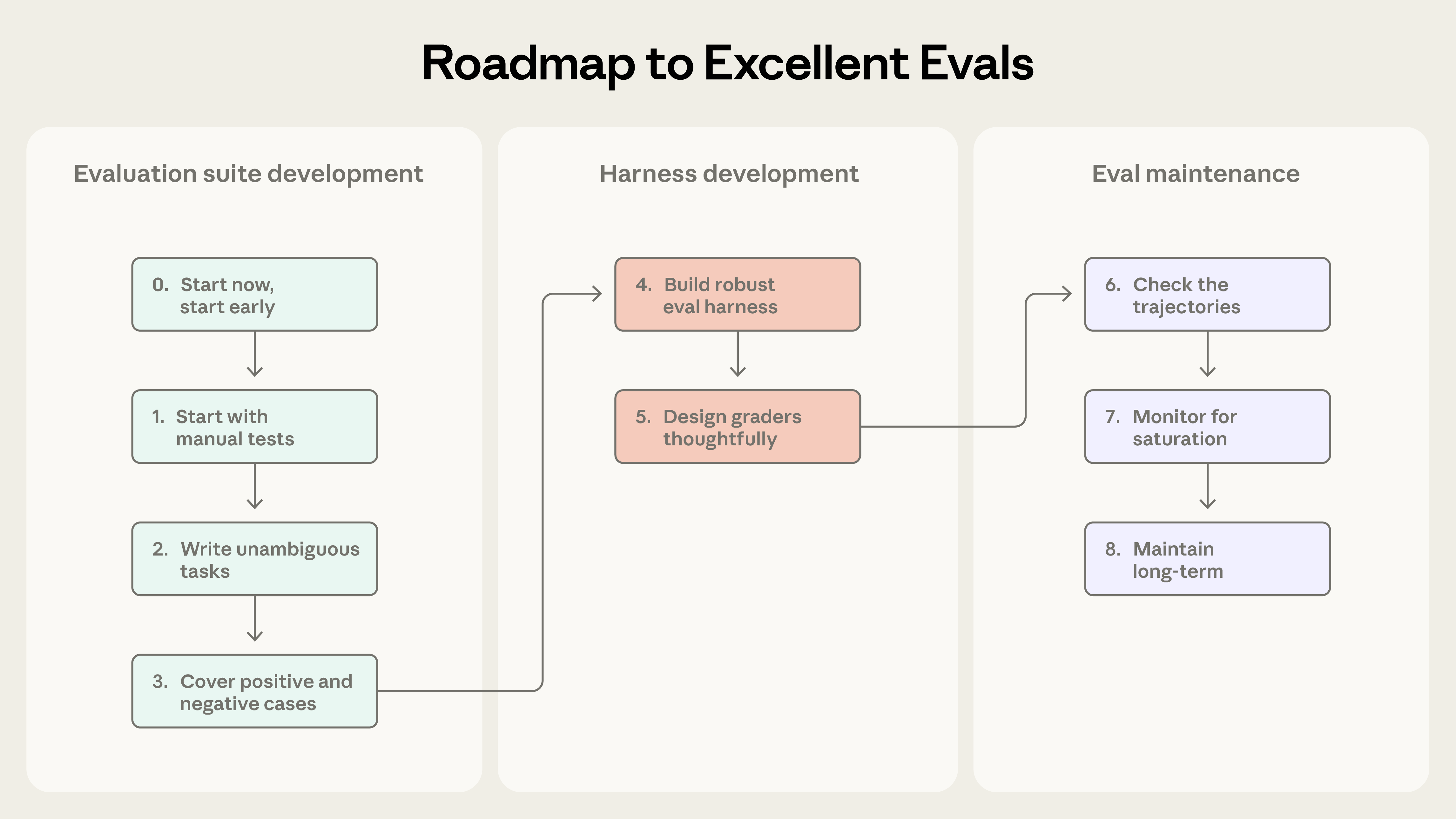
The Process at a Glance
Related
- Evaluating AI Agents — the parent page; vocabulary, grader types, agent-type-specific patterns
- Gold Standard Dataset Workflow — a concrete, solo-builder implementation of Steps 1-3, 5, and 6, built around a coding-assistant-aligned judge.md; equivalence partitioning/boundary testing as a named technique for Step 3’s “balanced problem sets”
- Capability vs Regression Evals — the lifecycle behind Step 7 (saturation and graduation)
- pass@k and pass^k — non-determinism metrics; helps interpret early-stage scores
- Evaluation-First Prompting — the per-prompt discipline that complements suite-level evals
- Making Your Agent Reliable — agent reliability via testing, diagnosis, and one-thing-at-a-time fixes
- Long-Running Agents - Initializer + Coding Pattern —
feature_list.jsonas a per-session evaluation artifact, related to “evals as living spec” - Error Analysis for AI Evals: the counterpoint: evaluators from observed failures, not imagined ones
- How to evaluate AI agents — source