The companion to Claude Code Team Code Review: how the Claude Code team gives agents ways to check their own work, from Addy Osmani (How the Claude Code team thinks about verification, November 2026). The central claim is about scale: without verification loops you can run one or two agents, because you check everything yourself; with them you can run dozens.
Two supporting points. Verification that used to be expensive (tests, benchmarks, specs, end-to-end runs) is now cheap to ask an agent for, and once written it runs as ordinary software at almost no token cost. And Anthropic reports that a separate grader checking work against a rubric raised task success by up to 10 points on structured file generation, most on the hardest problems.
Three kinds of test worth the investment
First, two failure modes to avoid in any test: flaky tests teach the agent to re-run instead of fixing the code; slow tests mean fewer runs and harder-to-locate failures (run heavy ones before committing).
| Test | What it does | Why it suits agents |
|---|---|---|
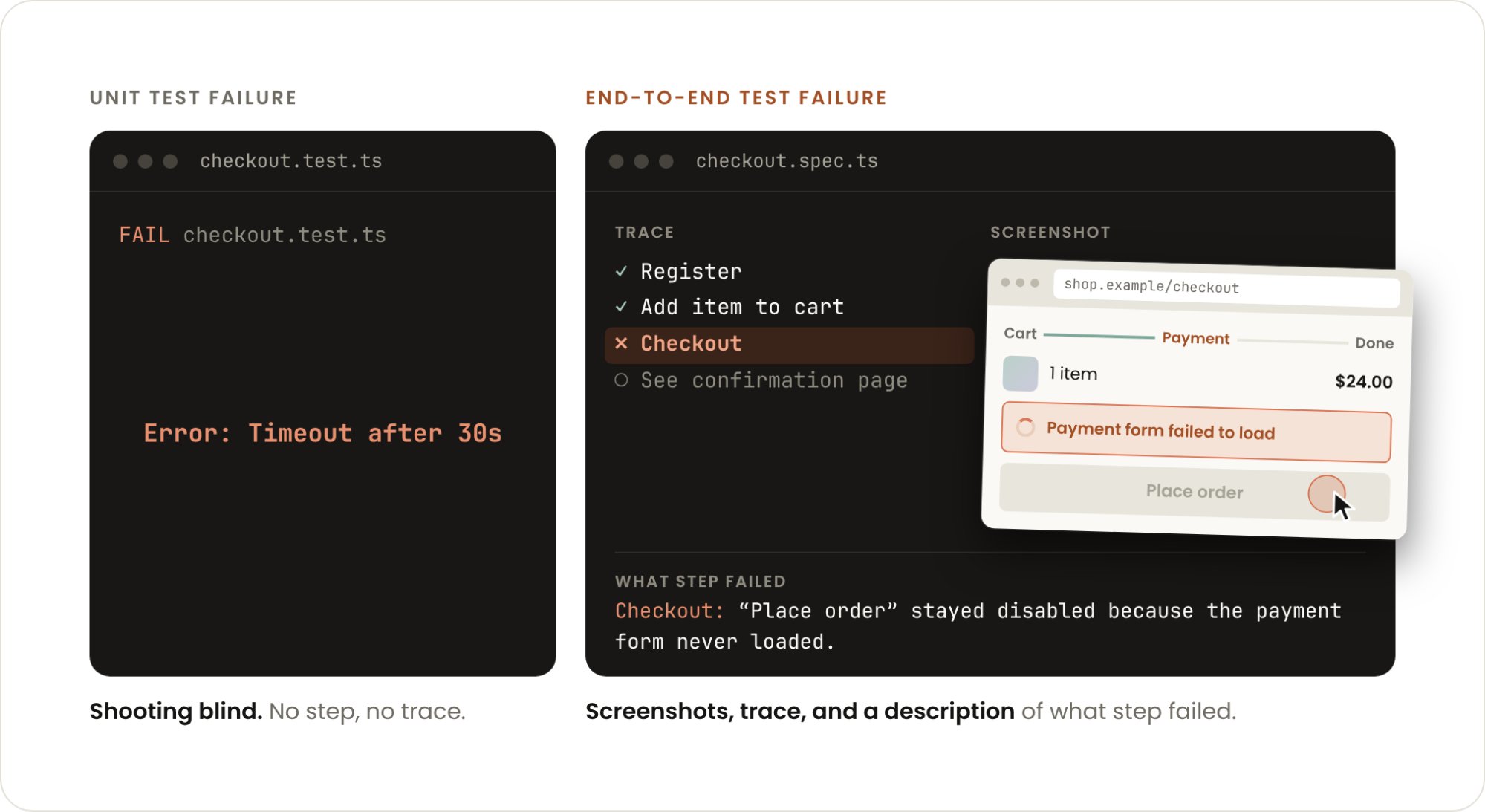
| End-to-end (pick this if only one) | Drives a real user flow: add to cart, check out, see confirmation. | Hard to fool: the feature works or it does not. A unit test says “timeout after 30 s”; an E2E run can return a screenshot of what broke. Unit tests can pass while the feature is broken, because neither the agent nor the test grasps the whole task. Give the agent hands and eyes via a skill that boots and drives the app (Chrome DevTools Protocol, simulators, API harnesses). A feature map (paths, shortcuts, selectors, expected results) doubles as guide and grading rubric. |
| Property tests | State something that must always hold, let a library (fast-check, Hypothesis, proptest) throw thousands of inputs at it. | Edge cases are where agents fail, and generated inputs do not share the agent’s blind spots. Common properties: round-trip (encode then decode gives the original), invariants (“balance never negative”), idempotency (doing it twice equals once), equivalence (optimised code matches the naive version). Useful for rewrites where the spec has drifted from production. |
| Differential tests | Run the old and new system on the same inputs; any difference is a bug or a breaking change. | The old system is the oracle, ideal for migrations. Use random inputs or sampled production traffic, normalise noise like whitespace, keep a list of approved differences. See Agentic Porting Workflow. |
How the team does it
Verification means running the change. Running the app end to end matters more than tests. Web changes through the Chrome extension, mobile through an iOS or Android MCP, desktop through computer use, backend by running the service locally. Codify it as a verify skill in .claude/skills/, as close to the relevant code as possible, as many as needed; Claude uses it before committing. Then make that skill fast and reliable: it is your smoke-test harness.
Failing checks decide what needs a person. Claude runs the checks and fixes failures; still failing after three rounds, it stops and brings in a human. Failures, not reading, route human attention.
Code owners write their own checks and tune them until they flag what the owner would flag. A check that pulls in a reviewer must say why.
Reliability checks trigger on the diff. A 39-item checklist, each item with a trigger readable from a diff, the check, and the incidents behind it. Example: “—resume loads old transcripts”: when session storage changes, does a new field load safely from older transcripts that lack it? Claude matches triggers against the diff and runs only the 3 to 10 that apply, so nobody has to remember past outages. This is the cheapest idea in the post to copy.
One reviewer, several rounds. They do not add reviewers; a second, costlier reviewer is often worse than tuning the main one with a REVIEW.md of what matters in this code. Each round gets context from earlier rounds and past failures instead of starting fresh.
Changes cannot modify their own checks. Code Review reads REVIEW.md from the base branch, never from the PR. Gate rules live where the change cannot touch them. A review is tied to a commit; if someone pushes during review, the result is void. Cheap checks first: tests, build and lint run before a PR, enforceable by a hook or a /goal of a passing suite.
New gates start in observe mode. Every commit is stamped with how it was verified, including “none”, so unverified commits can be queried. A commit gate (off, observe, enforce) can block commits from sessions that never ran /code-review or /verify. Observe logs what would have been blocked so false positives are found first. Enforce allows an explanation in the commit message, and after two blocks in one session lets the next through so Claude does not get stuck.
Review the reviewers. Track reverts, changes rejected by maintainers, and a size-matched set of changes that stayed clean. The formal eval: rebuild the repo at review time for each past incident, give a one-sentence answer key, score only findings that describe that bug, use stable merged changes as a control for over-flagging, keep the tuning set separate from the test set. Measure recall at three stages (raw findings, after verification, final review) to see where found bugs get lost; one end-to-end score hides this. Severity matters too (must-fix, should-fix, nit), and recall is tuned only until further gains would be overfitting to the eval. Compare Capability vs Regression Evals, LLM-as-Judge Calibration and Error Analysis for AI Evals.
Turn misses into rules, with a filter. Two routes:
- Mine human review comments and reverts for patterns. A candidate rule must appear in at least two PRs and be detectable from a diff; three agents try to disprove it; a human approves it in a PR.
- Replay three bug finders on a PR tied to a known incident. If two of three find the bug, it is detectable; if the bug is missed on a small diff, that gap becomes a REVIEW.md rule.
Flaky tests: Claude may not skip, add sleeps or retry until green. If it cannot find the root cause it deletes the test and writes down why. And rules get pruned on a schedule, because test suites and .md files only grow if you let them.
The summary rule
Treat the verification layer as a system
Keep it out of reach of the changes it judges, grade it against the bugs that mattered, write down lessons when it misses, and prune those lessons so they stay worth running.
Your job then shifts from reading every diff to defining “done” and reviewing evidence.
Where this adds to the vault
- The Ratchet - Every Mistake Becomes a Rule gains a quality gate: a mistake becomes a rule only if it recurs (two PRs), is diff-detectable, survives three disproval attempts and gets human approval. That answers the rule-bloat risk in Curse of Instructions, together with scheduled pruning.
- Verification Bottleneck gets concrete widening moves: E2E first, property and differential tests, diff-triggered checklists, failures as the router for human attention.
- “Checks out of reach of the change” is the same principle as keeping evaluators separate from what they judge in Agent Security and Threat Model and Cross-Modal Evaluation.
- The three-round stop matches the convergence cap in Claude Code Team Code Review.
Contradiction with Agentic Code Review
“One reviewer, tuned” conflicts with Agentic Code Review’s “run two heterogeneous reviewers”. Details and a partial reconciliation on Claude Code Team Code Review.
How much weight to give this
- Written by a member of the team about its own products (Code Review,
/goal, Chrome extension, Managed Agents); several links are product docs. - The “up to 10 points” grader result comes from internal testing on one task type, cited from a product post. No other numbers.
- The test-type advice (E2E, property, differential) is standard engineering practice, well supported outside this source.
Related
- Claude Code Team Code Review, Critical Thinking with Agents, Agentic Code Review
- Evaluation-First Prompting, Loop Engineering, Dynamic Workflows in Claude Code
- AI Agents
Sources
- How the Claude Code team thinks about verification: “How the Claude Code team thinks about verification” (Addy Osmani, X Article, 2026-11-17)