How the team that builds Claude Code reviews code when Claude writes about 90% of it, as told by Addy Osmani (now on that team) in a rewrite of Anthropic’s own post (How the Claude Code team does code review, October 2026). The most concrete published example in this vault of review at agent scale, with numbers.
The headline
Between June and September 2026, merged PRs to Claude Code more than doubled while the share of PRs that had to be reverted fell by more than 40%. Anthropic’s monorepo went from about 2,500 merged changes a day in May to over 30,000 in September. They did not stop reviewing; they moved most of the reading to machines and spent human time where it matters.
Reframing what review is for
Review has two jobs: catch bugs before they ship, and spread understanding of the codebase. For the first, they replace “did someone read the code?” with a sharper question:
What could go wrong with this change, and what check, automated or human, is the right one to catch it?
Review also moved earlier: it runs continuously while writing, “like a spellcheck”, so most changes have been reviewed and fixed by Claude at least once before a person sees them.
The goal and its guardrail. Most PRs should merge with at most one person in the loop (who may be the author), without more reverts or incidents. They count human time on both sides: time reviewing and time fixing bugs that slipped through. Measured by median and p95 human approvals per PR, human comments, and time waiting on a person; revert and incident rates are the guardrail. If those rise, human time was moved, not saved.
Layers, not one gate
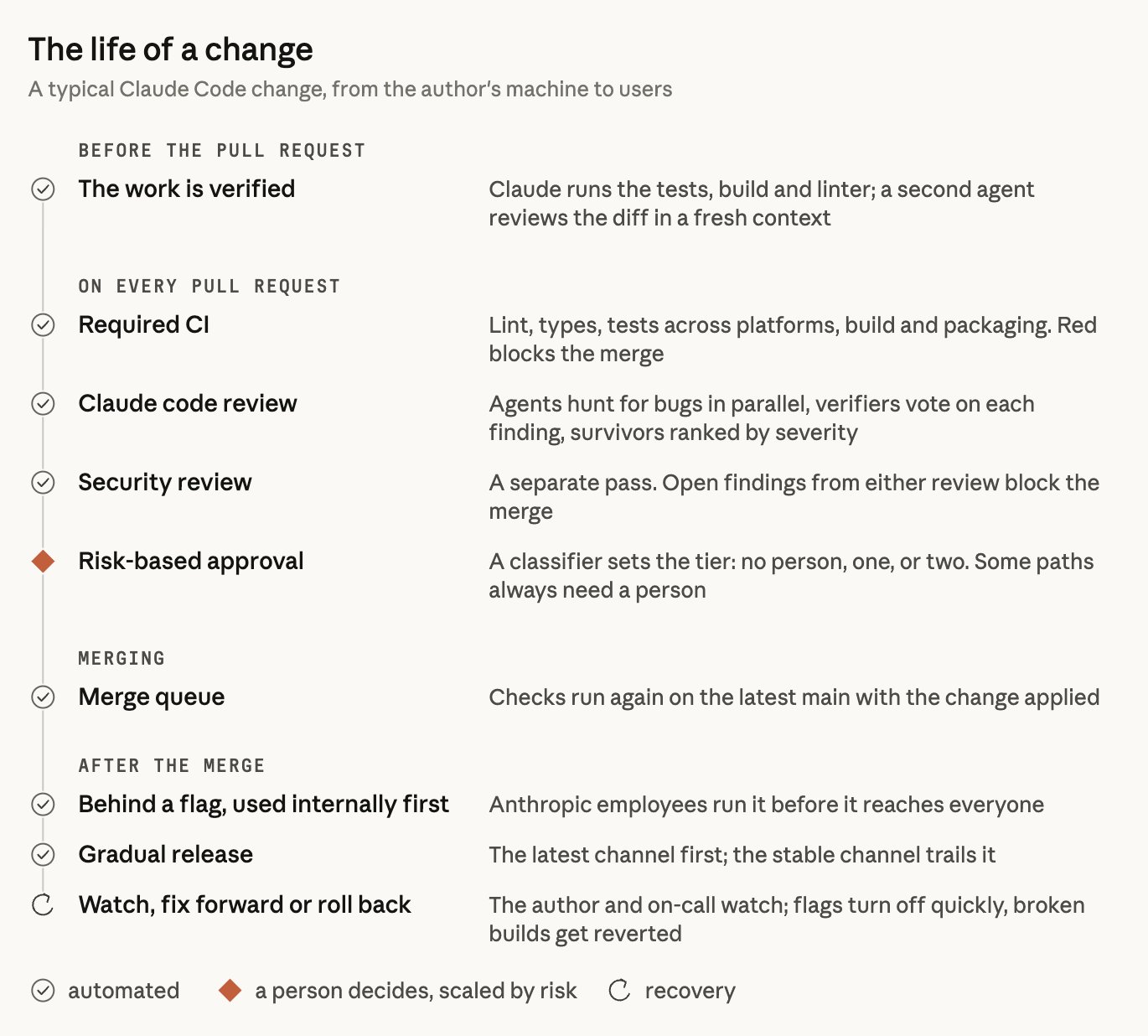
| # | Layer | What happens |
|---|---|---|
| 1 | Pre-PR verification | Claude must show a result (tests, build, screenshot against the design), then a fresh-context subagent reviews the diff. Many also run internal skills: bug hunt, diff reduction, end-to-end check, UI-against-guidelines. Boris Cherny estimates a verification process improves output quality 2 to 3 times. |
| 2 | AI review on every PR | Diff checked against the whole codebase and the stated intent. Parallel agents hunt bugs, a vote filters false positives, style-only findings are dropped (A/B tested first). Findings are tagged Important, Nit or Pre-existing. Every finding must be fixed or resolved with a reason; agents often fix overnight. Share of PRs with substantive comments went from 16% to 54%. |
| 3 | Security review that blocks | Open findings block the merge; auto-closed when a later commit fixes them. |
| 4 | Blocking CI | Lint, types, tests on all platforms, build. PR template asks how it was tested and how to revert. |
| 5 | Human approval scaled by risk | See the tiers below. |
| 6 | Merge queue, flags, staged rollout | Checks rerun on main with the change applied; features behind flags, employees first; “latest” channel before “stable”. |
| 7 | Fast feedback and rollback | Flags switch off without a deploy; weekly on-call; incident reviews ask which layer should have caught it. |
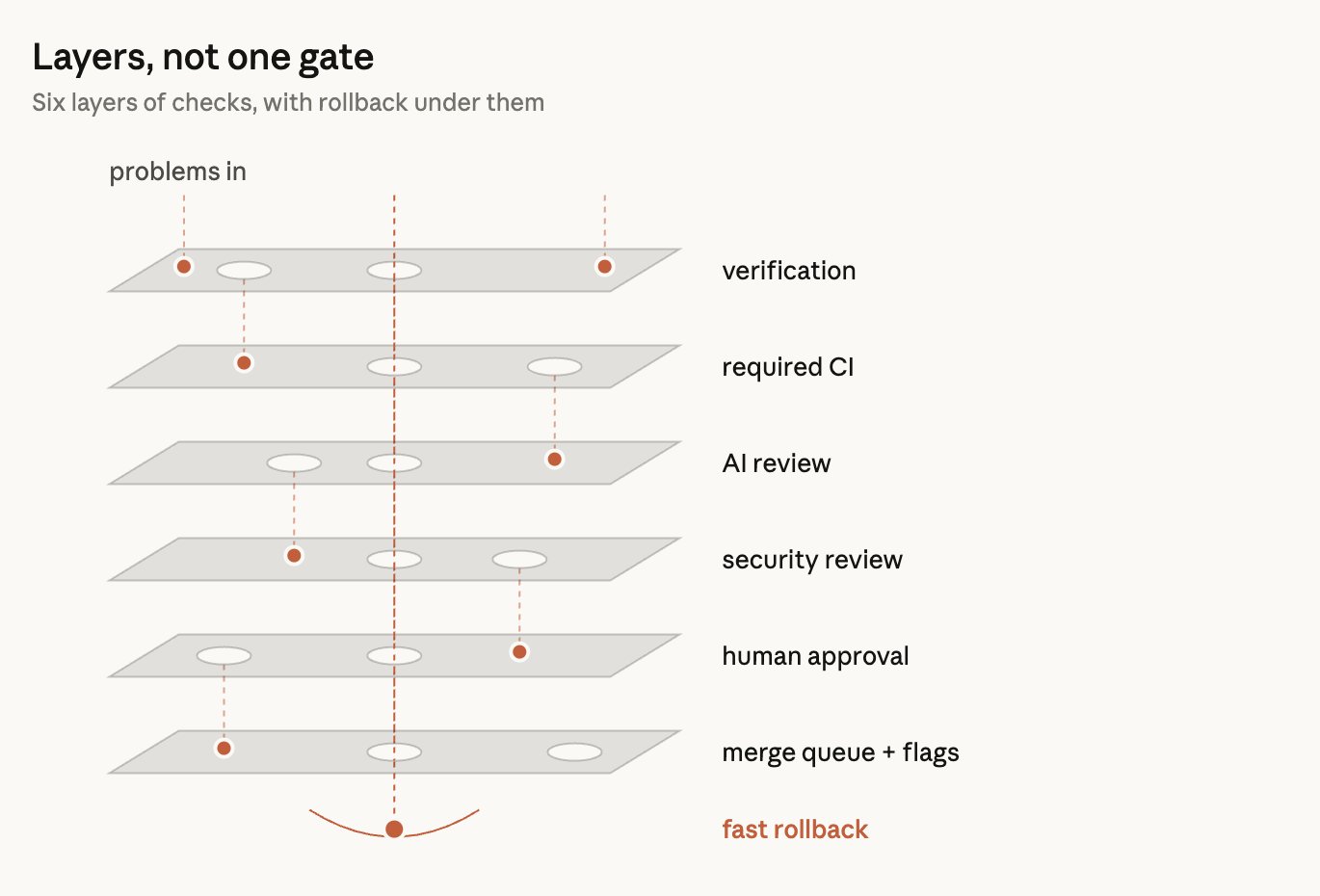
Each layer misses some bugs; few get through all of them; rollback catches the rest. This is defence in depth applied to review, and it is why no single gate has to be perfect.
Approval tiers
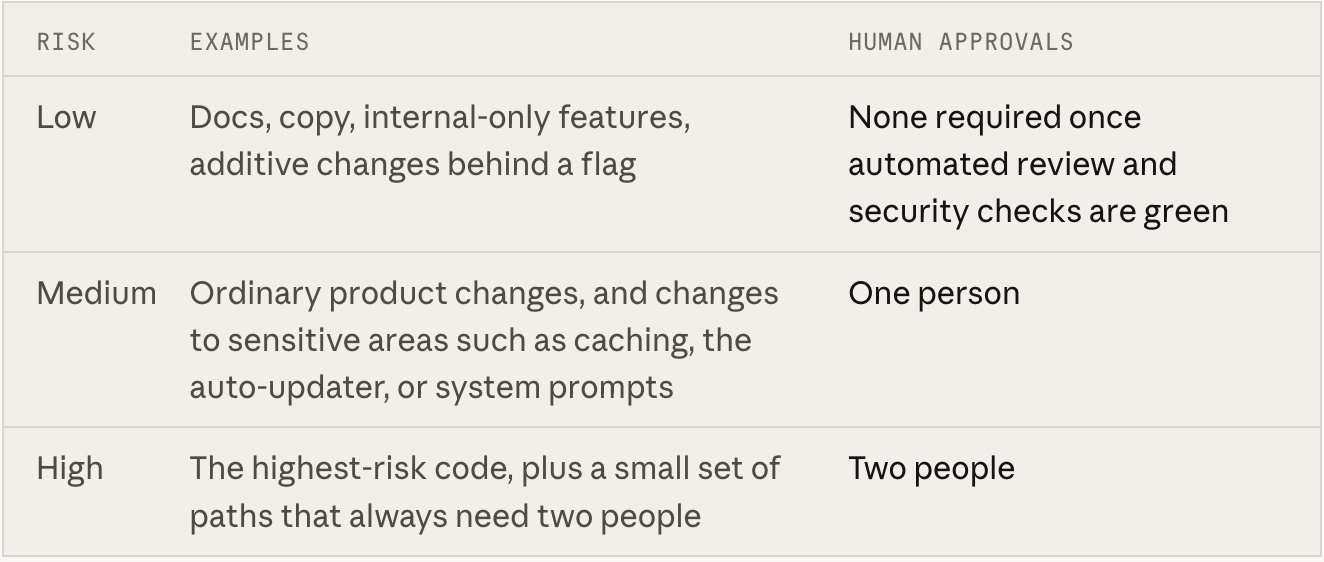
| Risk | Examples | Human approvals |
|---|---|---|
| Low | Docs, copy, internal-only features, additive changes behind a flag | None, once automated review and security checks are green |
| Medium | Ordinary product changes; sensitive areas like caching, the auto-updater, system prompts | One |
| High | Highest-risk code, plus paths that always need two | Two |
Rules around the tiers:
- The change sets the tier, not the author. A classifier sets it; a second classifier can demand an approval the tier did not.
- Some paths always need a person: anything owners mark sensitive, and every CI workflow file.
- Relaxed rules only for authors on the repo’s trusted list; everyone else needs a second person.
- Agent approvals never count as human approvals.
- If an agent wrote the PR, the person operating the agent is always one of the required reviewers.
- An approval covers one commit. A new untrusted commit (agent push, hand-resolved merge) needs re-approval.
Making the reviewer better
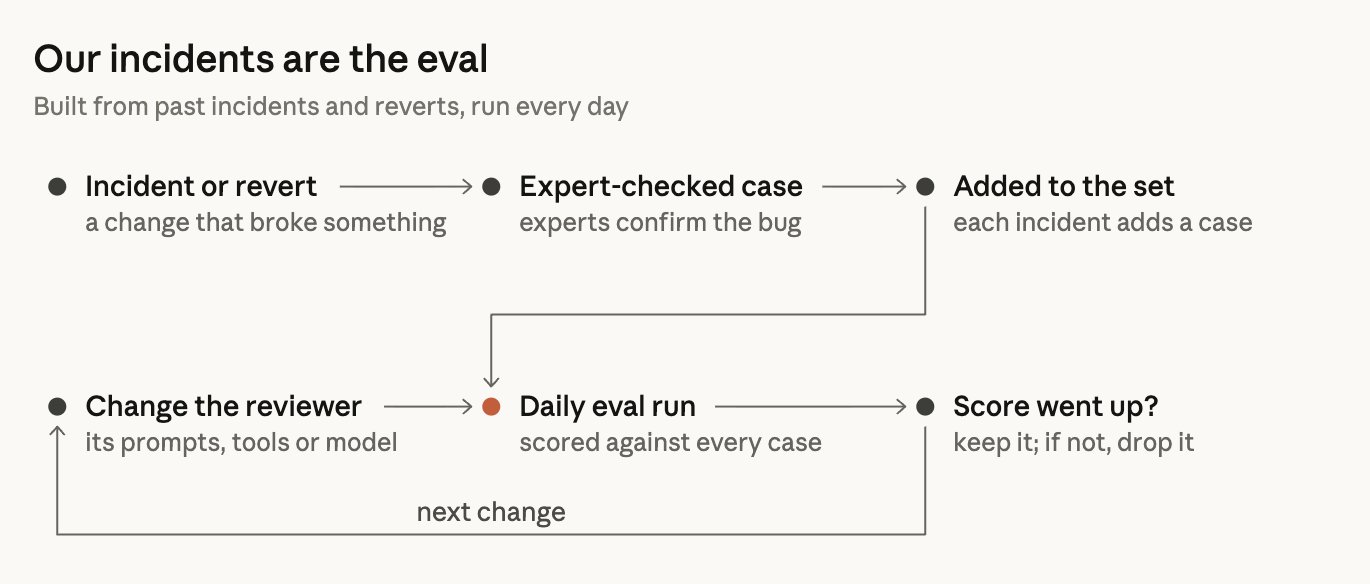
- Incidents are the eval. They collected incident-causing PRs with their fixes and reverts, had engineers confirm each bug’s location, and score the review system against that set daily. Every new incident joins the set; every change to the reviewer is scored against all of it.
- Noise is measured by human reaction: each comment is classed as fixed, rejected, clarified as intentional, or judged not to matter. They also run the reviewer on known-clean PRs to count harmful false alarms.
- Priorities: first find real bugs, second cut review cycles. A nit costs a human a second but costs an agent author another commit and another review round.
Review must converge
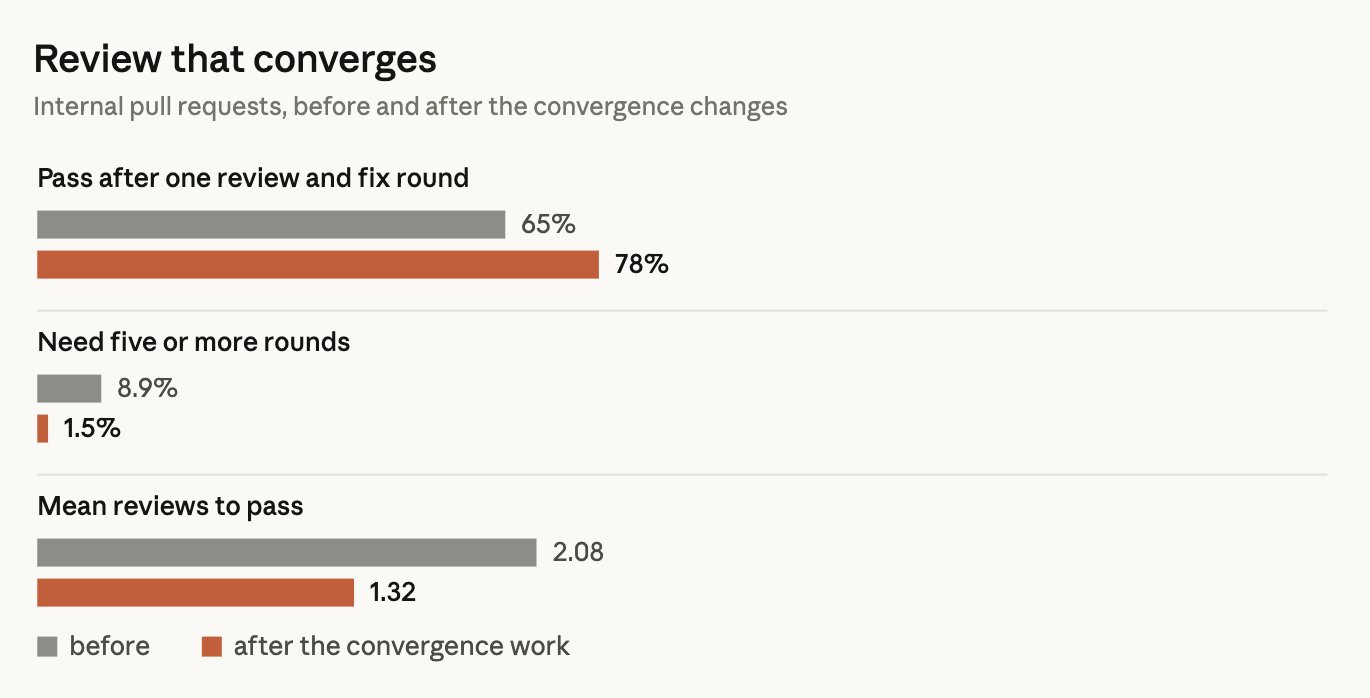
One PR cycled more than fifty times overnight between an agent author and an agent reviewer until someone stopped it. git blame showed about 59% of what the reviewer kept flagging was code from the first pass: it was finding old bugs a few at a time, not new ones. Running several review cycles by default had made this worse. Fixes:
- After three cycles, the reviewer asks the author to rethink the approach.
- After the first rounds, re-review only the new diff.
- Name the class of bug so the author fixes all instances, not one line.
- Never re-report an issue already raised.
- Run the review agents over the whole codebase overnight to find historical bugs separately.
They now track cycles-to-pass alongside recall.
What humans still do
- Decide whether to build it at all (vision, taste, goals). Even a team that says it solved the review bottleneck still reviews outside contributions for this.
- Audit dangerous code: billing, auto-updater, CI workflows.
- Review architecture, because it sets conventions others copy.
- Check the evidence (test output, commands, screenshots, reviewer comments). “If you can’t describe what the checks would miss, don’t ask for a 👍.”
- Take responsibility: one person answers for every change, whoever typed it.
Learning the code without reading diffs
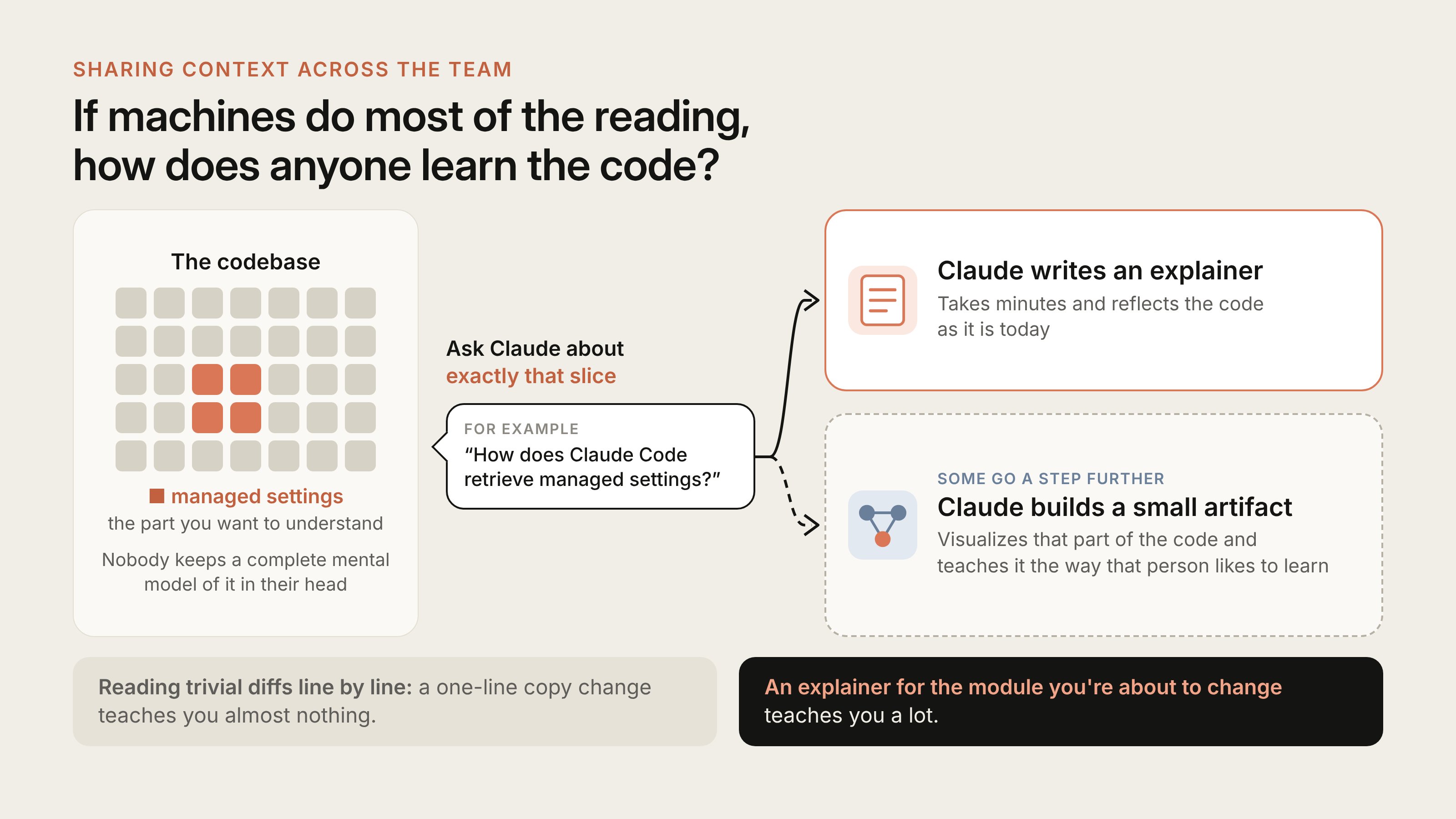
Review used to be how people learned the codebase. Now nobody on the team holds a full mental model and they do not think anyone needs to: they ask Claude for an explainer of the exact slice they are about to change, sometimes as a small visual artifact. They argue this teaches more than reading trivial diffs. Open Slack channels do the rest. Compare Comprehension Debt, which is more worried about this.
”You land it, you own it”
Whoever merges a small or medium change fixes it if it breaks. This works because changes are small, everything can be reverted in minutes, blast radius sets the bar, telemetry and internal use catch regressions fast, and incident reviews look at the system, not the person. Closing a PR is cheap when writing it was cheap, so pivot early in the thread rather than block at the end.
The rollout checklist
Before the PR: a short CLAUDE.md listing the checks the agent can run; formatters and linters via hooks; local /code-review and /security-review or a fresh-context subagent; a REVIEW.md for recurring issues.
On every PR: enforced CI; template with Testing, Risk, How to revert; an AI reviewer on one repo first, tuning REVIEW.md for a few weeks before spreading; automated security review; all threads resolved before merge; rigour by risk; capped review rounds.
Approval: risk levels set by the change; start strict and relax on evidence; lenient paths only for trusted authors; bot approvals never satisfy a required approval; approvals dismissed on new commits; humans own auth, billing, CI, release and installers via CODEOWNERS and branch protection.
Merge and after: merge queue, feature flags, internal users first, staged rollout, one-step revert, evals built from incidents and reverts, rescore the reviewer on any prompt, tool or model change, track human effort with reverts and incidents as guardrails.
Where it is going
Code Review the product only posts findings; a human approves. Internally they go further: owners choose low-risk changes that merge automatically when checks pass. Every miss is answered with “what was not in the model’s context?” and becomes a CLAUDE.md line, a skill or a check (The Ratchet - Every Mistake Becomes a Rule). No circuit breaker yet that tightens approval when revert rates rise.
Tensions with other pages
Contradiction: one reviewer or several different ones?
Agentic Code Review (Osmani, June 2026) recommends running two heterogeneous reviewers at high stakes, because four different tools almost never flagged the same line. The companion verification post (Claude Code Team Verification Practices) says the Claude Code team does not stack reviewers and finds a second, costlier reviewer often worse than tuning the primary one with a REVIEW.md. Partial reconciliation: their single “reviewer” is itself several parallel bug-hunting agents with a vote, and the June advice was about commercial tools of different vendors on unknown codebases. Not resolved here; worth testing on your own code, as both posts say.
- Running many review cycles by default made things worse here, while other pages (and the verification post) favour multiple passes that build on each other. The difference is convergence: rounds must look at new diffs and avoid repeats.
How much weight to give this
- Vendor case study. The team describes its own product, and the article ends by pointing to Code Review for Team and Enterprise customers. Numbers are self-reported with no baseline detail (for example, what the revert rate was).
- The doubling of merges and the 40% revert drop overlap with launching the product internally and with model upgrades; the post does not separate causes.
- The practices (risk tiers set by the change, agent approvals never count, approvals bound to a commit, incidents as eval set) stand on their own and are cheap to copy.
Related
- Agentic Code Review, Verification Bottleneck, Claude Code Team Verification Practices, Critical Thinking with Agents
- Orchestration Tax, Paradox of Supervision, Capability vs Regression Evals, Error Analysis for AI Evals
- AI Agents
Sources
- How the Claude Code team does code review: “How the Claude Code team does code review” (Addy Osmani, X Article, 2026-10-26)