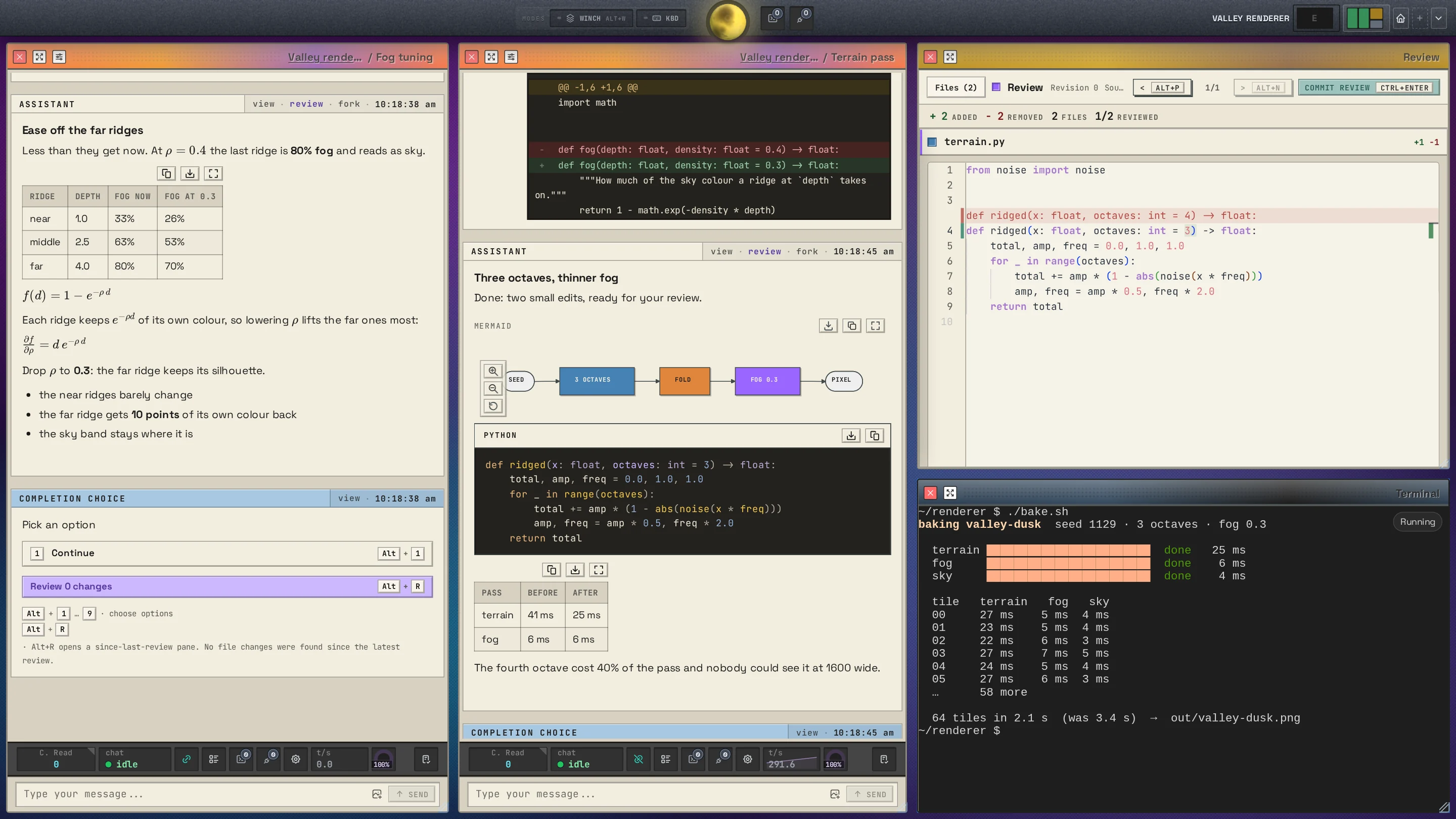
The claim that the coding harness (the program you drive an agent through) is turning into the IDE of the future, and so should be designed around the human who spends all day in it, not around a single chat pane. From Mickey Petersen, author of Mastering Emacs, in the launch post for his own harness, DreamCoder (Announcing DreamCoder).
The complaint
Most harnesses look the same: a terminal, or a sidebar of chat titles plus one chat pane. Petersen’s problems with that:
- The terminal is a poor home for the main tool. He calls it a “shoe rack-sized” window; copying multi-line text out of a terminal is the everyday example.
- GUIs are second-class. Most harnesses have one, but the terminal stays the primary surface.
- Parallel work has no overview. His image is people running ten Claude Code sessions in tmux and cycling through them “like a duck gallery at a carnival” to see which one finished or is stuck on a question or a permission prompt. That is the human side of the Orchestration Tax.
What he built instead
DreamCoder runs in the browser and borrows its design from Emacs:
| Idea | How it works | Emacs ancestor |
|---|---|---|
| Tiling window manager | Chats, terminals, code review and image panes tile side by side. Each pane has a minimum, comfortable and maximum size; a constraint solver fits new panes in and pushes ones that do not fit to a hidden bar (with a live preview on hover). | Emacs windows |
| Workspaces | Named snapshots of a pane layout, like virtual desktops. Park chats waiting on a colleague in their own workspace. | Window configurations |
| Minimap per workspace | A small copy of each layout; panes pulse while working, show clearly when blocked, turn green when idle. This is the answer to the duck gallery. | none (new) |
| Keyboard first, mouse allowed | Alt+x for global commands, Alt+c for pane commands, Alt+m to jump to panes by number or WASD direction. Full Emacs bindings were dropped because browsers reserve key combinations. | M-x, avy, embark, Helm |
| Search-as-you-type palette | Opening and creating panes through a filterable list; dialogs are JavaScript objects, so prefilled “macros” are possible. | Helm |
Underneath he lists the usual frontier features: MCP, background subagents and shell commands, skills, hooks, a claimed 99% cache hit rate, runs lasting days, open-weight model support, and an importer for Pi, OpenCode and Codex configs. A pentest suite is in progress.
The history argument
Most of the post is a history of AI through Lisp and Emacs, used to explain why he cares about ductile (bendable, extensible) tools:
- John McCarthy designed Lisp in the 1950s for the Advice Taker, a program meant to reason over hand-written facts about the world. It was never built in pure form: every rule needs another rule (the locked door, the car parked on the street).
- Warren Teitelman’s PILOT thesis turned the “advising” idea into a way to wrap code around a function without editing it. That became ADVISE in Interlisp and lives on as
advice.elin Emacs. - Symbolic AI (SHRDLU, Minsky’s frames,
M-x doctor) never produced intelligence. The connectionists, whose perceptron Minsky and Papert attacked, won in the long run.
His point: the rigid rule-based approach failed to produce AI, but the flexible tools built while pursuing it (Lisp, Emacs) survived because they bend to their user. Neural networks, themselves flexible, are what worked. He finds it sad and striking that he started DreamCoder by hand in Emacs and it now writes itself inside DreamCoder.
This matches the vault’s thread on rules versus judgment: Curse of Instructions and A Sufficiently Detailed Spec Is Code both meet the same wall the Advice Taker hit, where every explicit rule spawns exceptions. His teenage internship story (losing a bike-assembly flowchart contest because he forgot “open the box”) is a good small example.
Taste and the human in the loop
Mickey Petersen
Taste is a scarce, human resource.
He argues that AI still needs a person who knows what they are doing and sees the work through, that most people do not want to program even when the machine does the typing, and therefore the tool programmers live in should be human-centric. This lines up with Good Taste, Domain Expert Advantage and Human-Agent Interaction Design.
He also describes the same relief others report (compare Vibe Coding and the optimistic half of The Coming Loop): decades of experience used to hold his ambition in check by showing him how much tedium a project would cost; now he can build again, though he is still “busy all day doing real work”.
On local models
He says small open models are now good for local development in his experience, naming Qwen 3.8 27B, and thinks a lot of work will move local as intelligence becomes “too cheap to meter”. Bigger models mean more autopilot; small ones need a capable human. Compare Local Models - Focus and Polish and Model Tier Routing.
How much weight to give this
Launch post from the maker
- It is an announcement and an invitation to try the product. There are no user numbers, benchmarks or failure cases.
- “99% cache hit” and “runs for days” are claims without method.
- The original 2 to 3 month estimate became 15 months; he presents this as a lesson (“it’s always the last mile”) rather than hiding it, which is honest.
- Nothing here was tried. Treat the design ideas as a checklist for evaluating any harness UI, not as a reason to switch.
What to take from it
- Judge a harness by how it handles many sessions at once, not by its chat pane. The question is: can I see, at a glance, which agent is working, blocked or done? See Session Observability and Replay.
- Blocked states are the expensive ones. An agent waiting on a permission prompt costs wall-clock time silently; surfacing that is worth more than another feature.
- Keyboard plus mouse, not either. A tool for experts and newcomers keeps both paths.
Related
- Coding Agent Harnesses - 2026 Landscape (the mainstream options this post reacts against)
- Agent Harness, Pi (Coding Agent), Self-Extending Agents (Pi’s extensibility comes from the same Emacs-like instinct)
- Orchestration Tax, Conductor vs Orchestrator
- AI Agents
- Agent Platform Blueprint: the organisation-scale view from the same week; tmux-like panes and canvases as two of several app containers
Sources
- Announcing DreamCoder: “Announcing DreamCoder” (Mickey Petersen, Mastering Emacs, late 2026)