A spec cannot make the hard decisions in engineering disappear. Gabriella Gonzalez argues that a document detailed enough to reliably generate an implementation starts to resemble a program: data structures, control flow, retry rules, error handling, and algorithms, expressed in prose or pseudocode. Calling this work “specification” instead of “coding” changes its form, not the precision it demands.
Her March 2026 essay challenges the claim that engineers can become managers of coding agents simply by writing cheaper, higher-level documents. It also challenges the assumption that putting a specification stage in front of generation automatically improves quality. The useful distinction is specification as deliberate design versus specification as a promise to eliminate design work. Source: A sufficiently detailed spec is code.
The two misconceptions
1. Specifications are necessarily simpler than code
An incomplete brief can be short because it leaves decisions to the implementer. A detailed document can reduce that freedom, but only by doing more of the engineering up front. When it specifies state fields, scheduling rules, and startup algorithms, much of the implementation’s logic is already present.
Gonzalez does not object to pseudocode or reference implementations in specifications. She objects to counting them as evidence that code has been replaced by something fundamentally easier. A shorter artifact is not automatically a cheaper decision process.
She cites Dijkstra’s argument that changing the human-machine interface also adds communication work. Natural-language instructions can increase the burden on both sides; familiar prose is not necessarily a better tool for precise reasoning. This is a constraint on the “just describe what you want” promise, not a claim that every spec must reproduce every implementation detail.
2. Specification work is necessarily more thoughtful
Specifications can create time to examine a design critically before implementation encourages a bias toward action. But that benefit comes from deliberation, not the Markdown file itself.
If the incentive is to generate a spec quickly so an agent can start shipping, the spec can be as confused as the code it was supposed to improve. Structure, length, and headings are not evidence that tradeoffs were considered. Gonzalez’s “garbage in, garbage out” conclusion is that agents cannot reliably supply clarity the author has not achieved.
The concrete case: OpenAI’s Symphony
The essay examines a pinned revision of Symphony’s SPEC.md, an agent orchestrator. Its examples include:
- A detailed list of live-session state fields and their types.
- A concurrency formula:
available_slots = max(max_concurrent_agents - running_count, 0). - Retry timing, exponential backoff, and dispatch steps.
- A deliberately redundant configuration cheat sheet for coding agents.
- A complete language-agnostic startup algorithm.
These are engineering decisions, not merely a statement of desired outcomes. The document might be useful, but its usefulness does not show that the underlying work has vanished.
Gonzalez then reports asking Claude Code to implement Symphony in Haskell. She describes multiple bugs requiring repair prompts and, even after visible errors disappeared, an agent that made no progress on a ticket requesting a blank Git repository. She links the resulting symphony-haskell repository.
The important failure is “no errors” without the requested outcome. A detailed input document and a running process do not establish functional success. This connects directly to Evaluation-First Prompting and Verification Bottleneck: check the actual result, not the agent’s apparent completion.
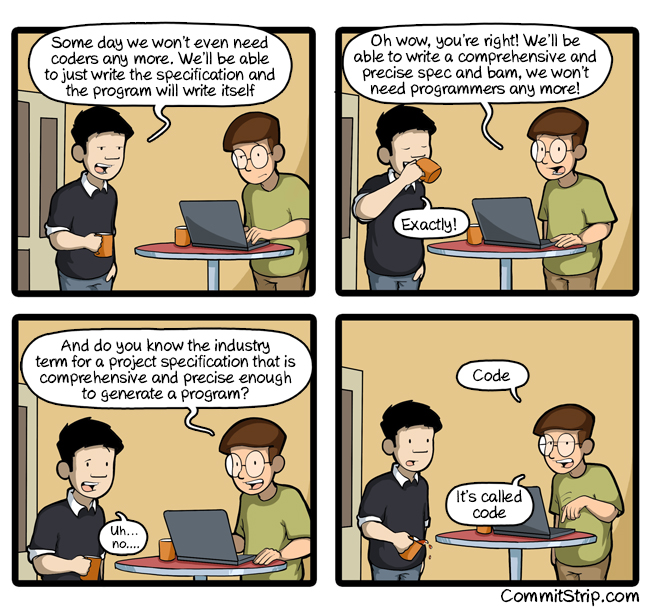
The article opens with CommitStrip’s “A very comprehensive and precise spec”, published in 2016. Its joke captures the same boundary: a fully precise description of the program starts looking like the program.
What the evidence establishes, and what it does not
Keep the argument separate from its supporting anecdote
This is a critical essay with one reported implementation experiment, not a controlled comparison of spec-first and code-first development. The wiki has not reproduced the Haskell run. It does not establish that every agent, language, or iterative spec workflow fails, nor that all specs are as costly as their implementations.
Other claims need the same care:
- The source’s one-sixth size ratio between Symphony’s spec and its Elixir implementation is the author’s reported figure, without a measurement method in the article. It is not a general spec-to-code ratio.
- The YAML conformance example illustrates that even mature specs and test suites do not guarantee conforming implementations. The source’s claim about the vast majority of implementations is not independently checked here.
- Calling Symphony’s spec AI-written slop is Gonzalez’s assessment. Her footnote speculates that it was derived from existing code; the essay does not establish that provenance. Code fences labelled
textdo not prove AI authorship. - Her conclusion that coding directly may be faster is a recommendation, not a measured productivity result.
The strongest supported lesson is narrower: a detailed spec does not guarantee correct implementation, and specifying design decisions remains engineering work.
The disagreement with existing wiki guidance
Spec-driven development remains useful, but is not a guarantee
Spec-Driven Development and Writing Specs for AI Coding Agents advocate durable requirements, small tasks, phase gates, and explicit verification. None requires a complete description of every implementation choice.
The tension appears when these practices are sold as eliminating ambiguity or making poor upstream decisions impossible. A human can approve a wrong spec; the agent can implement it incorrectly; new requirements can emerge during building. The phase gates make review possible at useful checkpoints, but they cannot certify understanding. This is already part of Comprehension Debt’s argument that specs are appealing, not complete.
Wiki synthesis: use specs to expose requirements and tradeoffs, not to promise a deterministic translation from prose to correct software. Put precise contracts, schemas, and invariants into machine-checkable forms where practical instead of duplicating implementation logic in prose.
The software factory moves the work, but does not remove it
Software Factory proposes inspecting intent and behavior rather than making line-by-line code reading the universal verification step. Its scouting phase does the discovery work before the spec, while the Decision Ledger surfaces choices made where the spec was silent.
Gonzalez’s challenge is that the upstream intent surface is not free. Making it trustworthy takes engineering judgment, and it can itself become a large, difficult artifact. Zhang’s answer that agents replace fallible programmers rather than deterministic compilers addresses translation reliability, but not the cost or clarity of the specification.
These positions are not wholly incompatible. The factory explicitly retains discovery and verification, so it need not claim a short brief is sufficient. The unresolved question is whether scouting, specifying, generating, auditing decisions, and verifying behavior together save work on a particular project. Moving review above the code does not, by itself, answer that question.
Related
- Spec-Driven Development: the gated workflow this critique constrains.
- Writing Specs for AI Coding Agents: practical spec-writing without assuming specs eliminate engineering.
- Comprehension Debt: the existing argument that fully describing a program recreates it in another notation.
- Software Factory: the alternative inspection surface, with specification cost still unresolved.
- Decision Ledger: makes delegated choices visible without pretending the spec was complete.
- Intent Debt: preserves the human reason for a requirement; an agent cannot reconstruct an unwritten why.
- Latent vs Deterministic: put hard guarantees into enforceable rules rather than probabilistic interpretation alone.
Source
- A sufficiently detailed spec is code: Gabriella Gonzalez, A sufficiently detailed spec is code, Haskell for all, 2026-03-17. Full article capture, with the comic stored locally. Article text licensed under CC BY-SA 4.0.