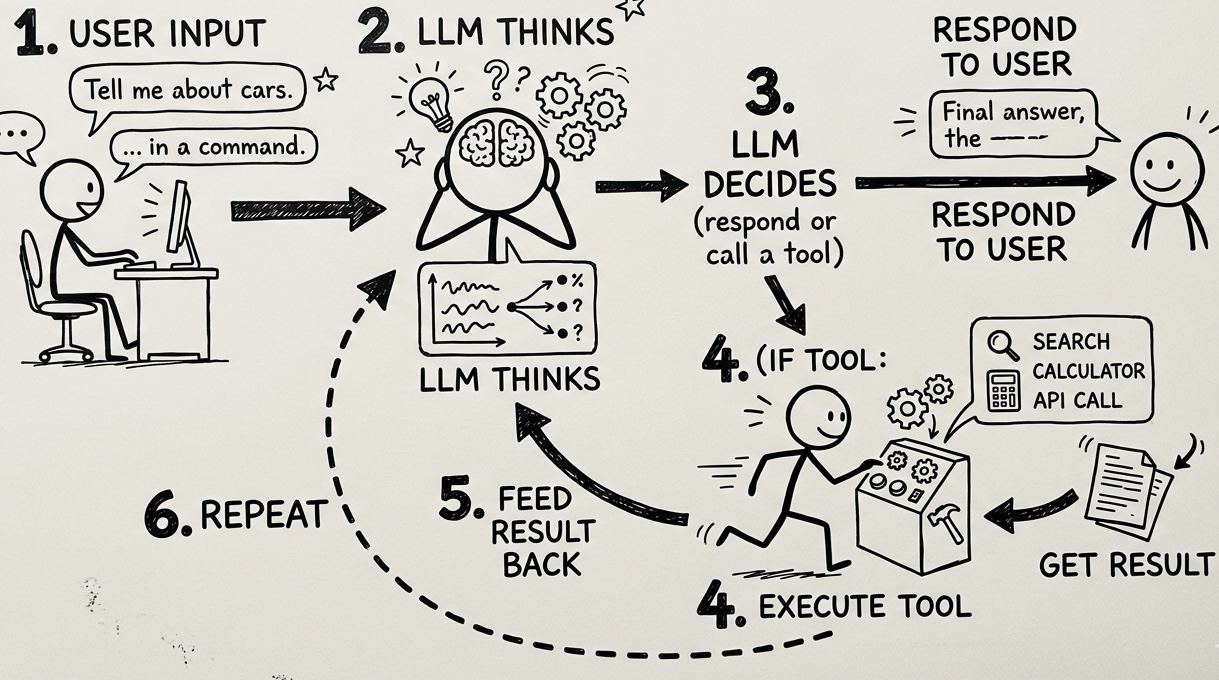
An AI agent is not magic — it’s a surprisingly simple loop. Understanding this loop is what separates someone who uses agents from someone who can build and debug them.
The Core Loop
Every agent, regardless of framework (LangGraph, CrewAI, Anthropic SDK, OpenAI Agents SDK), runs the same fundamental cycle:
User input → LLM thinks → LLM decides (respond or call a tool) → if tool: execute it, feed result back → repeat
Three components make up this loop:
- The LLM (brain): Reasons about the situation and decides what to do next
- Tools (hands): Functions the model can call to take real-world actions — calculators, web search, file I/O, APIs
- Memory (notepad): Records what has happened so far so the LLM can reason over it
All frameworks are just abstractions around this loop. They don’t change its essence.
Plain LLMs vs Augmented LLMs
A plain LLM accepts text and emits text — nothing more. An augmented LLM gains three additional capabilities that make agents possible:
| Capability | What it does | Examples |
|---|---|---|
| Tools | Functions the model can call | Calculator, database queries, file operations, APIs |
| Retrieval | Pull relevant info from external sources | Search engines, documents, vector databases |
| Memory | Retain information across interactions | Message history, external storage |
Both Anthropic and OpenAI expose tools via JSON schemas. The implementation differs slightly — Anthropic uses input_schema, OpenAI wraps functions in a function object with parameters — but the concept is identical.
Workflows vs. Agents
One of the most useful distinctions to make before building anything:
| Workflows | Agents | |
|---|---|---|
| Control | Your code controls execution | LLM decides the next step |
| Predictability | Same input always produces same path | Dynamic, may call tools repeatedly |
| Best for | Well-defined tasks with fixed steps | Open-ended tasks requiring judgment |
| Cost | Cheaper (fewer LLM calls) | More expensive |
Start by using a simple workflow. Graduate to an autonomous agent only when the workflow can’t handle the task.
Most problems that feel like they need full agent autonomy can actually be solved with one of the five workflow patterns. This distinction matters because autonomous agents are significantly harder to debug and keep reliable.