Ted Gioia’s central insight about note-taking is that the practice has three distinct levels — and most people never get past the first. Moving through all three transforms reading from a consumption activity into a generative one. The shift from taking notes to taking notice is the shift from information retrieval to original thought.
The framing comes from an unlikely origin: at 18, Gioia won a blind wine-tasting contest using only another contestant’s richly descriptive tasting notes — wines he had never tasted. The lesson was immediate: notes are not just memory aids. They are a transmission vehicle for perception, rich enough to reconstruct experience.
The Three Levels
Level 1 — Mark the Book
Underline key passages. Add marginal commentary. Insert post-its. Fold in newspaper reviews. Scrawl questions and connections as they occur.
The value works in two directions:
- While reading: it makes you an active reader, constantly searching for connections and surprising statements rather than passively absorbing text
- After reading: returning to a marked book months or years later allows you to re-experience your original impressions without re-reading the whole thing — the markings are a compressed record of your past attention
Gioia’s marginal notes from his teenage reading of Ezra Pound’s Cantos — made at 17, still intelligible decades later:
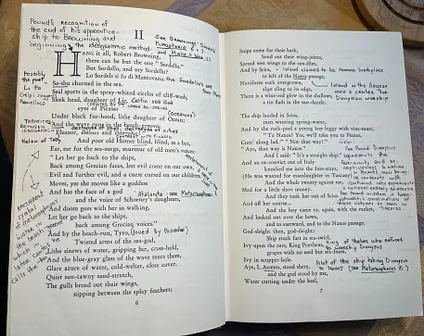
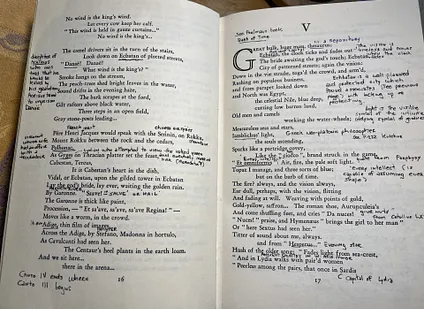
He regrets not doing this more aggressively. “I didn’t deface my books enough.”
Level 2 — Summarize the Book
When you finish, don’t immediately start the next book. Spend another couple of hours writing a brief holistic summary. This serves two purposes:
- Processing: forces you to mentally consolidate what you’ve actually learned
- Reference: gives you a guide when you want to revisit the subject without re-reading
This is where most serious readers stop. Gioia found it was not enough.
Level 3 — Write Down Your Own Ideas That the Book Spurred
This is the highest level — and the most important. Not notes about the book. Notes generated by the book. Your own thinking, analysis, comparisons, speculations, and syntheses, triggered by what you read.
The key distinction
Level 2 is a record of the book. Level 3 is a record of what the book did to your mind.
Gioia didn’t do this consistently until approaching middle age, and considers it the most transformative form of engagement with reading. His 400+ literary essays published in The Vault began as exactly this kind of extended reading note — never commissioned, never requested, written entirely for his own benefit.
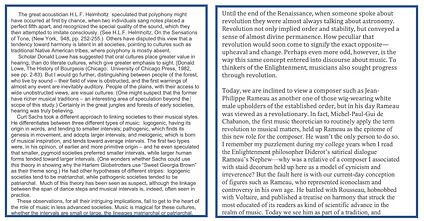
Some of Gioia’s unpublished notes on music — originally written for himself
Write in Coherent Sentences
After the wine-tasting experience, Gioia changed his entire approach to note-taking. He taught himself to write in complete sentences and integrated paragraphs in real time — even during live lectures.
This is not a style preference. It is a cognitive discipline. Writing in coherent sentences forces you to:
- Listen for structure, not just content — you are always asking “how does this connect?”
- Synthesize as you go — you cannot write a coherent sentence about something you don’t yet understand
- Produce something durable — bullet points degrade fast; coherent prose can be understood years later
His reading notes from the 1980s — written in his twenties — are still fully comprehensible today:
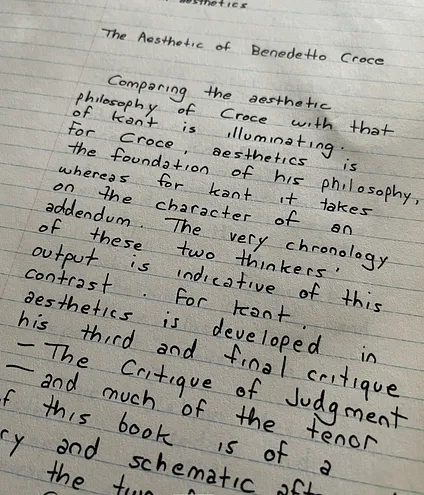
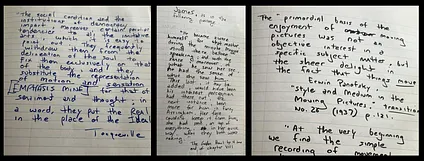
The result: walking out of a lecture with several handwritten pages that were “almost an essay.” A summary returnable to a month or years later that conveyed exactly what transpired.
Notes Compound Over Time
This is the most underappreciated aspect of serious note-taking: the value is often invisible at the time of writing.
Gioia makes two observations:
- Notes that seemed useless often proved valuable 10–20 years later. The notes you write at 30 frequently pay off at 50. “We seldom understand the full benefit of high-level reading until long after the fact.”
- Your notes improve with age — notes from his 40s and 50s are far more useful than those from his 20s and 30s, because his engagement with the material was deeper.
This means: never dismiss notes as useless. Never assume a book has no future relevance. The return is often deferred.
Taking Notes vs. Taking Notice
The phrase Gioia uses to name the highest level is precise:
The discipline of taking notes can evolve into taking notice — which is a much higher level activity.
Taking notes is about the book. Taking notice is about you — your attention, your perception, your way of engaging with the world. The book is the catalyst. The practice is the development.
This is not limited to writers. In any field — science, business, craft — the habit of writing down your own ideas generated by what you’ve learned accelerates thinking in ways that passive reading cannot. Gioia applied this to business reading (HBR, McKinsey Quarterly, The Economist) during his non-writing career years. The cognitive habit is domain-independent.
Connection to Gioia’s Broader Reading Practice
Note-taking is not a separate activity from Gioia’s reading methodology — it is integrated into it. Slow reading naturally produces more to note. Gap lists and tracking are themselves forms of note-taking. The curiosity that drives reading-for-wisdom gets its return through this practice of writing down what reading generates.
The three levels also parallel the structure of Deliberate Practice: marking the book is engaged attention; summarizing is feedback and consolidation; Level 3 notes are the creative recombination that drives genuine expertise forward.
See also Essays as Thinking Tools — Dan Koe arrives at a related insight from the creator’s side: the essay is valuable not because of what it communicates to readers but because of what the act of writing does to the writer’s thinking. Gioia’s Level 3 notes are private essays.
See also Second Subconscious — Koe’s harsher companion claim: a note-taking system without a project pulling on it is close to useless regardless of method, which sits in tension with (and complicates) the “notes compound over time” optimism below.