Ted Gioia’s practical companion to his lifetime reading philosophy — a structured one-year immersion in arts and culture for anyone willing to commit to ~250 pages per week. He devised his own reading education over fifty years; this is his attempt to compress a solid foundation into twelve months.
The curriculum is not a shortcut. It’s an entry path for those who are already serious — what Gioia calls the “happy few.” All four parts ingested. Weeks 1–52: ancient world through contemporary fiction. The complete curriculum.
The Ground Rules
- ~250 pages per week — the constraint that shapes everything; no War and Peace
- Music suggestion each week — the humanities are not just books
- Visual arts suggestion each week — find the works online
- Expect rough patches — difficulty is part of the process, not a sign you’re failing
- Group reading amplifies the benefit — but solitary readers gain too
The Reading List — Part 1: The Ancient World (Weeks 1–13)
| Week | Books | Theme |
|---|---|---|
| 1 | Plato: Final Days of Socrates + Republic I, VII | Truth vs. power; the Allegory of the Cave |
| 2 | Sappho + Greek lyric poets; Homer: Odyssey 1–10 | The birth of the lyric self |
| 3 | Homer: Odyssey 11–24 | Wisdom over brute force |
| 4 | Confucius: The Analects | Ethics, leadership, Chinese culture |
| 5 | Aristotle: Nicomachean Ethics + Poetics | Virtue ethics; the foundations of criticism |
| 6 | Plato: Symposium; Herodotus: Histories 1, 6–8 | Love and war |
| 7 | Epic of Gilgamesh; Dhammapada | Pre-Homeric epic; Buddhism |
| 8 | Ancient Egyptian hymns, prayers, songs | The oldest secular love songs |
| 9 | Bible: Genesis, Ecclesiastes, Four Gospels, Romans | Foundation of Western civilization |
| 10 | Sophocles (3 plays); Aeschylus; Euripides; Aristophanes | Greek comedy and tragedy |
| 11 | Marcus Aurelius: Meditations; Epictetus: Enchiridion | Stoicism — from Emperor to slave |
| 12 | Suetonius: The Twelve Caesars | Decadence |
| 13 | Koran (14 surahs); Rumi: Selected Poems | Islamic civilization |
The Design Philosophy
Why the Ancient World first? This is consistent with Gioia’s broader principle from Ted Gioia’s Reading Methodology: master the tradition before you can properly evaluate the present. Everything in modern literature, philosophy, and culture is in conversation with these texts — often without knowing it. You can’t understand the conversation without knowing what came before.
Why 250 pages per week? It’s the constraint that makes the course doable. Gioia acknowledges it rules out some options and forces hard choices. But the discipline of the constraint — like the discipline of essay writing — is itself part of the education.
Why music and art alongside books? A genuine humanities education is not just literary. Gioia pairs each week’s reading with music that either shares the cultural moment or creates a productive contrast. The juxtapositions are often surprising — Early Blues for Greek tragedy (Week 10), Joni Mitchell’s Blue for Sappho (Week 2).
Highlights Worth Noting
The Odyssey over the Iliad (Week 3): Gioia’s most explicit editorial choice. The Odyssey is the first major text in Western culture to celebrate a hero for wisdom and intelligence rather than physical strength. “Brute force is no longer the highest ideal.” He calls Odysseus’s return to Ithaca his favorite moment in all of literature.
Stoicism (Week 11): Marcus Aurelius was Roman Emperor; Epictetus was born a slave. The same philosophy worked for both. This is Gioia’s way of showing the Stoic framework is not privilege-dependent.
The Bible (Week 9): No commentary offered — plenty exists elsewhere. Gioia simply notes these writings help him constantly, even in understanding the daily news. They are presented as foundational cultural texts, not exclusively theological ones.
The Egyptian love songs (Week 8): Predating even Sappho, these are the oldest secular love songs we have. Navigating a worldview this different from our own is part of the point of the entire curriculum.
The Reading List — Part 2: Rome through Shakespeare (Weeks 14–26)
| Week | Books | Theme |
|---|---|---|
| 14 | Virgil: Aeneid 1–2; Ovid: Metamorphoses 1; Roman lyric poets | Roman national epic and decadence |
| 15 | Boethius: Consolations of Philosophy | Philosophy as consolation; empire in decline |
| 16 | Lao Tzu: Tao Te Ching; Sun Tzu: The Art of War | Two contrasting paths — mystical vs. practical |
| 17 | Apuleius: The Golden Ass | Satire and early novel; Rome’s collapse |
| 18 | Arabian Nights (selections) | Scheherazade frame + 5 tales |
| 19 | Bhagavad Gita; Rule of St. Benedict; Augustine: Confessions 1–2 | Cultivating the interior life |
| 20 | Augustine: Confessions 2–13 | Memoir, autobiography, self-help from a collapsing world |
| 21 | Chaucer: Canterbury Tales (4 selections); Malory: Le Morte D’Arthur 13–15 | Greatest pre-Shakespeare English literature |
| 22 | The Mwindo Epic; Sundiata | African epic tradition; literature born from music |
| 23 | Letters of Abelard and Heloise; Troubadour love lyrics | Medieval romance; love across cultures and classes |
| 24 | Dante: La Vita Nuova + Inferno | Personal narrative transformed into art; descent into Hell |
| 25 | Dante: Purgatorio + Paradiso | Ascent; merging personal, spiritual, imaginative, romantic |
| 26 | Shakespeare: Hamlet, King Lear, Macbeth | Psychological depth unprecedented in literature |
Highlights from Part 2
Boethius (Week 15): Written in prison while awaiting execution. Gioia’s framing: “timeless guidance for tough times.” The contrast with Part 1’s confident Plato is stark — we are watching a world collapse and watching philosophy hold steady anyway.
Lao Tzu + Sun Tzu together (Week 16): A deliberate provocation. One mystical and paradoxical, one brutally practical. Reading them in the same week forces comparison: do you need to choose a path, or can both coexist?
Augustine (Weeks 19–20): The pivot point of the curriculum. Augustine of Hippo changes the whole tone of Western narrative — the personal, interior approach becomes dominant. This is where memoir and autobiography as forms begin. Gioia notes it’s also a kind of self-help guide from a collapsing society where citizens had to learn to help themselves.
African epics (Week 22): Gioia’s most explicit reminder that literature originated in music. When The Mwindo Epic (from the Nyanga people of Congo) was documented, three percussionists accompanied the bard — one of whom typically took over the bard’s role. Reading the text cannot deliver the full performance, but confronting it is still essential. Sundiata (Mali) is included for the same reason. Gioia also notes the Anansi spider tales from West Africa as a worthy alternative: the quintessential trickster figure, directly comparable to Odysseus (Homer) and Puck (Shakespeare). This cross-cultural pattern is exactly what the curriculum is designed to surface.
Dante across three weeks (24–25): The only author given three consecutive weeks. Gioia treats Dante as the synthesis of everything built since Week 1 — personal narrative, spiritual cosmology, romantic love, political exile, all fused. Week 24 ends mid-journey (we’re still in Hell); Week 25 completes the ascent.
Shakespeare (Week 26): The psychological benchmark. Gioia asks readers to compare these inner lives to modern TV and film. The implicit claim: nothing since has consistently matched it.
The Reading List — Part 3: Renaissance through 19th-Century America (Weeks 27–39)
| Week | Books | Theme |
|---|---|---|
| 27 | Shakespeare: Midsummer Night’s Dream, Romeo and Juliet, The Tempest | Romantic Shakespeare; mass market genius |
| 28 | Vasari: Lives (5 artists); Cellini: Autobiography 1–18 | Renaissance lives; the holistic well-rounded life |
| 29 | Shakespeare: Henry IV Parts 1 & 2; Othello | History and final tragedy; Shakespeare complete |
| 30 | Cervantes: Don Quixote 1–5; Molière: Tartuffe | The novel’s origins; satire and idealism |
| 31 | Machiavelli: The Prince; Rousseau: The Social Contract | Pragmatic vs. idealistic politics |
| 32 | Rousseau: Confessions Book 1; Voltaire: Candide | Raw personal memoir; secularization of culture |
| 33 | Descartes: Discourse on the Method; Spinoza: Ethics Part 1; Kant: Groundwork | Cogito, pantheism, categorical imperative |
| 34 | Goethe: The Sorrows of Young Werther | Enlightenment exhaustion; legitimizing human feeling |
| 35 | Romanticist Poetry: Keats, Wordsworth, Blake, Coleridge, Byron, Shelley, Novalis, Hölderlin | The Romantic revolt against industrialization |
| 36 | Declaration of Independence + U.S. Constitution; Marx & Engels: Communist Manifesto; Wollstonecraft: A Vindication of the Rights of Woman | Democracy, communism, feminism — all to be read for thinking |
| 37 | Jane Austen: Pride and Prejudice | The template of the modern love story |
| 38 | Darwin: Origin of Species 1–4; Mill: On Liberty | Evolution and libertarianism — still shaping current thinking |
| 39 | Dickinson, Poe, Melville, Thoreau, Twain, Whitman | American literature breaking free from European models |
Highlights from Part 3
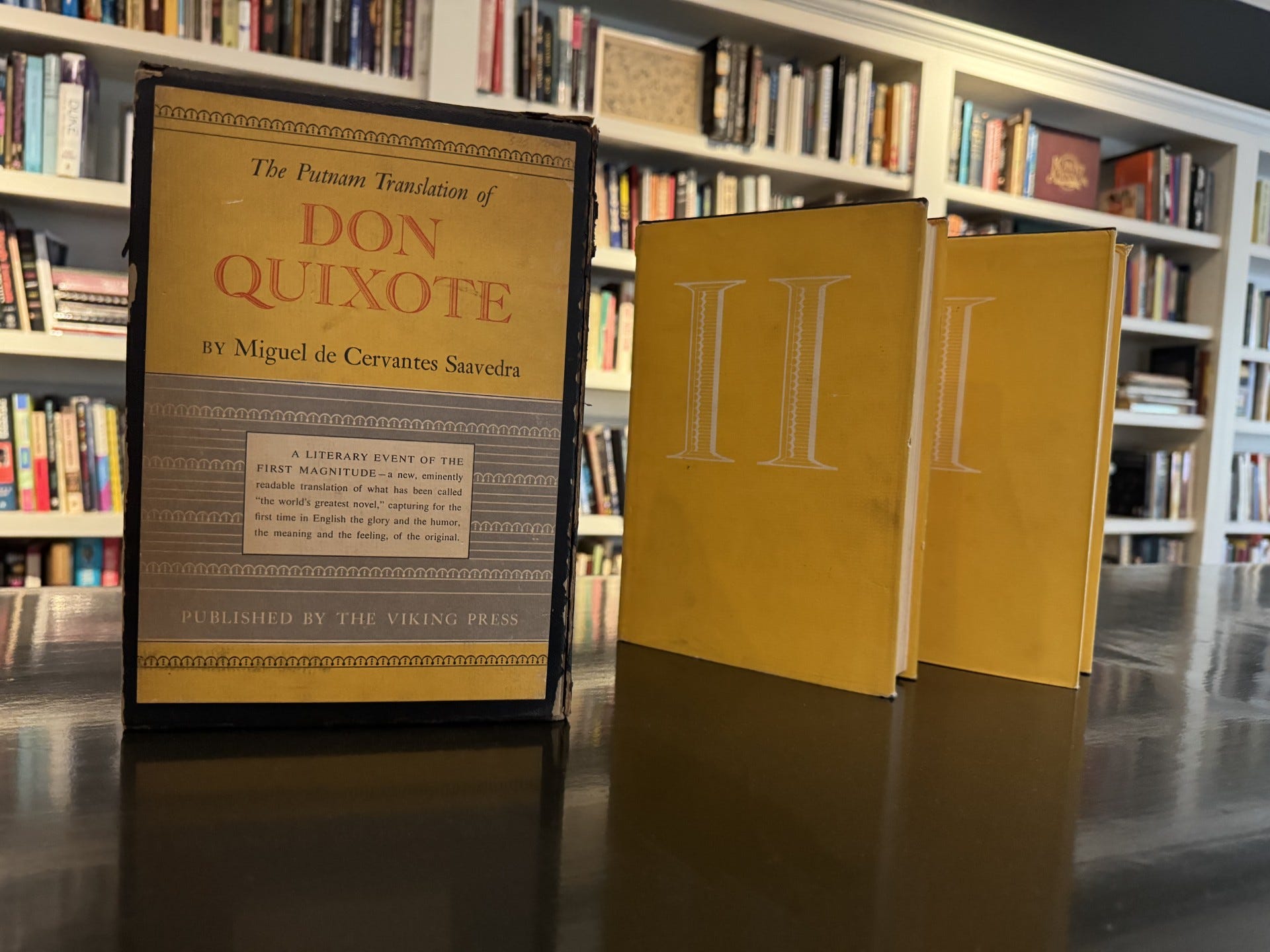
Don Quixote and the long fuse (Week 30): Gioia read the entire novel at twenty (two-volume Putnam translation) and found it a slapstick comedy — enjoyable but opaque. Decades later, while researching medieval romance and chivalry for his Oxford University Press book Love Songs, the full significance landed: Cervantes had deconstructed the popular myths of knights and jousts — the Star Wars of his era, tired franchises with too many reboots — and replaced them with the form we now call the novel.
The double edge Gioia finally saw: Cervantes mocks Don Quixote relentlessly, subjecting him to indignities throughout. Yet the reader loves him anyway. We admire his loyalty to ideals that have vanished from the world. Tilting at windmills becomes heroic precisely because the windmills are real to him.
Gioia offers this as a metaphor for the entire curriculum: we can find beauty in things that have disappeared. The act of reading these books is itself a form of tilting at windmills — and that’s the point.
“This kind of hermeneutic exercise is invaluable. We actually put ourselves in the proverbial shoes of another person, from another world.”
Shakespeare again (Weeks 27–29): Gioia gives Shakespeare more attention than any other author across the 52 weeks. His rationale: Shakespeare probed the subconscious with a profundity that has not been consistently matched since. The psychological depth of these characters is the benchmark against which Gioia measures modern TV and film — and finds them wanting.
The Renaissance lives (Week 28): Vasari and Cellini shift the curriculum from reading texts to reading lives. The Renaissance changed what a well-rounded human life looks like — and you can’t understand that shift from paintings and sculptures alone.
The philosophical trio (Week 33): Three dense, brief texts that between them define the intellectual architecture of modernity. Gioia’s most pointed editorial choice here: Kant’s Groundwork as the superior alternative to Effective Altruism. The categorical imperative — do only what you could will to be a universal law — sidesteps the utilitarian abuses that brought EA into disrepute.
Goethe and the Romantic turn (Weeks 34–35): Gioia draws an explicit contemporary parallel — rising youth suicides may be recreating the response that Werther catalysed: desperate emotion as revolt against an overly rationalized world. The Romanticists who followed laid the groundwork for abolition, better working conditions, and the end of child labour. Ideas matter.
Week 36 as provocation: Three foundational documents of democracy, communism, and feminism assigned in the same week — explicitly framed as tools for thinking, not compliance. Gioia’s note: you should be able to read all of these without being called before a committee.
American literature (Week 39): Six authors crammed into one week — Dickinson, Poe, Melville, Thoreau, Twain, Whitman. The common thread: each liberated American culture from European imitation through rule-breaking, cranky individuality. Poe was more influential in Europe than at home.
The Reading List — Part 4: 19th-Century Russia through Contemporary Fiction (Weeks 40–52)
| Week | Books | Theme |
|---|---|---|
| 40 | Dostoevsky: “The Grand Inquisitor”; Nietzsche: Beyond Good and Evil; Tolstoy: The Death of Ivan Ilyich | Moral dilemmas; toppling Western moral code |
| 41 | James: The Spoils of Poynton; Proust: “Overture” from Swann’s Way | The gold standard of psychological prose fiction |
| 42 | Baudelaire: Selected Poems; Flaubert: “A Simple Heart” | Realism and naturalism; the subterranean human psyche |
| 43 | Douglass: Narrative; Du Bois: The Souls of Black Folk | African-American experience; endurance and triumph |
| 44 | Joyce: “The Dead” + Ulysses Episode 1; Beckett: Waiting for Godot | Pushing writing to its limits |
| 45 | Woolf: To the Lighthouse; Eliot: “Prufrock,” The Waste Land | Stream-of-consciousness; tone over explicit meaning |
| 46 | Freud: An Outline of Psychoanalysis; Beyond the Pleasure Principle | The unconscious; thanatos; the death instinct |
| 47 | Ellison, Faulkner, Fitzgerald, Hemingway, Jackson, O’Connor, O. Henry | Rapidfire American fiction — 7 authors, 52 pages |
| 48 | Borges: Ficciones; Kafka: “Metamorphosis”; García Márquez: One Hundred Years Ch. 1 | Magical realism and its origins |
| 49 | de Beauvoir: The Second Sex; Foucault: “The Eye of Power”; Girard: mimetic desire | Feminism, post-modernism, mimetic desire |
| 50 | Sontag: 3 essays; Benjamin: “Work of Art in the Age of Mechanical Reproduction”; Ortega y Gasset: 3 essays | Cultural theory; hidden meanings in current conflicts |
| 51 | Huxley: Brave New World | The most accurate predictor of our tech-defined lives |
| 52 | Butler: “Bloodchild”; Didion: “The White Album”; DFW: The Pale King §22; AA Ch. 5; O’Brien: “The Things They Carried” | Humans at the brink; the etymology of humanities |
Highlights from Part 4
Dostoevsky’s “Grand Inquisitor” (Week 40): Gioia calls The Brothers Karamazov one of his top five all-time books. This self-contained section is an entry point that “reads like a Platonic dialogue updated for contemporary life.” Paired with The Death of Ivan Ilyich — which Gioia calls the most riveting book about end-of-life issues — this is the week most likely to force genuine self-examination.
Joyce (Week 44): The most difficult author in the entire curriculum. Gioia notes Joyce “may have aimed” at difficulty. The Week 2 Homer helps — Ulysses is modeled on the Odyssey — but only so far. An annotated online edition is recommended for when you get stuck.
Freud’s thanatos (Week 46): The death instinct is Freud’s most controversial concept and, Gioia suggests, helps explain “seemingly paradoxical elements of our self-destructive times.”
Week 47’s rapidfire: Seven authors in one week is the most compressed reading in the entire curriculum. The Faulkner extract (The Sound and the Fury) is the longest and hardest — but the course is not being “dumbed down.”
Magical realism (Week 48): The lineage runs Kafka → Borges → García Márquez → Rushdie, Murakami, and beyond. The Kafka image caption: “Franz Kafka helps you understand everything from Severance to politics.” An elegant summary of why these texts remain relevant.
The finale (Week 52): Gioia returns to the etymology of humanities — human beings, humanistic thinking. Five texts about people at the brink finding their way back. He gives away the DFW short novel (Something to Do with Paying Attention, just 150 pages and unusually accessible for Wallace) regularly to young people, saying it tells you things they don’t teach in school. The AA chapter — “the most influential guide to recovery of the last hundred years” — is the most unexpected inclusion in the entire 52-week curriculum, and perhaps the most honest.
The Missing Week: Cinema
If Gioia were to add a Week 53, he would not add more books. He would add film.
Cinema is the biggest gap in the curriculum. Many young people have never seen The Godfather, Casablanca, or Citizen Kane. Black-and-white movies feel alien; silent films are perceived as artifacts, not art. His proposed solution: add one film per week alongside the existing reading — 52 films over the course of the year, covering the entire sweep of cinema history.
The logic is consistent with the curriculum’s broader philosophy: you cannot evaluate the present without understanding what it emerged from. Film is not optional decoration — it is a major art form of the 20th century that shaped how people see the world. Skipping it is as large a gap as skipping 19th-century American literature.
What the Complete Curriculum Covers
Arc across 52 weeks:
- Weeks 1–13: The ancient world (Plato → Islamic civilization)
- Weeks 14–26: Rome through Shakespeare
- Weeks 27–39: Renaissance through 19th-century America
- Weeks 40–52: Russia and modernity through contemporary fiction
What it achieves: A foundation in human civilization’s major literary, philosophical, and cultural traditions across every inhabited continent. Not comprehensive — Gioia acknowledges the 250-page constraint forces hard choices — but sufficient to “feel some mastery over human culture in its depth and breadth.”
Connections
This curriculum is the what to read; Ted Gioia’s Reading Methodology is the how. Together they form a complete self-education program.
The curriculum also embodies Self-Directed Education in practice — Gioia offering himself as “an imperfect guide” because even an imperfect guide is better than none, when the alternative is stumbling around alone.
See Also
- Ted Gioia
- Ted Gioia’s Reading Methodology
- Self-Directed Education
- Reading for Wisdom
- Making Gioia’s Curriculum Achievable — practical tips for getting through it without burning out