Director: Quentin Tarantino
Screenplay: Quentin Tarantino, Roger Avary
Cinematography: Andrzej Sekula
Score: Various (curated soundtrack)
Studio: Miramax Films
Logline
Three interlocking crime stories — a hitman and his partner on a bad day, a boxer who won’t throw his fight, and a gangster’s wife on a dangerous night out — collide and fold back on themselves in a nonlinear mosaic that turns the B-movie pulp tradition into high art.
Plot Summary
Pulp Fiction is structured as five narrative segments presented in deliberately fractured chronological order, so that the film’s ending loops back to its beginning. The connecting thread is a briefcase — glowing, never opened, belonging to crime boss Marsellus Wallace — and the various people drawn into orbit around his world.
In the first and longest thread, hitmen Vincent Vega and Jules Winnfield retrieve the briefcase from a group of young men who stole it. After a near-miraculous escape from gunfire that Jules takes as divine intervention, the day spirals into a series of crises: an accidental shooting, a body to dispose of, a frantic call to a fixer named Winston Wolfe. Vincent also has to take Marsellus’s wife Mia out for the evening — a date that turns perilous when Mia overdoses on heroin and Vincent must revive her with an adrenaline shot to the heart.
In the second thread, aging boxer Butch Coolidge takes Marsellus Wallace’s money to throw a fight, then wins it instead, killing the other fighter. On the run, he risks everything to retrieve his dead father’s watch — a digression that leads to a surreal sequence in a pawn shop, a dungeon, and an act of reluctant solidarity that changes everything between him and Marsellus.
The film bookends with a sequence in a diner where a couple (Pumpkin and Honey Bunny) attempt a robbery — an event that intersects with Jules and Vincent eating breakfast. This scene opens and closes the film, but lands entirely differently the second time, because by then we know Jules has decided to quit the life. What began as a threat ends as a philosophical act.
The non-chronological structure means we already know certain characters are dead when we see them alive again, which produces a strange tenderness: we watch Mia Wallace dance with Vincent knowing he will kill her accidentally later; we watch Jules and Vincent eat together knowing their paths are already diverging.
Key Characters
Vincent Vega (John Travolta) — A hitman recently back from Amsterdam, loose and laconic, slightly out of step with the pace of events around him. Vincent is the film’s principal figure of irony: he is present at near-miraculous events that he dismisses, and is undone by ordinary carelessness (he is shot while in the bathroom).
Jules Winnfield (Samuel L. Jackson) — Vincent’s partner and the film’s moral center. A man who recites a bastardized Ezekiel passage before each kill treats it as performance — until the day it stops feeling like performance. Jules’s decision to “walk the earth” is the film’s closest thing to a redemptive arc.
Mia Wallace (Uma Thurman) — Marsellus’s wife, intelligent and restless, whose evening with Vincent is the film’s most stylized set piece. Charming, dangerous to be around, and given one of the film’s best monologues (the uncomfortable silence test).

Mia Wallace — the film’s most iconic image.
Butch Coolidge (Bruce Willis) — An aging boxer operating under no illusions. His thread is the most classically structured of the three: a simple moral transgression (taking the money) ramifies into a series of escalating complications. His return for the watch is the film’s most unexpected act of sentiment.
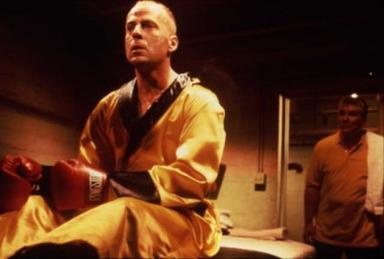
Butch Coolidge — the film’s most unexpectedly moral character.
Marsellus Wallace (Ving Rhames) — Crime boss, mostly heard and felt before he is seen. The glowing briefcase is his. His presence organizes the film’s world without dominating its screen time.
Winston Wolfe (Harvey Keitel) — A fixer introduced at dawn, impeccably dressed, brisk to the point of rudeness. A brief appearance that became one of the film’s most quoted. Represents efficiency as a moral stance.
The Gimp (Stephen Macrisan) — A figure from the pawn shop dungeon sequence. No explanation is given. One of cinema’s most unsettling background presences.
Themes
- Redemption as surprise — Jules experiences what he chooses to interpret as a miracle and acts on it; Butch makes a brutal choice to save someone who doesn’t deserve it; the film is skeptical of easy redemption but genuinely interested in the unexpected kind
- The banality of evil — hitmen discuss foot massages and the Royale with Cheese; violence is interspersed with the mundane without ironic distance; the effect is not comedy but something stranger, closer to the texture of actual moral life
- Fate and chance — the glowing briefcase, the miracle of the bullets missing, the watch, the abandoned car — the film is saturated with objects and events that carry meaning but resist symbolic reduction
- Honor and code in a world without legitimacy — Marsellus, Jules, Winston Wolfe all operate by codes; the codes are internally consistent and externally meaningless; the film takes them seriously anyway
- Storytelling and digression — the non-linear structure enacts its own argument: the detour is the story; the moment of waiting or eating or talking is as significant as the dramatic event
Craft Notes
Non-linear structure — The film’s greatest formal achievement. The sequence Tarantino chose is not arbitrary: it withholds, then delivers, emotional information in a way that makes the final diner scene (chronologically the first) feel like arrival rather than repetition.
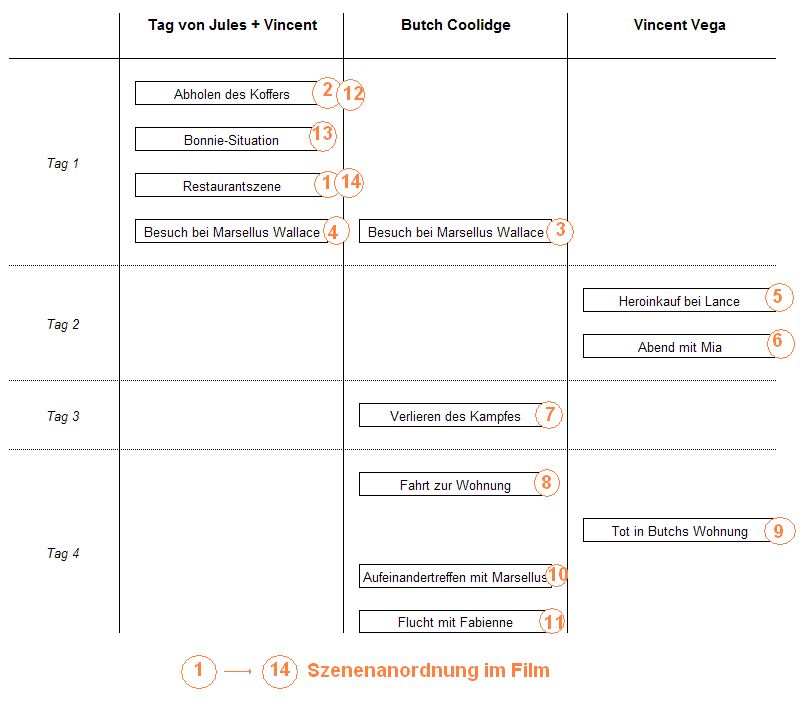
The film’s five segments mapped in chronological vs. presented order.
Dialogue — Long exchanges about nothing (Big Mac versus Royale with Cheese, foot massages, what they call a Quarter Pounder) function as both character revelation and deliberate counter-programming against conventional thriller pace. The chatter creates intimacy and then makes the violence more disturbing by proximity.
Soundtrack — Entirely curated; no original score. Surf rock, soul, pop. Dick Dale’s “Misirlou” opens the film with outrageous confidence. Urge Overkill’s “Girl, You’ll Be a Woman Soon” scores Mia’s dance and her overdose. The music is never ironic — it is used straight, which is what makes the juxtapositions so effective.
Cinematography (Sekula) — Naturalistic but precise. The Jack Rabbit Slim’s sequence is the most stylized — a constructed unreality that feels right for Mia and Vincent’s oddly formal first-date energy. Most of the film shoots close, in real spaces.
Genre metabolism — Tarantino takes the vocabulary of exploitation cinema (crime, hitmen, gimp dungeons, samurai swords) and treats it with the seriousness of literary fiction. The result is neither parody nor homage but something genuinely new.
Critical & Cultural Context
Pulp Fiction premiered at Cannes in 1994 and won the Palme d’Or. It was made for roughly 200 million worldwide, becoming the first independent film to cross that threshold and permanently changing how the industry thought about independent cinema.
The film revived John Travolta’s career — he had not had a significant role in over a decade and received an Academy Award nomination for the performance. Samuel L. Jackson’s Jules became one of the most quoted characters in 1990s cinema. Uma Thurman’s performance established her as a major screen presence.
It arrived at the crest of the American independent cinema wave of the early 1990s (alongside Reservoir Dogs, The Hudsucker Proxy, Clerks) and became the defining text of that era. Tarantino’s approach — encyclopedic film knowledge metabolized into original work, violence treated without moral punctuation, dialogue prioritized over plot — became one of the most widely imitated styles in American cinema for the following decade.
Critically, the film divides those who see the amorality as sophisticated and those who read it as nihilism dressed as style. The redemption reading (Jules’s arc, Butch’s unexpected act) is available in the text but the film refuses to push it — it ends with Jules walking out into the unknown, which is honest rather than reassuring.
See Also
- Fargo (TV Series) — similarly interested in crime, violence, and the mundane; similarly dark-comic in tone
- Generalists vs Specialists — Tarantino as the paradigmatic generalist-synthesizer: no film school, encyclopedic self-education in cinema