Teresa Torres wrote this guide for product managers who have heard “evals” for a year and still have only a vague picture of them. Her definition is plain: evals are methods for measuring whether an AI product or workflow is performing well. Her stance is that the product team owns the definition of “good”, and that evals are a feedback loop in the same family as customer interviews and assumption tests.
Source: AI Evals: A Hands-On Guide for Product Teams. For the engineer’s version of the same ideas, with more depth on judges, see Error Analysis for AI Evals.
Why this is not unit testing
A function that adds two numbers returns 5 every time. An LLM service might return 5, then 4. A unit test expects a right answer every time. An eval measures how often the output is right. And many LLM tasks are semantic, so “right” has degrees: a joke can be funnier, a summary can be more faithful.
So the first job is to define what correct looks like, in writing, even when it feels blurry. For her interview summaries she used three rules: follow the participant’s narrative, include all key moments, invent no quotes. She does not accept vendor defaults such as “conciseness” or “helpfulness”: a student and a professor asking about astrophysics want different answers. “Don’t let a vendor define correctness for your product.”
Step 1: Look at what the model actually does
This is error analysis, and how much you do depends on who gets hurt by a bad answer.
- Personal workflow. She had 17 interview transcripts to turn into stories. She read one transcript fully, checked what ChatGPT included, and found two error types: invented details (a job title) and invented quotes (two statements merged). That gave her two evals, a fact checker and a hallucination guard, which she then ran on the other 16.
- Customer facing product. Her Interview Coach was fine on her own transcripts, which were in the format it expected. She needed real student traces. She logged every mistake, grouped them, then decided which mattered. She looked at hundreds of cases and still reviews today. Her advice: annotate first, categorize second, fix third, or you fix minor errors before finding the big ones.
Step 2: Pick a way to count each error
Four types of eval:
| Type | What it is | Good for |
|---|---|---|
| Golden dataset | Known inputs with ideal outputs | Small inputs and outputs with one right answer: classification, routing, factual answers |
| Code assertion | Deterministic rule | Anything a fixed check can decide |
| LLM as a judge | A second model judges the output | Semantic quality that needs judgment |
| Customer feedback | Ratings, regenerate clicks, edits, follow up questions | Ultimate truth for customer facing products, but hard to act on |
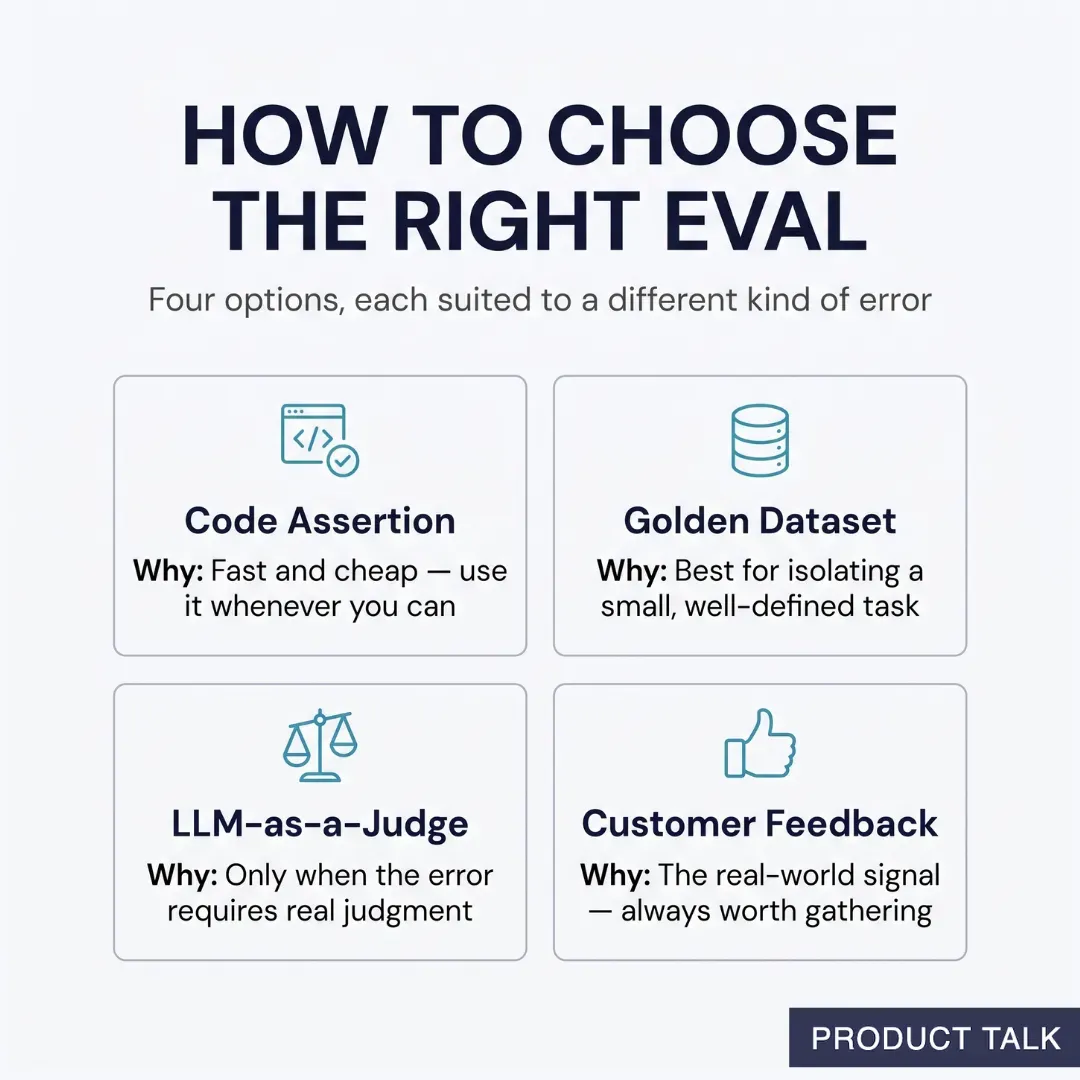
Her ordering rule: use code first because it is cheap, use golden datasets to isolate small steps of a complex process, use judges only when judgment is required, and collect customer signals wherever you can.
Her examples show the pattern:
- A quote not in the transcript: code, because the exact string is either there or not.
- A claim not grounded in the transcript: judge, because the model can restate it in new words.
- A “general question” suggested by the Coach: code, with a short list of red flag words.
- A leading question: judge, because there is no fixed wording.
- A branch missing a sub grouping: both. Count children with code on every node, and only send nodes with too many children to the judge. That keeps judge cost low.
For judges she lists four rules: give the judge a much simpler task than the original, use true or false criteria, align it with your own judgment, and expect judge mistakes and account for them in the reported error rate. This article does not show how she measures that alignment. She promises a deeper piece later.
Step 3: Use the evals to improve something
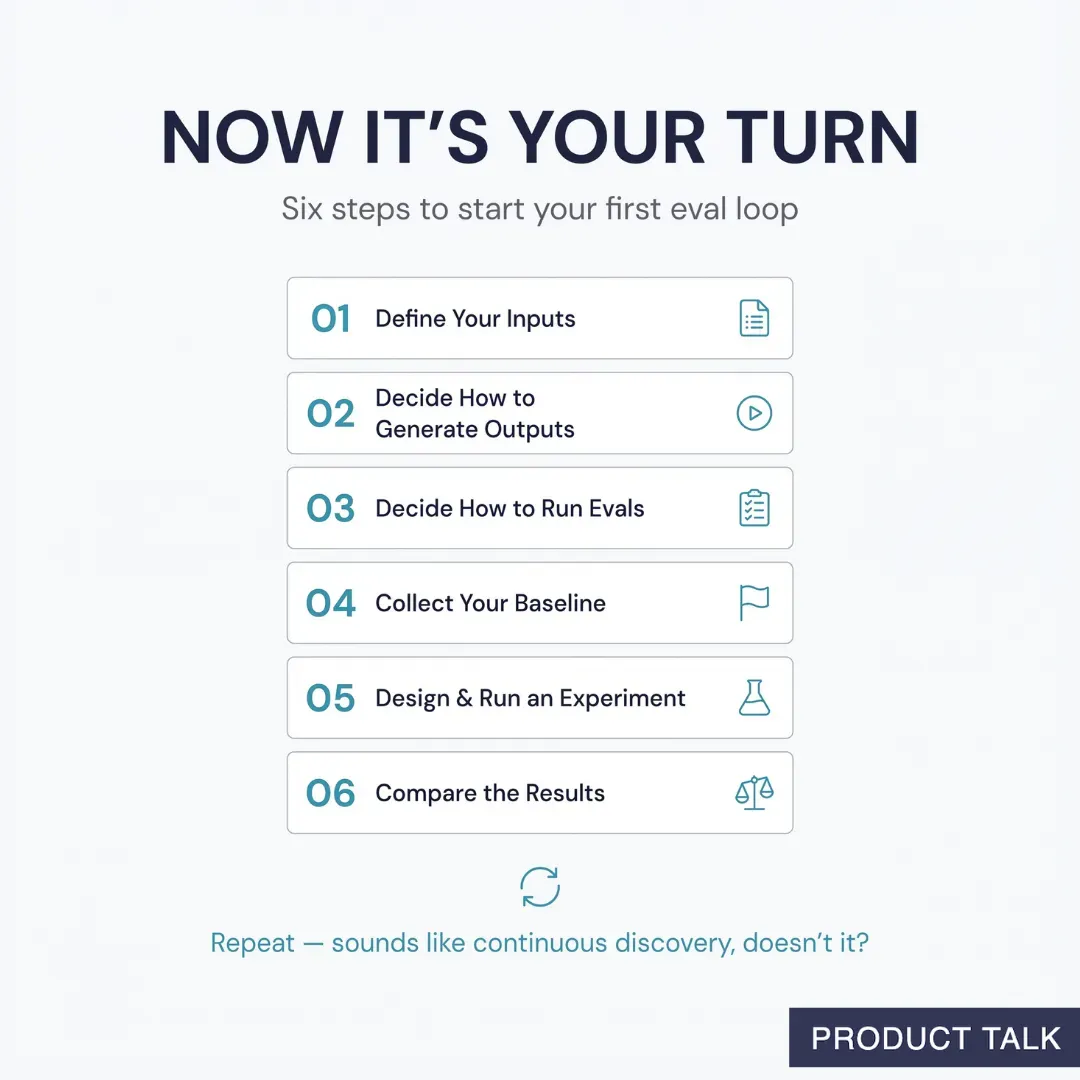
- Define inputs that represent real use. A personal workflow needs only your typical cases. A product needs broad coverage, and you keep evolving the set.
- Run them by hand into a spreadsheet, or with a script. For a product, automate it with a test harness.
- Run the evals and take a baseline, one score per error. Her Coach baseline: 15 of 105 suggested questions were leading, 3 were general, 9 were already answered in the transcript.
- Design an experiment variant. Five levers: change the prompt, add context, change the model, split into smaller calls, add orchestration such as tool calls or audit loops. Group changes under one hypothesis instead of trying many things at once.
- Document each variant so you can roll back: an experiment ID, a description, the git commit that holds the code and prompts, and which evals to run. She keeps this in a YAML file and builds each eval as a module the harness just calls.
- Compare across all evals. A prompt change may fix one error and worsen another. It can take many variants to fix one complaint (she says one took 16).
Evals as a discovery habit
Each product discovery habit answers a question: outcomes tell you whether you build the right thing, interviews whether you solve the right problem, assumption tests whether a solution will work. Error analysis plus evals plus experiments answers a fourth: did our change work? She says error analysis is stronger when it is informed by what the other habits teach you about which errors matter to customers.
How it compares with Hamel’s FAQ
| Topic | Torres | Husain and Shankar |
|---|---|---|
| Start point | Read outputs, find error types | Same, with open and axial coding |
| Who defines good | The product team | One domain expert, the “benevolent dictator” |
| Cheapest first | Code assertions | Code assertions |
| Judge style | Binary, simple task | Binary, one judge per failure |
| Judge validation | Align with yourself, expect errors, no method shown | True positive and negative rates on held out labels |
| Golden datasets | A common starting point with limits | Mentioned as reference based checks |
| Customer signals | A full eval type | Mostly production monitoring and sampling |
| Experiments | Baseline, then variants with a documented hypothesis | Rerun evals after changes; avoid writing evals before you have seen failures |
They agree on most things. The gap is judge validation. Torres tells you to align the judge but does not say how to measure it, and the Hamel page fills that in.
Caveats
- Every number is from her own products and workflows, with small samples. They show the method, not general rates.
- The test harness is a paid member resource. The article describes it without publishing it.
- This is a practitioner guide, not a study. It contains no evidence that the loop outperforms other approaches.